
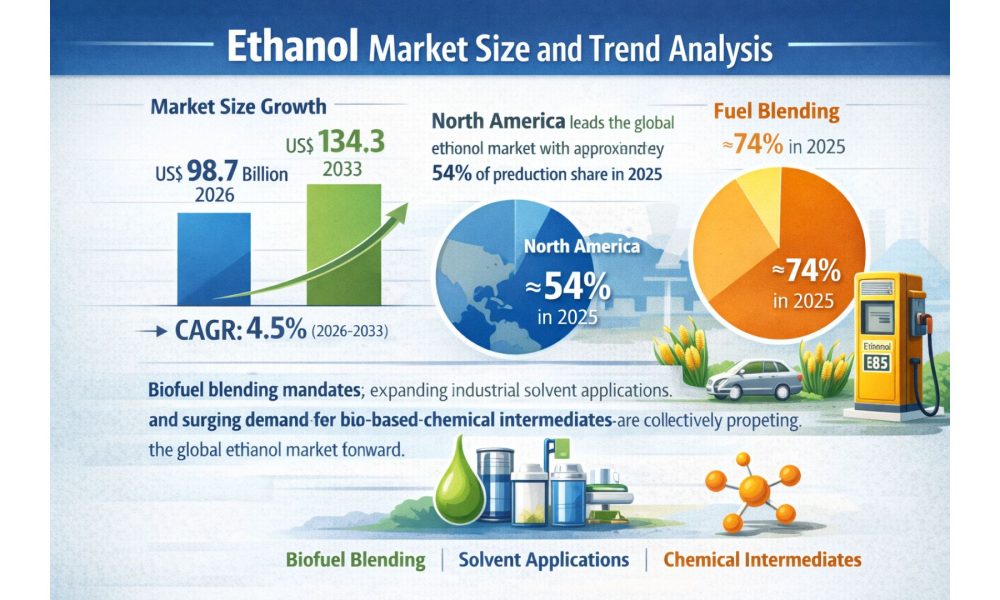
Ethanol Market Size and Trend Analysis
The global ethanol market is experiencing steady expansion, driven by rising demand for renewable fuels, supportive government policies, and growing applications across industrial and consumer sectors. The market was valued at approximately US$ 102.7 billion in 2026 and is projected to reach around US$ 141.0 billion by 2033, registering a CAGR of 4.6% during the forecast period.
Ethanol, a bio-based alcohol primarily derived from feedstocks such as sugarcane, corn, and biomass, plays a crucial role as both a fuel additive and an industrial chemical. Its increasing adoption as a cleaner-burning alternative to fossil fuels has positioned it as a key component in global decarbonization strategies. Governments worldwide are promoting ethanol blending programs to reduce greenhouse gas emissions and dependency on crude oil imports, significantly boosting market growth.
Get Your FREE Sample Report Instantly – Click Now: https://www.persistencemarketresearch.com/samples/36296
Key Market Drivers Accelerating Growth
One of the most significant drivers of the ethanol market is the widespread implementation of biofuel blending mandates. Many countries have introduced policies requiring ethanol to be blended with gasoline, directly increasing demand. These mandates not only reduce carbon emissions but also enhance fuel efficiency and octane levels, making ethanol a preferred additive for transportation fuels.
Additionally, the growing focus on energy security is encouraging nations to produce ethanol from domestically available feedstocks. This reduces reliance on imported crude oil while supporting rural economies through agricultural activities. Rising geopolitical uncertainties and fluctuations in crude oil prices further reinforce the importance of alternative fuels like ethanol.
Another key factor is the increasing use of ethanol in industrial applications, including solvents, pharmaceuticals, personal care products, and disinfectants. The surge in hygiene awareness and healthcare expenditure has particularly boosted demand for ethanol-based sanitizers and medical products.
Expanding Applications Across Industries
Ethanol’s versatility is a major factor contributing to its sustained demand. The largest application segment is fuel and fuel additives, accounting for over 66% of the market share. This dominance is driven by its use in gasoline blending, where it improves combustion efficiency and reduces emissions.
Beyond fuel, ethanol is widely used as an industrial solvent in paints, coatings, inks, and cleaning products. Its low toxicity and biodegradable nature make it an environmentally friendly alternative to petroleum-based solvents.
In the pharmaceutical and personal care sectors, ethanol is used in formulations such as antiseptics, cosmetics, and oral care products. It also plays a key role in the food and beverage industry, particularly in alcoholic beverages and food-grade applications. The diversity of these applications ensures a stable demand base, reducing dependence on any single industry.
Market Segmentation
The ethanol market is segmented based on source, purity, and application:
By Source:
- Sugar & Molasses-Based
- Grain-Based
- Second-Generation (Cellulosic Biomass)
Among these, the sugar and molasses-based segment holds the largest share, accounting for over 58% due to its cost-effectiveness and strong supply chain integration with sugar industries.
By Purity:
- Denatured
- Undenatured
The denatured ethanol segment dominates the market, with over 60% share, owing to its widespread use in fuel blending and industrial applications.
By Application:
- Fuel & Fuel Additives
- Industrial Solvents
- Beverages
- Pharmaceuticals
- Others
Fuel applications remain the largest segment, while industrial solvents are expected to witness the fastest growth due to increasing environmental regulations.
Regional Insights and Market Dynamics
North America dominates the global ethanol market, accounting for over 50% of total share. This is largely due to strong regulatory frameworks such as the Renewable Fuel Standard (RFS) in the United States, which mandates the use of renewable fuels.
Asia Pacific is emerging as a key growth region, driven by increasing energy demand, rising vehicle ownership, and strong government initiatives supporting ethanol blending programs. Countries like India are investing heavily in ethanol production infrastructure, including grain-based and second-generation plants.
Europe is also witnessing steady growth due to stringent environmental policies and incentives promoting renewable energy adoption. Meanwhile, the Middle East & Africa region is expected to register the fastest growth, supported by increasing investments in alternative energy sources.
Technological Advancements and Innovation
Technological innovation is transforming the ethanol market, particularly with the development of second-generation (cellulosic) ethanol. Unlike traditional ethanol derived from food crops, second-generation ethanol is produced from agricultural residues, forestry waste, and non-food biomass.
This advancement addresses concerns related to food security and land use while improving the sustainability profile of ethanol production. Continuous improvements in fermentation processes, enzyme technologies, and biomass conversion methods are enhancing production efficiency and reducing costs.
Moreover, advancements in engine technologies and fuel infrastructure are enabling the use of higher ethanol blends, further expanding its adoption in the transportation sector.
Challenges and Market Constraints
Despite its promising growth, the ethanol market faces several challenges. One of the major issues is the volatility in feedstock prices, particularly for crops like corn and sugarcane. Fluctuations in agricultural output and commodity prices directly impact ethanol production costs and profitability.
Another significant concern is the competition between food and fuel. The use of food crops for ethanol production has raised questions about food security, especially in regions with limited agricultural resources.
Infrastructure limitations also pose challenges, particularly in developing countries where storage, transportation, and compatibility with higher ethanol blends may be inadequate. Additionally, regulatory uncertainties and varying policies across regions can impact market stability.
Emerging Opportunities in the Market
The ethanol market presents numerous growth opportunities, particularly in the context of global sustainability goals. The increasing focus on reducing carbon emissions is expected to drive demand for ethanol as a low-carbon fuel alternative.
Second-generation ethanol offers a major opportunity, as it utilizes waste materials and non-food biomass, aligning with circular economy principles. Governments and private players are investing heavily in research and development to commercialize these advanced technologies.
Another promising area is the expansion of ethanol applications beyond fuel, including its use in bioplastics, chemicals, and renewable energy solutions. The growing demand for eco-friendly products and sustainable manufacturing practices is expected to create new avenues for market growth.
Get a Customized Market View in One Click: https://www.persistencemarketresearch.com/request-customization/36296
Competitive Landscape
The ethanol market is highly competitive, with several global and regional players operating across the value chain. Key companies include:
- Archer Daniels Midland Company (ADM)
- POET LLC
- Valero Energy Corporation
- Green Plains Inc.
- Cargill Incorporated
- Raízen Energia
- CropEnergies AG
These companies focus on capacity expansion, technological innovation, and strategic partnerships to strengthen their market position. Investments in advanced biofuel technologies and sustainable production methods are key strategies adopted by leading players.
Future Outlook
The future of the ethanol market remains positive, with consistent growth expected through 2033. Increasing government support for renewable fuels, rising environmental awareness, and advancements in production technologies will continue to drive market expansion.
As countries strive to achieve carbon neutrality and reduce fossil fuel dependence, ethanol is expected to play a crucial role in the global energy transition. While challenges such as feedstock volatility and infrastructure limitations persist, ongoing innovation and policy support are likely to mitigate these issues.
In conclusion, ethanol is not only a vital renewable fuel but also a versatile industrial chemical with applications across multiple sectors. Its growing importance in sustainable energy systems positions it as a key driver of future market growth.
About Persistence Market Research:
Persistence Market Research delivers strategic research solutions that drive business growth. Founded in 2012 and registered in England and Wales in 2023 as Persistence Research & Consultancy Services Ltd., we have completed 3,600+ custom and syndicated studies and supported 2,700+ projects for leading research firms. Combining traditional methodologies with modern tools, we provide actionable insights to multinational corporations, consultants, investors, and government bodies, earning strong trust through long-term client relationships.
Contact Us:
Persistence Market Research
Second Floor, 150 Fleet Street,
London, EC4A 2DQ, United Kingdom
USA Phone: +1 646-878-6329
UK Phone: +44 203-837-5656
Email: [email protected]
Web: https://www.persistencemarketresearch.com




