
Urea Fertilizer Market Size and Trend Analysis
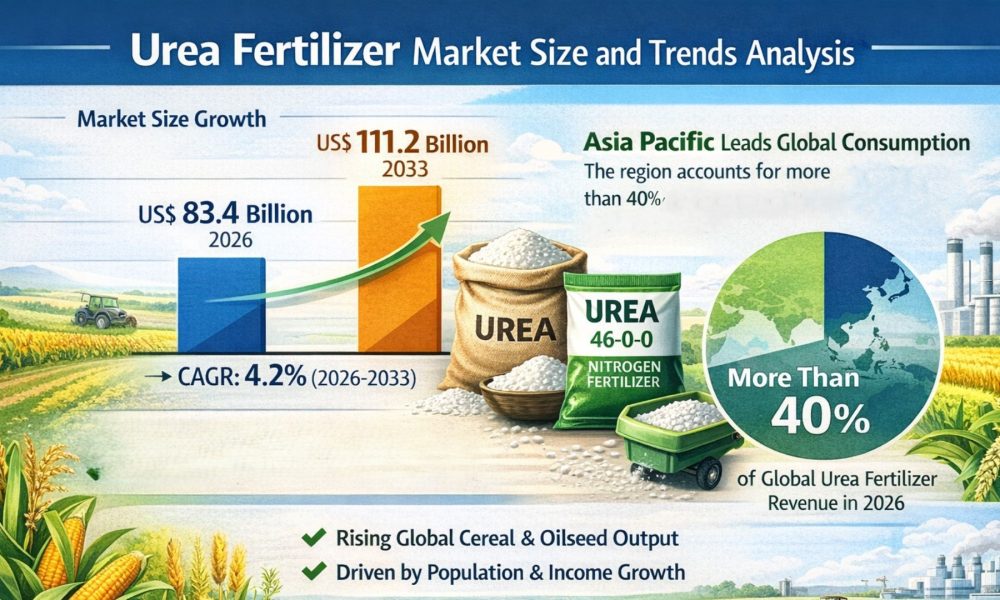
The global urea fertilizer market is experiencing steady growth, driven by rising agricultural demand and the need to enhance crop productivity. According to industry insights, the market is expected to reach a valuation of US$ 83.4 billion in 2026 and further expand to US$ 111.2 billion by 2033, registering a CAGR of 4.2% during the forecast period.
Urea remains the most widely used nitrogen-based fertilizer due to its high nitrogen content, cost-effectiveness, and ease of application. It plays a critical role in improving soil fertility and boosting crop yields, especially in cereal production. The increasing global population, rising food demand, and intensification of agricultural practices are key factors supporting long-term market expansion.
Get Your FREE Sample Report Instantly – Click Now: https://www.persistencemarketresearch.com/samples/36311
Rising Demand for Food Production Driving Market Growth
One of the strongest growth drivers for the urea fertilizer market is the increasing demand for food worldwide. Global crop production continues to expand, with primary crop output reaching nearly 9.9 billion tonnes, reflecting the need for higher agricultural productivity.
Cereals such as rice, wheat, and maize dominate global agriculture and require significant nitrogen inputs. Since urea is a highly concentrated nitrogen fertilizer, it is widely adopted by farmers to maximize yield per hectare. As developing economies continue to improve food security and agricultural efficiency, urea consumption is expected to remain robust.
Additionally, rising incomes and changing dietary patterns are increasing demand for grains, livestock feed, and high-value crops, further strengthening the requirement for nitrogen fertilizers.
Government Support and Subsidy Programs
Government policies play a crucial role in shaping the urea fertilizer market, particularly in countries such as India, China, and Indonesia. Many governments provide subsidies to ensure fertilizer affordability for farmers and stabilize food prices.
For instance, India has significantly expanded its domestic urea production capacity, increasing output to over 300 LMT annually with the addition of new energy-efficient plants. These initiatives reduce dependency on imports and ensure consistent supply to farmers.
Subsidy programs also encourage farmers to maintain or increase fertilizer usage even during periods of price volatility. However, they can create fiscal pressure on governments, especially when global prices rise sharply.
Market Segmentation
The urea fertilizer market is segmented based on product type, application, crop type, and distribution channel.
By Product Type:
- Granular Urea
- Coated / Stabilized Urea
- Prilled Urea
- Liquid Urea
Granular urea dominates the market, accounting for over 70% of total revenue, due to its ease of handling, storage, and compatibility with modern farming equipment.
By Application:
- Soil Application
- Fertigation
- Foliar Spray
Soil application remains the most widely used method, contributing over 80% of market share, as it aligns with traditional farming practices and requires minimal infrastructure.
By Crop Type:
- Cereals & Grains
- Pulses & Oilseeds
- Fruits & Vegetables
- Plantation Crops
- Others
Cereals and grains dominate the segment, accounting for more than 63% of total consumption, due to their high nitrogen requirements.
By Distribution Channel:
- Agricultural Cooperatives
- Retail Stores
- Online Platforms
- Direct Sales
Agricultural cooperatives lead the distribution landscape, particularly in developing economies.
Emerging Trends in the Urea Fertilizer Market
Shift Toward Enhanced-Efficiency Fertilizers
The market is witnessing a growing shift toward coated and stabilized urea products. These fertilizers improve nitrogen-use efficiency by reducing losses due to volatilization and leaching. This segment is expected to grow at a CAGR of around 4.8%, making it one of the fastest-growing categories.
Adoption of Precision Agriculture
Technological advancements in farming, such as precision agriculture and smart irrigation systems, are influencing fertilizer application methods. Farmers are increasingly adopting fertigation techniques, which allow precise delivery of nutrients through irrigation systems.
Digital Transformation in Distribution
Online agricultural platforms are gaining traction, offering real-time pricing, inventory tracking, and advisory services. This digital shift is improving supply chain efficiency and enabling better access to fertilizers in remote areas.
Regional Insights
Asia Pacific Dominates the Market
Asia Pacific holds the largest share of the global urea fertilizer market, accounting for over 40% of total revenue. This dominance is driven by high agricultural activity, large population base, and strong government support for fertilizers.
Countries like China and India are major consumers due to extensive cultivation of staple crops and large farming communities. Southeast Asian countries are also emerging as key markets due to increasing agricultural investments.
North America and Europe
North America shows stable growth, supported by advanced farming technologies and large-scale commercial agriculture. The United States, in particular, has strong demand linked to corn production.
Europe is witnessing moderate growth, driven by environmental regulations and the adoption of sustainable farming practices.
Latin America and Middle East & Africa
Latin America is experiencing increasing demand due to expanding soybean and maize cultivation. Meanwhile, the Middle East & Africa region is gradually growing, supported by agricultural modernization and food security initiatives.
Challenges in the Market
Despite steady growth, the urea fertilizer market faces several challenges. One of the major concerns is its dependency on natural gas, which is the primary feedstock for urea production. Fluctuations in gas prices and supply disruptions can significantly impact production costs and availability.
Geopolitical tensions and energy supply issues have recently caused volatility in urea prices, with benchmark prices exceeding USD 580 per tonne in 2026, reflecting tight supply conditions.
Another challenge is environmental impact. Excessive use of urea can lead to soil degradation, water pollution, and greenhouse gas emissions. Governments and environmental agencies are increasingly regulating fertilizer usage, which may influence demand patterns.
Opportunities for Market Growth
The market presents significant opportunities, particularly in sustainable agriculture. The growing emphasis on reducing environmental impact is driving demand for advanced fertilizers with improved efficiency.
The expansion of horticulture and high-value crops is also creating new avenues for urea usage, especially through fertigation and foliar application techniques.
Additionally, innovations in low-carbon ammonia production and green urea manufacturing are expected to reshape the industry, offering long-term growth potential.
Get a Customized Market View in One Click: https://www.persistencemarketresearch.com/request-customization/36311
Competitive Landscape
The global urea fertilizer market is moderately consolidated, with key players focusing on capacity expansion, technological innovation, and strategic partnerships. Major companies operating in the market include:
- Yara International ASA
- Nutrien Ltd.
- CF Industries Holdings, Inc.
- Qatar Fertilizer Company (QAFCO)
- SABIC Agri-Nutrients
- EuroChem Group AG
- OCI N.V.
- Indian Farmers Fertiliser Cooperative Ltd. (IFFCO)
- National Fertilizers Limited (NFL)
These companies benefit from access to low-cost natural gas and large-scale production facilities, giving them a competitive advantage.
Future Outlook
The future of the urea fertilizer market remains positive, supported by strong agricultural demand and continuous advancements in farming practices. Rising global population, increasing food consumption, and the need for higher crop yields will continue to drive market growth.
While challenges such as price volatility and environmental concerns persist, the adoption of sustainable and efficient fertilizer solutions is expected to balance growth with environmental responsibility.
In conclusion, urea fertilizer will remain a cornerstone of global agriculture, with steady demand growth and evolving innovations shaping the market through 2033.
About Persistence Market Research:
Persistence Market Research delivers strategic research solutions that drive business growth. Founded in 2012 and registered in England and Wales in 2023 as Persistence Research & Consultancy Services Ltd., we have completed 3,600+ custom and syndicated studies and supported 2,700+ projects for leading research firms. Combining traditional methodologies with modern tools, we provide actionable insights to multinational corporations, consultants, investors, and government bodies, earning strong trust through long-term client relationships.
Contact Us:
Persistence Market Research
Second Floor, 150 Fleet Street,
London, EC4A 2DQ, United Kingdom
USA Phone: +1 646-878-6329
UK Phone: +44 203-837-5656
Email: [email protected]
Web: https://www.persistencemarketresearch.com




