
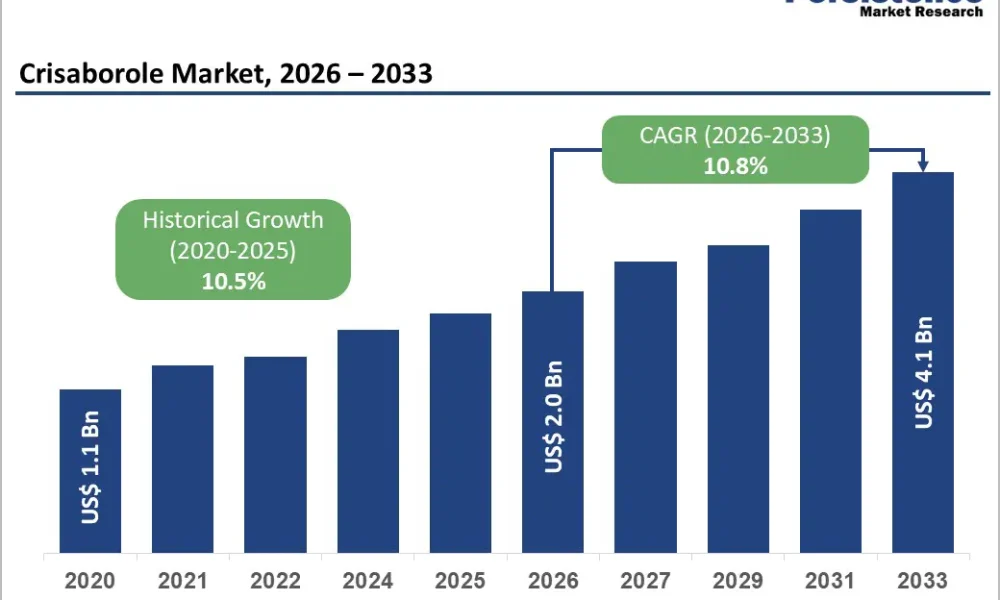
The global crisaborole market is poised for substantial growth over the coming years, with the market size estimated at US$2.0 billion in 2026 and projected to reach US$4.1 billion by 2033, registering a CAGR of 10.8% during the forecast period from 2026 to 2033. The rising prevalence of atopic dermatitis, particularly among pediatric and adult populations, is a key driver for market expansion. Moreover, increasing preference for non-steroidal topical therapies due to their favorable safety profile for long-term use is further fueling the demand for crisaborole-based products. Crisaborole, a phosphodiesterase-4 (PDE-4) inhibitor, has emerged as a promising therapeutic option for managing mild to moderate atopic dermatitis without the adverse effects commonly associated with corticosteroids.
Download Your Free Sample & Explore Key Insights: https://www.persistencemarketresearch.com/samples/30207
Market Dynamics
Drivers
The primary factor driving the crisaborole market is the growing incidence of atopic dermatitis worldwide. According to recent studies, atopic dermatitis affects approximately 15-20% of children and 1-3% of adults globally, creating a substantial patient population for crisaborole treatments. Additionally, the rising awareness of the risks associated with long-term steroid use has shifted preference toward non-steroidal therapies, further boosting crisaborole adoption. Other contributing factors include increasing healthcare expenditure, improved diagnosis rates, and the growing availability of innovative topical formulations that enhance patient compliance and convenience.
Restraints
Despite the promising growth prospects, several factors may hinder market expansion. The high cost of crisaborole compared to traditional topical corticosteroids may limit accessibility in price-sensitive regions. Furthermore, side effects such as application site pain and burning sensations, although mild, can negatively impact patient adherence. Regulatory challenges, including stringent approval processes in certain countries, may also pose barriers to market entry and expansion.
Opportunities
The crisaborole market presents significant opportunities for growth through new product launches, expansion into emerging markets, and the development of combination therapies. Pharmaceutical companies are focusing on creating advanced formulations such as gels, creams, and ointments that improve efficacy and patient compliance. Expanding awareness campaigns and patient education programs are expected to increase adoption rates, especially in regions with low penetration of non-steroidal topical therapies. Collaborations, strategic partnerships, and licensing agreements also provide avenues for market players to strengthen their global presence.
Challenges
Market growth is tempered by challenges such as high competition from established corticosteroid products and other emerging non-steroidal alternatives. Additionally, disparities in healthcare infrastructure, especially in developing regions, may limit market reach. Reimbursement policies and pricing regulations in certain regions may also affect market dynamics, potentially slowing adoption rates. Companies must address these challenges by implementing strategic growth initiatives and tailoring products to meet regional needs.
Get Custom Insights Designed for Your Businecss: https://www.persistencemarketresearch.com/request-customization/30207
Market Segmentation
By Product Type
The crisaborole market is segmented by product type into ointments, creams, and gels. Each formulation has unique characteristics that cater to different patient preferences and clinical requirements.
Ointments are known for their occlusive properties, which help in retaining moisture and enhancing drug absorption, making them ideal for patients with dry or severe skin conditions.
Creams are preferred for their ease of application and cosmetic acceptability, particularly for pediatric and adult patients who require daily use over large skin areas.
Gels provide a non-greasy texture, rapid absorption, and enhanced patient comfort, which is especially attractive for facial application or for patients sensitive to traditional ointments.
Among these, creams are expected to dominate the market due to their widespread acceptance and versatility in treating both pediatric and adult patients. However, the gel segment is projected to exhibit faster growth owing to increasing patient preference for convenient and cosmetically appealing formulations.
By Distribution Channel
The crisaborole market is distributed across hospitals, retail pharmacies, cosmetic clinics, and online pharmacies.
Hospitals serve as key distribution points for prescribed medications, ensuring access to certified products under professional supervision.
Retail pharmacies offer convenience and widespread availability, making them a major channel for over-the-counter or prescription-based crisaborole sales.
Cosmetic clinics play a growing role in promoting topical therapies for mild dermatological conditions, providing personalized consultation and treatment options.
Online pharmacies have emerged as a significant distribution channel due to increasing e-commerce penetration, ease of access, and discreet purchase options. The convenience of home delivery and digital payment options is expected to further boost online sales, particularly in urban and semi-urban regions.
By Region
The global crisaborole market is geographically segmented into North America, Europe, Asia Pacific, Latin America, Middle East & Africa, and South Asia & Oceania.
North America is expected to hold a significant share of the market, driven by high prevalence of atopic dermatitis, established healthcare infrastructure, and greater adoption of advanced non-steroidal topical therapies. The United States, in particular, represents a key market due to the presence of leading pharmaceutical companies and extensive patient awareness initiatives.
Europe is projected to witness steady growth, supported by rising healthcare expenditure, strong regulatory frameworks, and growing preference for non-steroidal therapies. Countries such as Germany, France, and the United Kingdom are significant contributors to market expansion.
Asia Pacific is expected to register the highest CAGR during the forecast period, fueled by increasing healthcare access, growing awareness of dermatological conditions, and expanding urban populations. China, Japan, and India are key markets driving growth in the region.
Latin America is witnessing moderate growth due to rising awareness and improving healthcare infrastructure. Brazil and Mexico are among the major markets contributing to regional expansion.
Middle East & Africa shows potential for growth due to increasing healthcare investments and the adoption of innovative therapies. However, economic disparities and limited access in rural areas may restrict market penetration.
South Asia & Oceania is emerging as a new market with increasing demand for non-steroidal dermatological treatments and the gradual adoption of advanced healthcare facilities. Australia and India are notable markets in this segment.
Checkout Now & Download Complete Market Report: https://www.persistencemarketresearch.com/checkout/30207
Competitive Landscape
The crisaborole market is highly competitive, with key players implementing strategic initiatives such as product launches, mergers, acquisitions, collaborations, and partnerships to strengthen their market position. Some of the major market players include Pfizer Inc., Anacor Pharmaceuticals Inc., Novartis AG, Sanofi S.A., GlaxoSmithKline plc, AstraZeneca plc, Johnson & Johnson, Merck & Co., Inc., Eli Lilly and Company, AbbVie Inc., Amgen Inc., Bristol-Myers Squibb Company, Allergan plc, and Bayer AG.
Pfizer Inc. is a market leader, leveraging its global presence and extensive research capabilities to expand the adoption of crisaborole-based therapies. Anacor Pharmaceuticals Inc., the original developer of crisaborole, focuses on strategic partnerships and product commercialization to maintain market relevance. Novartis AG and Sanofi S.A. are investing in research and development to introduce new formulations and broaden treatment options. Other companies like GlaxoSmithKline plc and AstraZeneca plc are concentrating on geographic expansion and marketing initiatives to capture untapped markets.
Market Forecast and Trends
The global crisaborole market is expected to maintain robust growth from 2026 to 2033. Key trends include the increasing adoption of non-steroidal topical therapies for long-term use, the development of patient-friendly formulations, and the expansion of digital healthcare platforms for product distribution. Growth in pediatric dermatology, increasing awareness of safe treatment alternatives, and the rising prevalence of atopic dermatitis are likely to drive sustained market demand.
Technological advancements in formulation science, such as improved bioavailability and reduced skin irritation, are anticipated to enhance product acceptance. Additionally, strategic initiatives like licensing agreements and collaborations are expected to create new revenue pockets and growth opportunities in emerging markets.
Strategic Growth Initiatives
Market players are increasingly focusing on mergers and acquisitions to consolidate their position in the global crisaborole market. Collaboration with healthcare providers and dermatology specialists is aimed at improving patient outreach and education. Companies are also investing in clinical trials to validate the efficacy and safety of new crisaborole formulations, thereby enhancing product credibility and market adoption. Targeted marketing campaigns, especially in regions with low awareness of non-steroidal therapies, are expected to drive growth further.
Pricing Analysis and Technology Roadmap
Pricing of crisaborole products varies by formulation, region, and distribution channel. While ointments and creams are priced moderately, gels tend to have slightly higher pricing due to advanced formulation technology and patient convenience. Technological advancements in drug delivery systems, such as nanoemulsion and liposomal carriers, are expected to enhance efficacy, reduce side effects, and provide competitive advantages for manufacturers.
Future Opportunities and Revenue Pockets
The crisaborole market offers significant opportunities in untapped regions such as Asia Pacific and the Middle East. Expansion of online pharmacy networks, increasing adoption of digital healthcare platforms, and growing consumer awareness about non-steroidal therapies are expected to create new revenue streams. Development of combination therapies targeting multiple dermatological conditions and personalized treatment solutions also presents lucrative opportunities for market players.
Conclusion
The global crisaborole market is poised for remarkable growth, driven by the increasing prevalence of atopic dermatitis and the rising preference for non-steroidal topical therapies. Key market players are leveraging strategic initiatives, technological advancements, and product innovation to strengthen their presence and expand into emerging regions. With favorable safety profiles, enhanced formulations, and growing awareness among patients and healthcare providers, the market is expected to reach US$4.1 billion by 2033, reflecting robust growth and long-term potential. The evolving landscape of dermatological treatments, combined with expanding healthcare infrastructure and digital distribution channels, will continue to shape the market dynamics, creating opportunities for sustained growth and innovation.
This article provides a comprehensive overview of the crisaborole market, highlighting key trends, growth drivers, challenges, competitive landscape, and future opportunities, making it a valuable resource for industry stakeholders, healthcare professionals, and investors seeking insights into this expanding therapeutic segment.




