
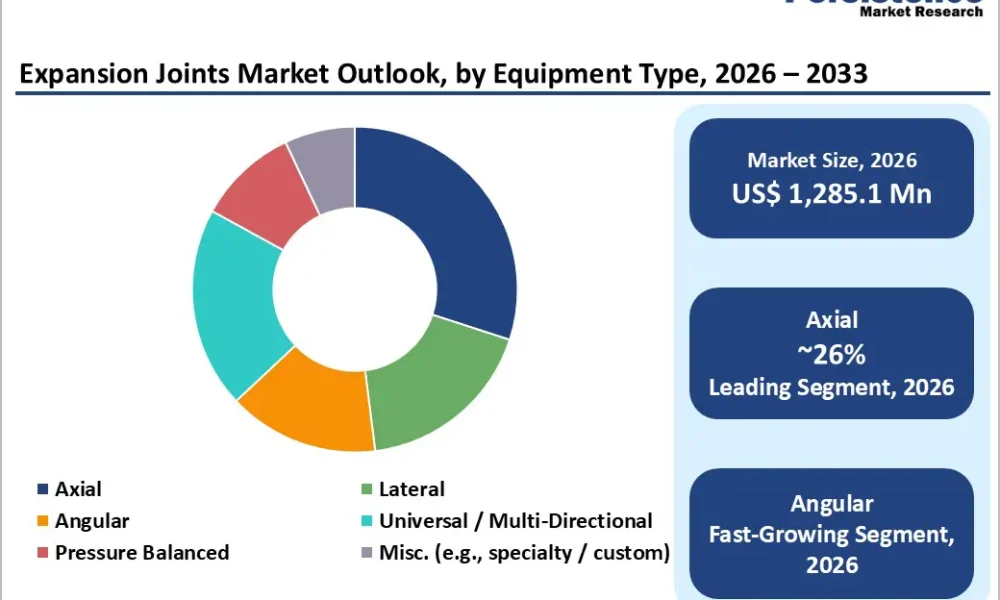
The global expansion joints market is witnessing steady growth, supported by rising infrastructure development and increasing demand across energy and industrial sectors. The market is projected to be valued at US$ 1,285.1 million in 2026 and is expected to reach US$ 1,695.1 million by 2033, expanding at a CAGR of 4.0% during the forecast period. Expansion joints play a critical role in absorbing thermal expansion, vibrations, and mechanical movements in pipelines, bridges, and industrial systems, ensuring structural integrity and operational safety. Their importance has grown significantly with the expansion of complex infrastructure systems that operate under varying temperature and pressure conditions.
The market’s growth is largely driven by sustained investments in global energy infrastructure, including oil & gas, power generation, and emerging low-carbon energy systems such as LNG facilities and district heating networks. According to the International Energy Agency (IEA), global energy demand increased by 2.2% in 2024, while electricity demand surged by 4.3%, highlighting the need for robust infrastructure components like expansion joints. Among product segments, metallic expansion joints dominate due to their high durability and ability to withstand extreme pressure and temperature conditions. Geographically, Asia Pacific leads the market, driven by rapid industrialization, large-scale infrastructure projects, and growing energy demand in countries such as China and India.
Key Highlights from the Report
• The market is projected to grow at a CAGR of 4.0% between 2026 and 2033.
• Rising investments in global energy infrastructure are driving demand.
• Metallic expansion joints dominate due to high durability and performance.
• Asia Pacific leads with strong industrial and infrastructure development.
• Regulatory compliance for pipeline safety is boosting market growth.
• Increasing demand for low-carbon energy infrastructure is creating new opportunities.
𝐆𝐞𝐭 𝐚 𝐒𝐧𝐞𝐚𝐤 𝐏𝐞𝐞𝐤, 𝐒𝐚𝐦𝐩𝐥𝐞 𝐏𝐃𝐅 𝐈𝐧𝐬𝐢𝐝𝐞: https://www.persistencemarketresearch.com/samples/30723
Market Segmentation
The expansion joints market is segmented based on product type, material type, application, and end-user industry. In terms of product type, the market includes metallic expansion joints, fabric expansion joints, and rubber expansion joints. Metallic expansion joints hold the largest share due to their ability to handle high temperatures and pressures, making them suitable for demanding applications such as power plants and petrochemical facilities. Fabric expansion joints are widely used in low-pressure systems, particularly in air and gas handling applications, while rubber expansion joints are preferred for applications requiring flexibility and vibration absorption.
From a material perspective, expansion joints are manufactured using stainless steel, alloys, rubber compounds, and specialized fabrics. Stainless steel and alloy-based joints dominate due to their corrosion resistance and strength. In terms of application, the market is categorized into piping systems, bridges and highways, power generation plants, chemical processing facilities, and HVAC systems. Piping systems represent the largest segment, driven by extensive use in oil & gas pipelines, water distribution networks, and industrial processing systems.
Based on end-users, the market is divided into oil & gas, power generation, chemical and petrochemical, construction, and water and wastewater management sectors. The oil & gas sector accounts for a significant share due to the extensive use of expansion joints in pipelines and refineries. Power generation is another key segment, particularly with the growing adoption of renewable and nuclear energy systems that require advanced thermal management solutions.
Regional Insights
Asia Pacific dominates the global expansion joints market, driven by rapid industrialization, urbanization, and infrastructure development. Countries such as China, India, and Southeast Asian nations are investing heavily in energy projects, transportation infrastructure, and industrial facilities, creating strong demand for expansion joints. The region’s growing population and increasing energy consumption further support market growth.
North America is a mature market characterized by stringent regulatory standards and ongoing investments in energy infrastructure. The United States leads the region, with significant demand from the oil & gas and power generation sectors. Europe also holds a substantial share, driven by the modernization of aging infrastructure and the transition toward low-carbon energy systems. Countries such as Germany, the UK, and France are investing in district heating and renewable energy projects, boosting demand for advanced expansion joints.
Latin America and the Middle East & Africa are emerging markets with growing potential. In the Middle East, investments in oil & gas infrastructure and desalination plants are driving demand. In Latin America, expanding industrial activities and infrastructure development are contributing to market growth.
𝐎𝐧𝐞 𝐂𝐥𝐢𝐜𝐤 → 𝐘𝐨𝐮𝐫 𝐂𝐮𝐬𝐭𝐨𝐦 𝐌𝐚𝐫𝐤𝐞𝐭 𝐕𝐢𝐞𝐰: https://www.persistencemarketresearch.com/request-customization/30723
Market Drivers
The primary driver of the expansion joints market is the increasing investment in global energy infrastructure. As energy demand continues to rise, governments and private sector players are investing in new power plants, pipelines, and industrial facilities. Expansion joints are essential components in these systems, ensuring safety and efficiency. Additionally, stringent regulatory requirements related to pressure equipment and pipeline safety in advanced economies are driving the adoption of high-quality expansion joints. The growing focus on low-carbon energy infrastructure, including LNG terminals, nuclear power plants, and district heating systems, is further boosting market demand.
Market Restraints
Despite its steady growth, the expansion joints market faces certain challenges. High initial costs associated with advanced expansion joints can be a barrier, particularly for small and medium-sized projects. Fluctuations in raw material prices, especially metals such as stainless steel, can impact manufacturing costs and profit margins. Additionally, the complexity of installation and maintenance may deter some end-users. In certain regions, lack of awareness about the benefits of high-performance expansion joints can also limit market growth.
Market Opportunities
The market presents significant opportunities with the increasing focus on sustainable and energy-efficient infrastructure. The transition toward renewable energy and low-carbon systems is creating demand for advanced expansion joints capable of handling complex operating conditions. Technological advancements, such as the development of smart expansion joints with monitoring capabilities, are expected to drive innovation in the market. Emerging economies offer untapped potential due to their expanding industrial base and infrastructure development. Additionally, the growing emphasis on water and wastewater management is creating new opportunities for expansion joint manufacturers.
𝐁𝐮𝐲 𝐍𝐨𝐰 𝐭𝐡𝐞 𝐃𝐞𝐭𝐚𝐢𝐥𝐞𝐝 𝐑𝐞𝐩𝐨𝐫𝐭: https://www.persistencemarketresearch.com/checkout/30723
Company Insights
Key players operating in the global expansion joints market include:
• Trelleborg AB
• Witzenmann GmbH
• Senior Flexonics
• EagleBurgmann
• Hyspan Precision Products, Inc.
• Flexider S.r.l.
• Macoga, S.A.
Recent Developments:
Leading companies are focusing on developing advanced materials and designs to enhance the performance and durability of expansion joints. Additionally, strategic partnerships and investments in research and development are enabling companies to expand their product portfolios and strengthen their global presence.
Conclusion
The expansion joints market is poised for steady growth as global infrastructure development and energy demand continue to rise. With increasing investments in oil & gas, power generation, and low-carbon energy systems, the demand for reliable and high-performance expansion joints is expected to grow significantly. While challenges such as high costs and raw material price fluctuations persist, ongoing technological advancements and emerging opportunities in developing regions are likely to drive long-term growth. As industries continue to prioritize safety, efficiency, and sustainability, expansion joints will remain a critical component in modern infrastructure systems.




