
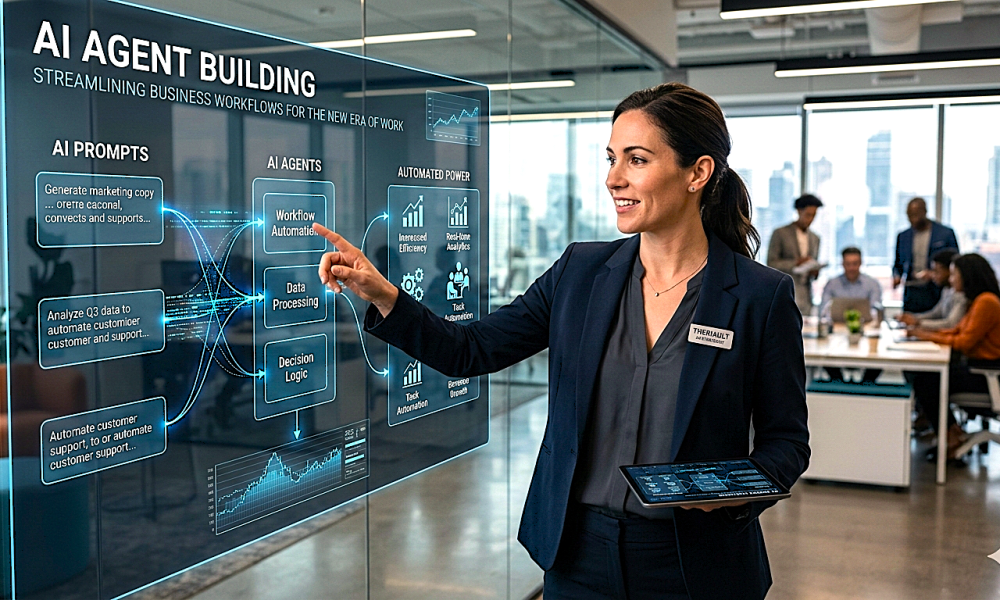
From Prompts to Productivity: The AI Agent Revolution Is Redefining Business Workflows
Most people are still playing with AI. Testing tools, tweaking prompts, and getting inconsistent results. But that’s not how real work gets done anymore.
In 2026, productivity doesn’t come from asking smarter questions—it comes from building intelligent systems that act on your behalf. AI has evolved beyond prompt engineering into a new phase of operational design: AI agent building. The professionals mastering it are redefining business workflows across industries.
Welcome to the shift from experimenting to executing—where tasks don’t just get imagined but done.
Why Business Workflows Need AI Agents, Not More Prompts
The traditional workplace still relies on fragmented systems and manual actions. Teams jump between tools, paste data across platforms, and tie up hours in coordination. But the organizations gaining a real competitive advantage are those upgrading these manual pipelines into autonomous, repeatable, and intelligent AI-powered workflows.
That’s the promise of AI agent building.
An AI agent isn’t a chatbot or a fancy macro—it’s a self-operating digital colleague that executes structured instructions, integrates across your tools, learns from context, and delivers consistent outputs. It’s the difference between asking ChatGPT to “write a summary” versus having an automated system that monitors your inbox, extracts key updates, drafts weekly reports, and posts them to your team’s dashboard—without your daily involvement.
Why this matters now:
- Teams are no longer relying on manual workflows. They’re relying on agents.
- The professionals and companies who learn to build them are already operating at a radically faster pace.
- The difference between testing tools and building systems that work will define who thrives in this new era.
AI adoption has shifted from curiosity to core strategy. Business functions like marketing, operations, sales, finance, product development, and customer success are now embedding agents directly into everyday processes. Whether it’s generating proposals, analyzing leads, or managing project timelines, AI-powered workflows are replacing inconsistent manual effort with 24/7 autonomous execution.
But here’s the real insight:
You don’t need to be a developer or data scientist to start. You need to understand structure, logic, and clarity—and the ability to think through what actions you want the AI to perform consistently.
No coding required. Just clear thinking and a smart strategy.
The New Playbook: Learning AI Agent Building for Real-World Workflows
AI literacy has evolved. It’s no longer enough to “know how to prompt.” In today’s workflow-driven economy, success belongs to those who can design, structure, and deploy AI agents that transform isolated tasks into intelligent, repeatable business processes.
Here’s what professionals and teams are learning to do:
- Understand what an AI agent really is — how it differs from a prompt and why it executes instead of merely responding.
- Structure instructions that actually work — define task logic so the agent performs accurately each time.
- Turn everyday tasks into repeatable workflows — eliminate manual drudgery by automating operations from start to finish.
- Design for real jobs, not hypotheticals — build agents that support your role, whether that’s managing leads, spreadsheets, or multi-channel content.
- Deploy usable agents immediately — instead of more theory, walk away with something real running in your environment.
Once professionals learn this framework, they gain a lasting advantage:
- Their first working AI agent, built for their unique workflow.
- A reliable blueprint for scaling automation across other tasks.
- A true understanding of AI as a collaborator, not just a tool.
- Direct, measurable impact on productivity, accuracy, and creative capacity.
It’s the hands-on, applied learning that bridges the gap between conceptual AI hype and real operational achievement.
For founders, operators, and team leads, AI agent literacy is becoming a defining skill—on par with digital fluency or data literacy from past decades. The learning curve is short, but the payoff is exponential.
From Experimenting to Executing: The Future of Work Is Autonomous
AI agents are no longer futuristic—companies are already weaving them into standard processes. Startups are deploying agents for outbound prospecting, mid-sized firms are automating their customer onboarding flows, and enterprise teams are scripting internal bots that coordinate logistics and compliance reporting.
The impact on business workflows is both practical and profound:
- Tasks that once took hours now run in minutes.
- Manual bottlenecks are replaced by seamless, cross-platform automation.
- Team members shift from repetitive execution to higher-level creative and strategic work.
This isn’t about replacing people—it’s about upgrading how work gets done. Professionals who build AI agents amplify their value. Operations become tighter, marketing execution more consistent, and data handling more precise.
AI agents extend your bandwidth, turning your processes into scalable, predictable systems that run even when you’re offline.
If prompt engineering was the first wave of human-AI interaction, agent building is the next industrial upgrade—one where digital assistants no longer just respond but reliably perform.
Who This Is For
This new approach is for anyone ready to move from experimenting to building:
- Product managers who need tighter iteration loops.
- Operations professionals looking to automate repeated logistics or updates.
- Marketers aiming to deploy content faster and analyze insights automatically.
- Finance teams managing data reconciliation and reporting.
- Customer success managers personalizing communication at scale.
- Founders and executives who want to embed intelligence directly into the company’s core workflows.
No matter your department, AI agents offer a simple promise: if you can describe your process, you can systematize it—and then automate it.
Why This Shift Is Unstoppable
The organizations investing in AI agents today aren’t just improving productivity; they’re future-proofing their competitive edge. As more industries rely on continuous automation, those who wait risk being left behind in manual inefficiency.
Just as spreadsheets transformed accounting and CRMs transformed sales, AI agent building will transform how every department functions. The professionals who lead this transformation—those able to design agents that actually do things—will command new levels of influence within their fields.
Because AI is no longer about ideas.
It’s about infrastructure that executes.
You don’t need more prompts.
You need AI agents that get real work done.
So, learn what they are.
Build one.
Deploy it.
And watch your business workflows evolve from effort to autonomy.