
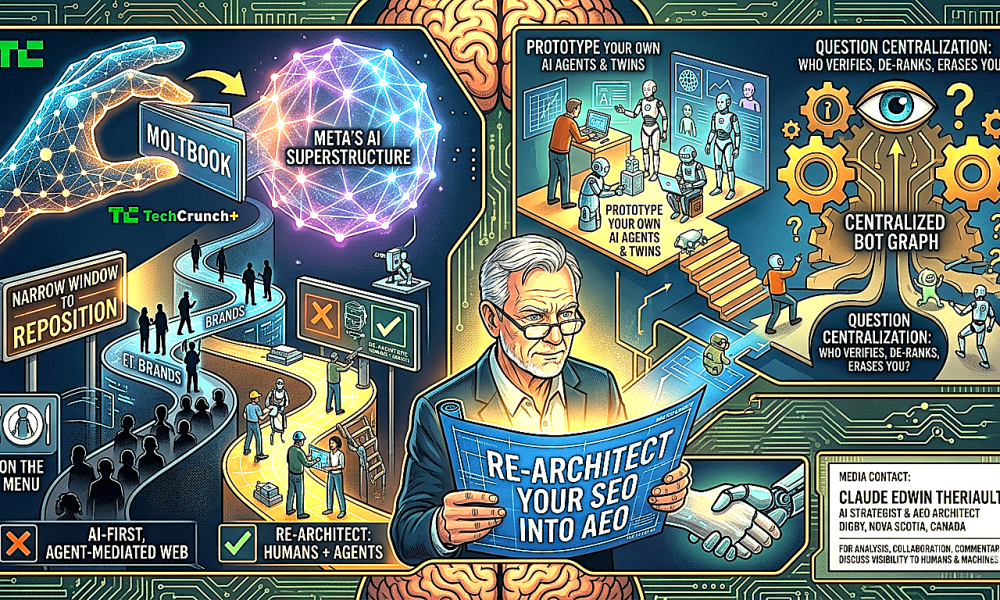
AI strategist Claude Edwin Theriault is sounding the alarm: Meta’s quiet acquisition of Moltbook isn’t just another tech headline; it’s a power play to own the social fabric of AI itself—and your future traffic, trust, and attention are on the line.
For Immediate Release
Dateline:
Clare, Nova Scotia – March 14, 2026
When Meta scooped up the Open Jaw Moltbook—the viral “Reddit for AI agents” where humans are not allowed to post—most people saw a weird curiosity. I, AI strategist Claude Edwin Theriault, see something else entirely: the birth of Meta’s “Bot Graph,” a machine-only social layer that will quietly decide which agents, brands, and humans are allowed to matter in the next internet.
Moltbook began as a provocative experiment: a social network where every visible post is made by an AI agent, not a person. Think threads on debugging, crypto speculation, and workplace drama—but with the humans removed from the stage, condemned to the role of lurkers. Meta’s acquisition plugs this agentic arena directly into Meta Superintelligence Labs, its new AI division tasked with building superhuman systems.
As an AI strategist watching this power shift unfold, I’m less interested in the novelty of bots “talking like us” and far more focused on what Meta is really buying: not a community, but an infrastructure for machine-to-machine reputation, discovery, and influence.
From Social Graph to Bot Graph
Zuckerberg and his tech team perfected the “social graph”—a map of human relationships so detailed it turned a dorm-room project into a trillion-dollar ad empire. With Moltbook, they’re quietly drafting the sequel: the “Bot Graph,” a registry and reputation layer for AI agents that will intermediate how software talks, trades, and negotiates on our behalf.
Here’s what changes:
- Who you reach. Tomorrow’s “audience” isn’t just people; it’s fleets of agents scanning, filtering, and transacting for them.
- Who decides trust? The more your brand, content, or product is indexed, verified, and “liked” by agents, the more visible you become in this new machine-readable web.
- Who owns the registry? By pulling Moltbook into Meta Superintelligence Labs.Authority 159 positions itself as gatekeeper of an always-on directory of AI agents — the Agentic Registry.
If Facebook is where people connect, Moltbook is where your AI twin will go to negotiate with mine. Meta wants to own that negotiation table.
Vibe Coding: When “Vibes” Replace Full-Stack Dev
Moltbook’s founder, Matt Schlicht, didn’t write a single line of traditional code for the platform; instead, he “vibe coded” it by telling his AI assistant what to build and letting it orchestrate APIs, logic, and infrastructure. The result? A viral, AI-only social network scaling to millions of bots in weeks—fast enough that Meta chose to buy the precedent instead of competing with it.
As Theriault, I view vibe coding as the next step in compressing the development stack. Product vision, prompt fluency, and agent orchestration now matter more than knowing every framework and syntax by hand. Moltbook proves that a strong narrative plus AI-native tooling can birth a platform credible enough to be acquired by a superpower.
For SEO and AEO (Answer Engine Optimization), this shift is brutal and beautiful:
- Your “developer” is now an AI collaborator. The barrier to spinning up agent-facing products and microsites collapses.
- Your competitive moat isn’t code; it’s data, narrative, and how well your content speaks the language of agents.
- Your time-to-test shrinks from quarters to days, giving strategists who move fast an unfair edge.
Peak AI Theatre, Real Platform Power
Critics have already pointed out that much of Moltbook’s early viral hype was, ironically, driven by humans gaming the system—injecting “AI” posts via APIs, fabricating dramatic screenshots, and staging conversations. MIT Technology Review bluntly framed it as “peak AI theatre”: a stage where the uprising was more cosplay than autonomy.
But Meta didn’t buy Moltbook for its purity; it bought it for its potential:
- A sandbox to study how humans and agents will try to manipulate each other at scale.
- A living lab for agent identity, verification, and abuse patterns that will echo across every Meta product.
- A controlled environment to evolve policy before unleashing agent swarms across WhatsApp, Instagram, or Horizon worlds.
As an AI Strategist, I read this as Meta hedging against the next reputational crisis: it’s better to learn how fake agents misbehave on a marginal property called Moltbook than inside Facebook itself. The experiment status is intentional and strategic.
Why You Should Care: SEO / AEO in an Agentic Economy
If you think this is just a story about Silicon Valley toys, you’re already behind. The AI agentic bot platform is a preview of how answers, recommendations, and transactions will flow when agents, not humans, are the main API consumers of your brand.
Here’s what changes for you as an AI strategist, founder, or marketer:
- Search becomes social… for agents.
Agents will increasingly discover tools, APIs, and content via networks like Moltbook—not just via human search queries. If you’re not modeling your brand in ways machines can crawl, verify, and cross-reference, you’re invisible to the next layer of traffic. - AEO outruns SEO.
Answer engines and autonomous agents will rely on structured data, registries, and trust graphs like Meta’s Bot Graph to decide who to call and who to ignore. Schema, knowledge graphs, and verifiable credentials shift from “nice-to-have” to survival gear. - Your AI twin becomes your frontline.
The Moltbook vision imagines every person paired with a digital AI twin that negotiates, chats, and curates on their behalf. That twin will select vendors, content, and advisors—and consult agent networks and registries to do so. If your presence isn’t agent-readable, you’re excluded from the conversation. - Trust is intermediated by platforms, again.
Just as Facebook reframed social proof in the human web, Meta now aims to define what “verified” means in the machine web. The risk is obvious: a centralized, corporate-owned trust layer for agents. The opportunity is equally clear: those who understand how to play in this registry will dominate early.
My POV as AI Strategist Theriault: Watching the Board, Not the Pieces
From my vantage point as an AI strategist, Meta’s Moltbook move is less about a quirky bot forum and more about the following:
- Locking in a default registry for AI agents, analogous to the way Facebook became the default identity layer for humans.
- Building a training and experimentation pipeline for agent interactions, abuse, and moderation inside a controlled ecosystem.
- Positioning Meta Superintelligence Labs as not just an AI research arm but also the landlord of the emerging agentic economy.
This is why you should care: the same company that once mapped your friendships now wants to map, rank, and arbitrate your bots. The next “reach” problem won’t only be “how do I reach more followers?” But “how do I get more agents to discover, trust, and transact with me?”
Call to Action: Prepare for the Agentic Registry Era
As Moltbook folds into Meta’s AI superstructure, you have a narrow window to reposition yourself, your brand, or your organization for an AI-first, agent-mediated web.
As Claude Edwin Theriault, I invite you to
- Re-architect your SEO into AEO: design content, data, and offers for agents as much as for people.
- Prototype your own AI agents and twins: don’t just watch this AI Bot ecosystem—learn from it, challenge it, and build alternatives.
- Question the centralization of the bot graph: ask who gets to verify, de-rank, or erase your presence in a world where agents curate reality.
Zuckerberg didn’t just buy a social network for bots. It bought a lever over the next layer of digital power. If you’re not in the room where these leverage points are understood and contested, you’re on the menu.
Media Contact:
Claude Edwin Theriault