
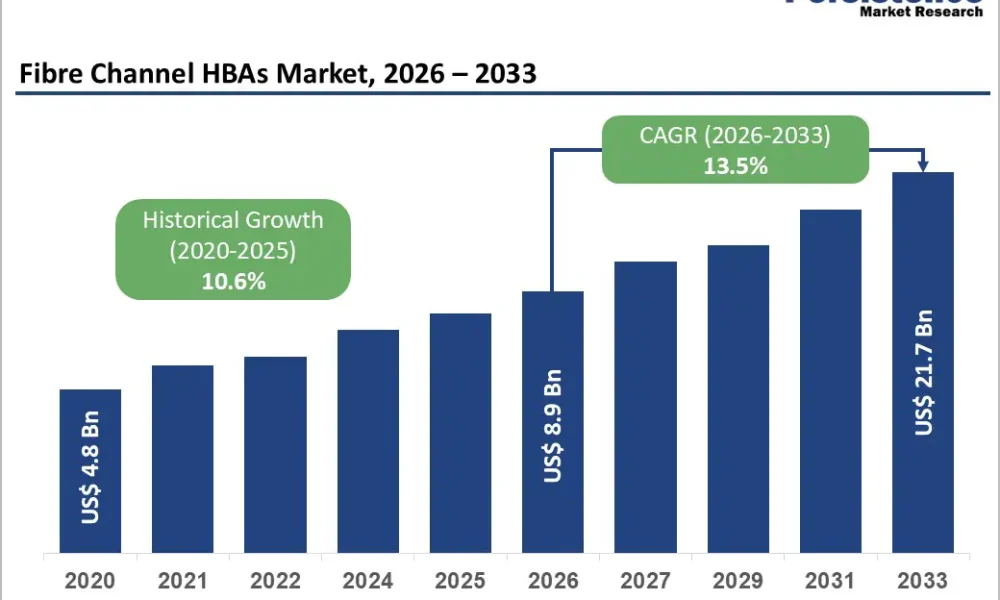
The global Fibre Channel Host Bus Adapter (HBA) market is experiencing strong expansion as enterprises modernize data centers and adopt high-performance storage architectures. According to industry estimates, the fibre channel HBAs market size is projected to grow from US$8.9 billion in 2026 to US$21.7 billion by 2033, registering a compound annual growth rate (CAGR) of 13.5% during the forecast period.
This growth is largely driven by the proliferation of all-flash storage systems, NVMe-based architectures, artificial intelligence workloads, and cloud infrastructure expansion. Organizations across industries are increasingly generating massive volumes of data from connected devices, analytics platforms, and enterprise applications. As a result, there is a growing need for high-speed, secure, and low-latency storage connectivity, which Fibre Channel HBAs are specifically designed to deliver.
Additionally, strict data protection regulations and enterprise requirements for operational efficiency and business continuity are pushing companies to adopt reliable storage networking technologies. Fibre Channel remains one of the most trusted technologies for mission-critical environments such as banking, healthcare, telecommunications, and government infrastructure.
Key Market Trends Driving Growth
Rising Demand for High-Speed Data Transfer in Data Centers
The exponential growth of digital data is one of the strongest drivers of the Fibre Channel HBA market. Modern data centers must handle enormous volumes of information generated by cloud services, IoT devices, video streaming, and AI applications.
To manage these workloads effectively, organizations require ultra-fast, reliable storage connectivity. Fibre Channel HBAs enable high-throughput communication between servers and storage systems, making them essential components of enterprise storage networks.
Global hyperscale and colocation data centers are rapidly expanding capacity. Industry estimates indicate that around 10 gigawatts of new data center capacity will be added globally in 2025, reflecting a massive infrastructure build-out. Additionally, nearly 6 billion people were connected to the internet in 2025, creating unprecedented data consumption levels.
This digital transformation is driving sustained investment in high-performance storage networking solutions, strengthening demand for Fibre Channel HBAs.
NVMe-oF Integration and Cloud Storage Virtualization
Another key market trend is the adoption of NVMe over Fabrics (NVMe-oF) and virtualized storage environments. NVMe-oF allows NVMe storage devices to communicate across networks while maintaining extremely low latency.
Fibre Channel HBAs are particularly well-suited for NVMe-oF deployments because they provide:
- Lossless data transport
- Deterministic performance
- High throughput
- Reliable redundancy
As enterprises increasingly deploy all-flash arrays and software-defined storage platforms, Fibre Channel infrastructure ensures consistent performance and data integrity across distributed environments.
Industry analysts expect around 50% of global data to reside in cloud environments by 2025, significantly increasing east-west data traffic within data centers. This trend reinforces the need for high-performance storage interconnects, further boosting HBA demand.
Market Challenges
Competition from Ethernet-Based Storage Networking
Despite strong demand, Fibre Channel HBAs face increasing competition from alternative storage networking technologies such as iSCSI and high-speed Ethernet networks.
Technologies such as 25GbE, 100GbE, and 400GbE Ethernet offer competitive performance at lower cost and allow organizations to consolidate networking infrastructure on a single Ethernet fabric.
Additionally, modern hyperconverged infrastructure (HCI) platforms combine compute, storage, and networking within unified systems. These architectures reduce reliance on dedicated Fibre Channel networks.
While Fibre Channel continues to offer superior reliability and performance for mission-critical workloads, enterprises evaluating total cost of ownership (TCO) may increasingly consider Ethernet-based alternatives.
High Initial Infrastructure Costs
Another significant barrier to adoption is the high initial cost of Fibre Channel infrastructure.
A typical Fibre Channel HBA can cost between US$500 and US$2,000, and deployments often require additional components including:
- Fibre Channel switches
- Optical cables
- SAN management software
- Skilled IT personnel
For small and medium-sized enterprises (SMEs), these costs can be prohibitive. Consequently, Fibre Channel networks are more commonly deployed by large enterprises, hyperscale cloud providers, and mission-critical industries.
Emerging Opportunities in the Market
Data Center Modernization and All-Flash Storage
One of the biggest growth opportunities for the Fibre Channel HBA market is enterprise storage modernization.
Organizations are replacing legacy disk-based storage systems with all-flash arrays to achieve:
- Sub-100 microsecond latency
- Millions of IOPS performance
- Higher energy efficiency
- Improved reliability
To fully utilize the capabilities of flash storage, companies must upgrade storage connectivity infrastructure. This transition is driving adoption of 32G and 64G Fibre Channel HBAs, which eliminate network bottlenecks and maximize storage performance.
Industries such as banking, telecommunications, healthcare, and cloud services are leading this modernization trend.
AI and High-Performance Computing Infrastructure
The rapid rise of artificial intelligence and machine learning workloads is creating another major growth driver for Fibre Channel HBAs.
AI training systems require continuous access to massive datasets stored across high-performance storage arrays. Fibre Channel networks provide predictable performance and reliable data transfer, enabling efficient GPU utilization.
Compared to Ethernet-based alternatives, Fibre Channel offers:
- Lower latency
- Greater reliability
- Stronger security
- Better workload isolation
As enterprises invest in AI infrastructure and high-performance computing clusters, demand for advanced Fibre Channel HBAs is expected to grow significantly.
Elevate your business strategy with comprehensive market data. Request a sample report now: https://www.persistencemarketresearch.com/samples/33147
Post-Quantum Cryptography and Secure Storage Networks
Data security is becoming increasingly critical in modern IT environments. Emerging cybersecurity regulations and standards are encouraging organizations to deploy advanced encryption across storage networks.
New Fibre Channel HBA solutions include hardware-level encryption capabilities, allowing organizations to secure data in transit without sacrificing performance.
These technologies help enterprises protect sensitive data against:
- Ransomware attacks
- Cyber espionage
- Quantum computing threats
As security requirements become stricter, secure Fibre Channel HBAs are expected to represent a major growth opportunity.
Category-Wise Market Analysis
By Port Configuration
Dual-Port Fibre Channel HBAs Lead the Market
Dual-port Fibre Channel HBAs dominate the market, accounting for more than 54% of total share in 2026, with a market value exceeding US$4.8 billion.
These adapters provide critical advantages including:
- Redundant connectivity
- Load balancing
- High availability
Organizations rely on dual-port configurations to maintain uninterrupted service during network maintenance or hardware failures.
Quad-Port HBAs Show Fastest Growth
Quad-port Fibre Channel HBAs are projected to grow at a 19.3% CAGR, making them the fastest-growing segment.
These adapters allow organizations to consolidate storage connectivity onto fewer physical cards, improving bandwidth density while reducing hardware complexity.
Quad-port solutions are particularly attractive for:
- High-density data centers
- Virtualized server environments
- Infrastructure consolidation initiatives
By Data Rate
32 Gbps Segment Dominates the Market
The 32 Gbps Fibre Channel HBA segment holds the largest market share, accounting for approximately 39% of the global market in 2026, with a value exceeding US$3.5 billion.
This data rate provides an ideal balance of:
- High bandwidth
- Low latency
- Backward compatibility
It is widely used for virtualized workloads, large databases, and all-flash storage systems.
64 Gbps Segment Witnesses Rapid Growth
The 64 Gbps segment is expected to grow significantly due to increasing demand for ultra-high bandwidth.
Next-generation servers and AI workloads require storage connectivity capable of handling extremely high data volumes. As a result, organizations are gradually upgrading to 64 Gbps Fibre Channel infrastructure.
By Application
Data Center Servers Lead the Market
Data center servers account for more than 35% of the global market, with a value exceeding US$3.1 billion in 2026.
These servers require high-speed storage connectivity to support large-scale data processing and virtualization workloads.
Fibre Channel HBAs ensure reliable and scalable storage networking, making them essential for:
- Cloud computing platforms
- AI workloads
- Enterprise storage systems
Virtualized and Cloud Environments Growing Rapidly
Virtualized and cloud environments are expected to grow at a 17.9% CAGR, reflecting global migration toward hybrid cloud architectures.
Cloud service providers are continuously expanding data center capacity, creating substantial demand for storage networking technologies.
Regional Market Analysis
North America Leads the Global Market
North America dominates the Fibre Channel HBA market, holding over 37% of global share in 2026, with a value exceeding US$3.3 billion.
The United States is the primary contributor, driven by:
- Hyperscale data center expansion
- AI infrastructure investments
- Advanced enterprise IT ecosystems
By 2033, the U.S. market alone is projected to surpass US$4.9 billion.
Asia Pacific: The Fastest-Growing Region
Asia Pacific is expected to record the fastest growth, expanding at a CAGR of 18.4% and reaching over US$8.7 billion by 2033.
Key growth drivers include:
- Massive data center construction in China
- 5G network expansion
- Government-backed digital infrastructure initiatives
India is projected to grow at a remarkable 21.8% CAGR, fueled by digital transformation and increasing cloud adoption.
Europe Market Trends
Europe’s Fibre Channel HBA market is expected to grow at 14.1% CAGR, supported by strict data protection regulations and increasing investments in data center infrastructure.
Countries such as Germany, the United Kingdom, and France are leading regional growth due to their strong enterprise technology ecosystems.
Competitive Landscape
The global Fibre Channel HBA market is moderately consolidated, with a small group of major technology providers dominating market share.
Key companies compete through:
- Higher port speeds
- Low-latency performance
- Security features
- Enterprise system compatibility
Major companies operating in the market include:
- Broadcom
- IBM
- Dell Inc.
- Hewlett Packard Enterprise
- Marvell Technology
- Lenovo
- ATTO Technology
- Microchip Technology
- Fujitsu
- NVIDIA
- Huawei Technologies
Recent Industry Developments
- In 2025, Broadcom launched Emulex Secure Fibre Channel HBAs, featuring built-in encryption to protect data in transit against cyber threats.
- ATTO Technology introduced new 64Gb Fibre Channel HBAs and Thunderbolt-based networking adapters designed for high-performance media production environments.
These innovations highlight the industry’s focus on security, speed, and performance optimization.
Future Outlook
The future of the Fibre Channel HBA market looks highly promising as organizations continue investing in AI infrastructure, cloud computing, and high-performance storage networks.
Although Ethernet-based alternatives are gaining popularity, Fibre Channel remains the preferred technology for mission-critical workloads requiring deterministic performance, reliability, and secure data transport.
With rapid data growth, expanding hyperscale data centers, and increasing adoption of NVMe-based storage architectures, Fibre Channel HBAs are expected to remain a core component of enterprise storage networking ecosystems.
By 2033, the global market is projected to exceed US$21.7 billion, reflecting the growing importance of high-speed, secure, and scalable storage connectivity in the digital economy.
Related Reports:




