
The global elastography imaging market is poised for significant expansion over the coming years, driven by increasing adoption of non-invasive diagnostic technologies and growing demand for affordable alternatives to conventional tissue biopsies. Elastography imaging, which evaluates tissue stiffness to assess disease progression, has gained prominence across multiple clinical applications, including chronic liver disease, breast cancer, and musculoskeletal disorders. With a growing emphasis on precision medicine, clinicians are leveraging elastography to monitor disease without subjecting patients to repeated invasive procedures, thereby improving both patient comfort and diagnostic efficiency.
Market statistics indicate robust growth potential for elastography imaging. The global market size is projected to increase from US$4.6 billion in 2025 to US$7.5 billion by 2032, representing a compound annual growth rate (CAGR) of 7.2%. Historically, the market has already exhibited a steady upward trajectory, with a CAGR of 6.8% from 2019 to 2024. Among modalities, ultrasound-based elastography is expected to dominate the market, accounting for approximately 70.1% of total revenue by 2025, due to its cost-effectiveness, portability, and ability to deliver real-time results. General imaging applications, encompassing liver, thyroid, and musculoskeletal assessments, are anticipated to hold the leading share of 33.8%, reflecting widespread clinical utility.
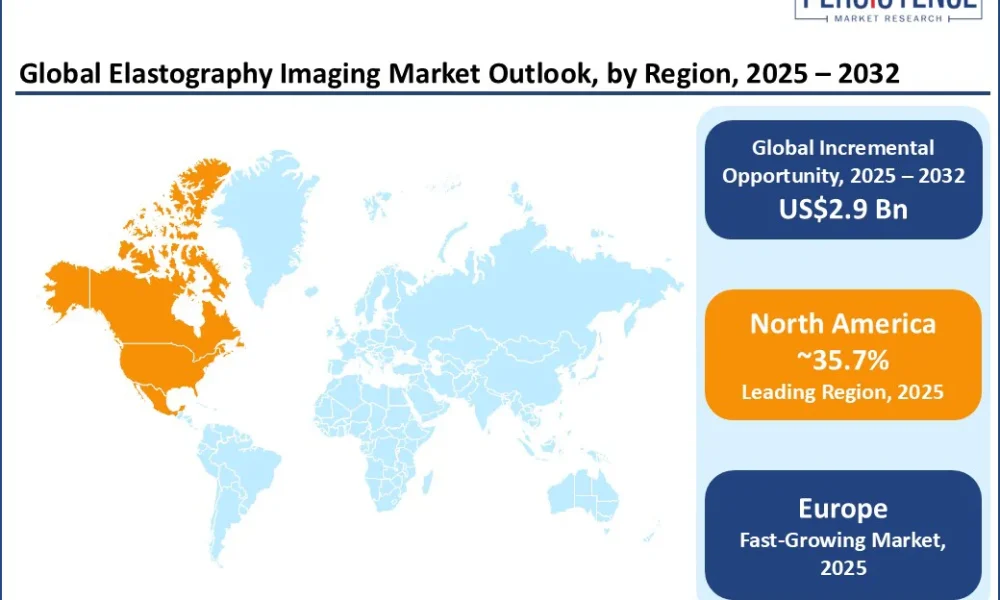
The leading geographical region for elastography imaging is North America, which is projected to command roughly 35.7% of the market in 2025. This dominance is attributed to favorable reimbursement policies, widespread access to advanced imaging technologies, and well-established healthcare infrastructure. Hospitals across the United States and Canada are increasingly integrating elastography into routine diagnostic workflows, especially for hepatology and oncology applications, supported by clear procedural coding and stable Medicare coverage. The region’s high adoption rate of innovative imaging solutions positions it as a stronghold for continued market expansion.
Download Your Free Sample & Explore Key Insights: https://www.persistencemarketresearch.com/samples/35570
Key Highlights from the Report
• The global elastography imaging market is expected to reach US$7.5 billion by 2032.
• Ultrasound-based elastography is projected to hold over 70% of the market share by 2025.
• North America leads the market with a 35.7% share due to favorable reimbursement policies.
• General imaging remains the dominant application segment with 33.8% market share.
• Europe is poised to be the fastest-growing region due to expanding cancer screening programs.
• Multi-modality elastography is emerging as a key opportunity in oncology diagnostics.
Market Segmentation
The elastography imaging market is segmented based on modality, application, and end-user, each offering unique insights into adoption trends and revenue potential. From a modality perspective, the market primarily comprises ultrasound elastography and magnetic resonance elastography (MRE). Ultrasound is favored for its affordability, portability, and real-time imaging capabilities, making it accessible to a broad range of hospitals and diagnostic centers. MRE, although more costly, offers superior reproducibility and whole-organ coverage, which is particularly advantageous in clinical trials or complex liver disease management, including MASLD and MASH.
Application-wise, elastography finds use across general imaging, hepatology, breast imaging, cardiology, nephrology, orthopedics, and musculoskeletal assessments. Among these, general imaging dominates, largely due to its versatility across multiple organ systems and integration with standard ultrasound machines. Hepatology is a rapidly growing application segment, fueled by the increasing prevalence of chronic liver diseases, while breast imaging is gaining traction in regions with high incidence of dense breast tissue, where mammography alone is insufficient. End-user segmentation identifies hospitals, diagnostic imaging centers, and research institutes as key adopters, with hospitals maintaining the largest share due to their capacity to invest in advanced systems and multi-modality elastography platforms.
Regional Insights
North America maintains a leadership position, with strong clinical adoption supported by procedural reimbursement frameworks and favorable regulatory oversight. The United States, in particular, has clear CPT codes for shear-wave and MR elastography, enabling predictable reimbursement. Hospitals leverage elastography as a front-line diagnostic tool in hepatology and radiology, reducing the reliance on invasive biopsies and facilitating early detection of liver and breast diseases.
Europe is witnessing rapid growth driven by cancer screening programs and national guideline endorsements. Countries like France and Germany have integrated elastography into standard chronic liver disease monitoring protocols. FibroScan and shear-wave technologies are widely used in hepatology, while updated EASL guidance encourages broader adoption across MASLD and MASH patient populations.
Asia Pacific represents a high-growth market due to rising metabolic liver disease, persistent hepatitis prevalence, and expanding imaging device availability. China leads with domestic platforms like the FT9000, enhancing accessibility and driving price competitiveness. Japan is advancing multi-modality adoption in tertiary centers, while India is integrating elastography in private hospitals, particularly in metropolitan regions. These trends reflect growing awareness of elastography’s clinical value and its potential to support personalized medicine in oncology and hepatology.
Get Custom Insights Designed for Your Business: https://www.persistencemarketresearch.com/request-customization/35570
Market Drivers
Several factors are fueling the growth of the elastography imaging market. Foremost is the rising burden of chronic liver disease. Conditions such as hepatitis B, hepatitis C, and non-alcoholic fatty liver disease (NAFLD) are on the rise globally, prompting clinicians to adopt non-invasive methods to stage fibrosis accurately. Hospitals in Germany and France report a 40% reduction in biopsy rates due to elastography, illustrating its impact on clinical workflows. Similarly, the prevalence of breast cancer is boosting demand, as elastography provides a reliable method to differentiate benign from malignant lesions, especially in dense breast tissue where mammography can be less effective. Increasing clinician preference for non-invasive diagnostics, coupled with growing awareness of elastography’s utility in musculoskeletal and thyroid evaluations, continues to drive adoption across regions.
Market Restraints
Despite its advantages, elastography imaging faces certain challenges. Technical limitations in patients with obesity or atypical anatomy hinder the reliability of measurements, as excess adipose tissue can reduce ultrasound signal penetration. Studies have reported failure rates of nearly 15% in liver stiffness assessment among obese patients, necessitating repeat scans or fallback on invasive biopsy. Similar challenges are noted in breast imaging, where large breast size or dense tissue can compromise stress distribution in compression-based techniques. While manufacturers are introducing AI-powered algorithms and specialized probes to mitigate these issues, adoption remains inconsistent in regions with high obesity prevalence.
Market Opportunities
The emergence of multi-modality elastography platforms presents significant growth opportunities. Combining ultrasound and magnetic resonance elastography allows clinicians to cross-validate measurements, improving diagnostic accuracy, particularly in oncology. Multi-modality systems support personalized medicine initiatives by providing complementary data on tissue stiffness, enabling more precise monitoring of disease progression and treatment response. Additionally, increasing integration of elastography into general imaging protocols, early cancer detection programs, and chronic liver disease monitoring in developing regions offers ample opportunity for market expansion.
Checkout Now & Download Complete Market Report: https://www.persistencemarketresearch.com/checkout/35570
Company Insights
Key players operating in the global elastography imaging market include:
• Canon Medical Systems Corporation
• FUJIFILM Corporation
• Esaote SpA
• Mindray Bio-Medical Electronics Co., Ltd.
• Koninklijke Philips N.V.
• Hitachi, Ltd.
• GE Healthcare
• Toshiba America Medical Systems, Inc.
• Siemens AG
• Samsung Medison Co., Ltd.
Recent Developments:
• In August 2025, Sonic Incytes Medical Corp received U.S. FDA 510(k) clearance for Velacur ONE, a point-of-care ultrasound elastography device offering improved portability and user experience.
• In April 2025, Royal Philips launched the Elevate Platform upgrade for its EPIQ Elite ultrasound system, incorporating remote diagnostics, proactive system monitoring, and enhanced workflow support for clinical teams.
Conclusion
The elastography imaging market is on a trajectory of sustained growth, driven by rising demand for non-invasive diagnostic solutions and the increasing prevalence of chronic liver disease and breast cancer. With ultrasound leading the modality segment and general imaging dominating applications, the market continues to benefit from versatile, multipurpose systems that improve patient outcomes while reducing invasive procedures. North America maintains a leadership position due to supportive reimbursement policies, while Europe and Asia Pacific are emerging as high-growth regions with expanding screening programs and domestic innovations. Although technical challenges persist in certain patient populations, opportunities arising from multi-modality platforms and personalized medicine adoption position elastography as a pivotal technology in modern diagnostics. With key players innovating and expanding their product portfolios, the market is expected to reach US$7.5 billion by 2032, reflecting a strong outlook for clinicians, patients, and investors alike.




