
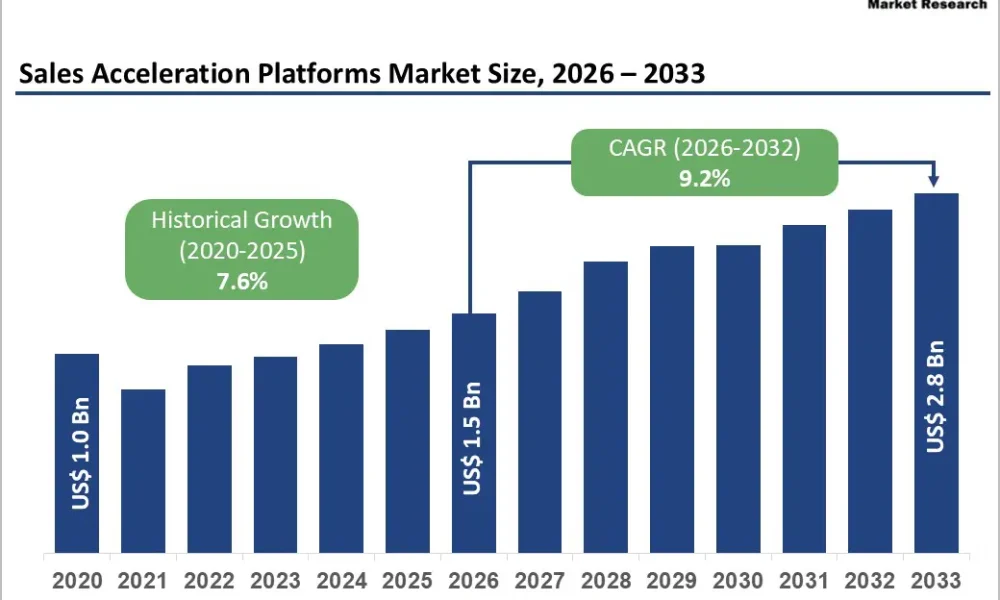
The global sales acceleration platform market is experiencing steady growth as organizations increasingly modernize their sales operations using cloud-based and AI-driven technologies. The market is projected to reach US$ 1.5 billion in 2026 and expand to approximately US$ 2.8 billion by 2033, registering a compound annual growth rate (CAGR) of 9.2% during the forecast period from 2026 to 2033.
Sales acceleration platforms are designed to streamline and optimize sales processes by integrating tools such as customer relationship management (CRM), communication automation, analytics, and artificial intelligence. These platforms enable sales teams to manage leads, track customer interactions, automate outreach, and analyze sales performance through a unified interface.
The increasing adoption of cloud-based software-as-a-service (SaaS) solutions, the growing need for AI-powered sales engagement tools, and the ongoing digital transformation of enterprise sales strategies are key factors driving the expansion of the market. Businesses across industries are investing in sales acceleration platforms to improve productivity, shorten sales cycles, and enhance customer engagement.
Additionally, the shift toward remote and hybrid work environments has accelerated the demand for digital sales management tools that allow geographically distributed sales teams to collaborate effectively and maintain consistent customer communication.
Key Industry Highlights
Several important trends are shaping the evolution of the sales acceleration platform market globally.
North America currently dominates the market, holding approximately 41% of the global share, driven by mature enterprise adoption, strong SaaS ecosystems, and the presence of leading technology innovators. Organizations in the region have been early adopters of cloud-based sales technologies and AI-powered analytics platforms.
The Asia Pacific region is expected to witness the fastest growth, expanding at a 12.1% CAGR through 2033. Rapid digital transformation across industries such as banking, financial services, retail, and IT services in countries like India, China, and Southeast Asia is fueling this growth.
In terms of platform type, customer relationship management (CRM) systems dominate the market, capturing approximately 38% of the total share. These systems act as the backbone of sales acceleration platforms by integrating sales, marketing, and customer service operations while providing advanced analytics and automation features.
From a deployment perspective, cloud-based SaaS solutions account for about 72.6% of the market, reflecting enterprise demand for scalable, accessible, and cost-efficient platforms that support global sales operations and remote teams.
One of the most promising opportunities in the market lies in the integration of artificial intelligence and generative analytics, which provide predictive insights, automated engagement, and real-time coaching to help sales teams improve conversion rates and overall productivity.
Market Dynamics
Rising Demand for Remote Sales Team Management
The widespread adoption of remote and hybrid work models has fundamentally transformed the way organizations manage their sales teams.
According to industry studies, around 39% of companies now operate fully remote environments, while approximately 23% follow hybrid work arrangements. This shift has created a strong demand for digital platforms that enable seamless collaboration among geographically dispersed sales professionals.
Sales acceleration platforms address these challenges by centralizing customer communications, automating administrative tasks, and providing real-time dashboards that allow managers to monitor sales performance.
Through integrated analytics and performance tracking tools, these platforms enable sales leaders to maintain visibility into pipeline activity, deal progress, and team productivity even when employees operate from different locations.
Companies implementing sales acceleration platforms often report sales cycle reductions of up to 50%, as automated workflows eliminate manual tasks and streamline customer engagement processes.
Artificial Intelligence Transforming Sales Workflows
Artificial intelligence has become one of the most significant drivers of innovation in the sales acceleration platform market.
Modern platforms use machine learning algorithms to analyze large volumes of customer interaction data and identify patterns that can improve sales outcomes.
Organizations that implement AI-powered predictive analytics can automate processes such as lead scoring, demand forecasting, and engagement recommendations.
Research indicates that 75% of companies using predictive sales analytics report significant performance improvements, while organizations implementing AI-driven personalization strategies achieve conversion rate increases of up to 30%.
Leading technology companies have integrated advanced AI capabilities into their sales platforms. For example, platforms such as Salesforce, HubSpot, and Microsoft Corporation provide AI-powered features that enable sales teams to identify high-value prospects and optimize engagement strategies.
These capabilities allow organizations to transition from intuition-based selling to data-driven decision-making, which improves forecasting accuracy and revenue generation.
Market Restraints
Complex Implementation and High Total Cost of Ownership
Despite strong growth potential, the adoption of sales acceleration platforms can be challenging for many organizations due to complex implementation requirements and high total costs.
Deploying a sales acceleration platform often involves integrating it with existing enterprise systems such as CRM software, financial management platforms, and customer support tools.
These integration processes may require external consultants and specialized technical expertise, which can significantly increase implementation costs.
For small and medium-sized enterprises (SMEs), the upfront expenses associated with customization and deployment can sometimes rival the cost of annual software licensing.
Additionally, implementation timelines can extend from several months to over a year, creating uncertainty about return on investment.
As a result, some organizations delay adoption until they can clearly justify the financial and operational benefits of implementing these platforms.
Elevate your business strategy with comprehensive market data. Request a sample report now: https://www.persistencemarketresearch.com/samples/33097
Emerging Market Opportunities
AI-Driven Revenue Intelligence
The integration of artificial intelligence into sales acceleration platforms is creating new opportunities for vendors to deliver revenue intelligence solutions.
Revenue intelligence platforms analyze customer interaction data, historical sales performance, and market trends to generate actionable insights for sales teams.
These insights include:
- Predictive lead scoring
- Deal risk identification
- Next-best-action recommendations
- Real-time sales coaching
By leveraging these capabilities, sales teams can prioritize high-probability opportunities and reduce time spent on unqualified prospects.
Additionally, generative AI technologies are enabling automated email creation, personalized messaging, and dynamic content recommendations that align with customer preferences.
These innovations significantly enhance platform value and allow vendors to introduce premium AI-powered features that increase subscription revenue.
Growing Adoption Among SMEs
Another major growth opportunity lies in the expansion of sales acceleration platforms among small and medium-sized enterprises (SMEs).
In the past, advanced sales technologies were primarily used by large enterprises due to high costs and complex implementations.
However, the rise of cloud-based SaaS platforms has dramatically lowered barriers to entry, making sophisticated sales tools accessible to smaller organizations.
SMEs increasingly rely on digital tools to compete with larger enterprises and manage omnichannel customer engagement.
Sales acceleration platforms that offer modular pricing, rapid deployment, and mobile-friendly interfaces are particularly attractive to SMEs seeking cost-effective solutions.
Emerging markets across Asia-Pacific, Latin America, and the Middle East present significant opportunities as startup ecosystems and digital commerce continue to expand.
Category-wise Market Analysis
Platform Type Insights
Customer relationship management systems represent the largest platform type in the sales acceleration market, accounting for approximately 38% of total share.
CRM platforms provide centralized databases that store customer information, track interactions, and manage sales pipelines.
These capabilities serve as the foundation for sales acceleration features such as automated workflows, predictive analytics, and engagement tracking.
Major CRM vendors continue to expand their platforms with advanced AI capabilities, strengthening their position in the market.
Deployment Mode Insights
Cloud-based SaaS deployment dominates the sales acceleration platform market with approximately 72.6% share.
Cloud platforms allow organizations to access sales tools from anywhere, making them ideal for remote teams and globally distributed sales operations.
Additionally, cloud-based solutions reduce IT infrastructure costs and enable vendors to deliver frequent updates and new features.
Although on-premise solutions are declining in popularity, they remain relevant for organizations in regulated industries that require strict data control and compliance.
Organization Size Insights
Large enterprises currently account for the majority of spending in the sales acceleration platform market, representing 58.3% of total revenue.
These organizations often operate complex global sales structures and require advanced tools to manage pipelines, forecast demand, and analyze performance.
However, the SME segment is growing faster, with a projected 12.4% CAGR, reflecting increasing demand for scalable sales automation tools among smaller businesses.
Industry Insights
The information technology and IT-enabled services sector represents the largest industry segment, capturing around 29% of the market share.
Technology companies rely heavily on efficient sales processes to manage complex solution-based sales cycles involving multiple stakeholders.
Meanwhile, the retail and e-commerce industry is expected to grow at the fastest rate, driven by the need for personalized customer engagement and omnichannel sales strategies.
Regional Insights
North America
North America leads the global market due to strong technology adoption and the presence of leading sales technology providers.
Companies in the region are early adopters of AI-powered sales tools and advanced analytics platforms, enabling them to optimize customer engagement and revenue generation.
Europe
Europe represents a significant share of the market, driven by increasing digital transformation initiatives and regulatory requirements related to data privacy and customer communication.
Countries such as Germany and the United Kingdom are leading adopters of advanced sales technologies.
Asia Pacific
Asia Pacific is the fastest-growing region due to rapid digital transformation across industries and the expansion of startup ecosystems.
Countries including India, China, and Japan are witnessing strong adoption of cloud-based sales technologies as businesses seek to modernize customer engagement strategies.
Competitive Landscape
The sales acceleration platform market is moderately consolidated, with several major vendors dominating global deployments.
Key companies operating in the market include:
- Salesforce
- HubSpot
- Microsoft Corporation
- ZoomInfo Technologies Inc.
- Clari, Inc.
- Zoho Corporation
These companies are investing heavily in AI innovation, revenue intelligence, and platform integrations to strengthen their competitive advantage.
Future Outlook
The future of the sales acceleration platform market will be shaped by advancements in artificial intelligence, predictive analytics, and generative AI technologies.
As businesses increasingly rely on data-driven sales strategies, demand for intelligent sales platforms will continue to grow.
By 2033, the market is expected to reach US$2.8 billion, driven by expanding cloud adoption, growing digital transformation initiatives, and the increasing importance of efficient sales processes.
Organizations that leverage advanced sales acceleration technologies will be better positioned to improve sales productivity, strengthen customer relationships, and maintain competitive advantage in an increasingly digital business landscape.
Related Reports:




