
The global laser processing market is entering a transformative phase as manufacturers increasingly adopt advanced technologies to improve precision, efficiency, and productivity. Laser-based processing systems are becoming critical tools in industries such as automotive, aerospace, electronics, semiconductors, and medical device manufacturing. As global production shifts toward automation and high-precision manufacturing, laser processing technologies are playing a key role in enabling modern manufacturing ecosystems.
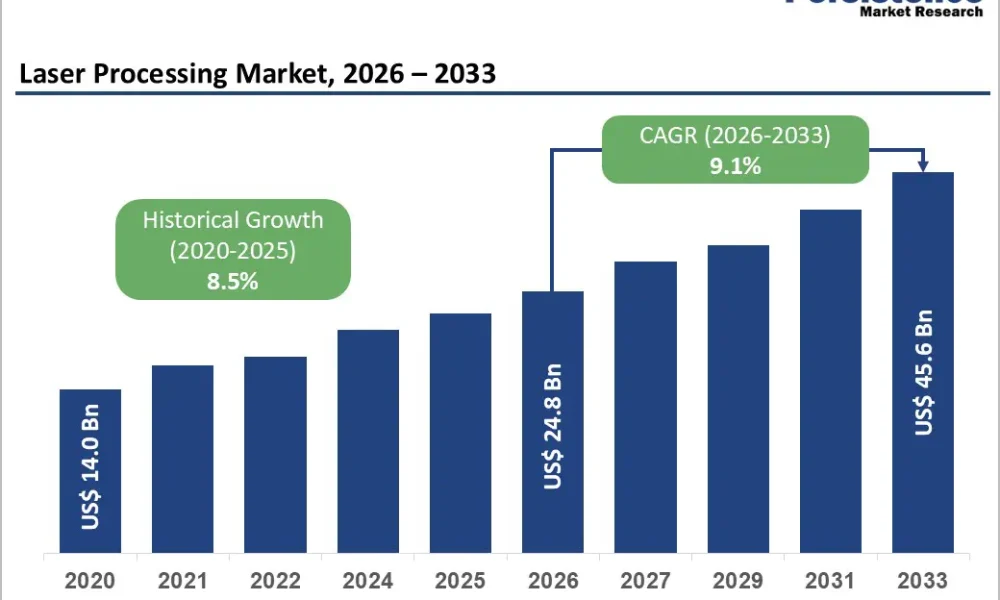
According to industry projections, the global laser processing market is expected to be valued at US$24.8 billion in 2026 and is projected to reach US$45.6 billion by 2033, growing at a compound annual growth rate (CAGR) of 9.1% between 2026 and 2033. This growth reflects increasing demand for precision manufacturing, widespread adoption of Industry 4.0 technologies, and the expanding role of laser systems in electronics and microelectronics production.
This article explores the key trends, drivers, challenges, opportunities, and regional developments shaping the future of the laser processing market.
Growing Importance of Laser Processing in Modern Manufacturing
Laser processing refers to the use of focused laser beams to cut, weld, drill, engrave, or mark materials with extremely high precision. Unlike traditional mechanical methods, laser systems provide non-contact processing, minimizing material distortion and improving accuracy.
Modern industries increasingly rely on laser technology due to several advantages:
- Higher precision and accuracy
- Minimal material waste
- Reduced production cycle times
- Greater flexibility across materials
Laser systems are widely used to process metals, plastics, ceramics, and composite materials. With the rise of digital manufacturing environments, laser machines are now integrated with sensors, artificial intelligence, and automation systems to deliver smarter production processes.
Manufacturers using laser technology often achieve 15–25% material waste reduction and 20–35% faster production cycles, making laser processing highly attractive for high-volume industrial operations.
Key Market Drivers Fueling Growth
Rapid Adoption of Industry 4.0 and Industrial Automation
One of the strongest drivers of the laser processing market is the rapid digital transformation of global manufacturing. Industry 4.0 technologies—such as artificial intelligence, IoT connectivity, real-time monitoring, and predictive maintenance—are transforming how factories operate.
Laser processing systems are increasingly integrated into automated production lines equipped with sensors and AI-powered analytics. These systems enable predictive maintenance, automated defect detection, and real-time performance monitoring.
Approximately 75% of large industrial facilities worldwide are expected to implement Industry 4.0 technologies by 2028, which will significantly increase demand for automated laser processing equipment.
In automated environments, laser systems help manufacturers reduce downtime by up to 20% through predictive maintenance, while also improving production quality and consistency.
Rising Demand from Automotive and Aerospace Industries
The automotive and aerospace sectors require extremely precise manufacturing processes, making laser systems essential tools for modern production lines.
Global automotive production exceeds 80 million vehicles annually, and laser technologies are widely used in applications such as:
- Body welding
- Component cutting
- Battery tab welding
- Surface marking
- Precision drilling
The rise of electric vehicles (EVs) has further accelerated the use of laser processing systems, particularly in battery manufacturing and component assembly.
Similarly, aerospace manufacturers use lasers for lightweight component fabrication, composite processing, and additive manufacturing. Laser systems provide the accuracy and repeatability required to produce high-performance aircraft components.
Expanding Electronics and Semiconductor Manufacturing
Electronics and microelectronics manufacturing represent one of the fastest-growing application areas for laser processing.
The global semiconductor industry—valued at over US$500 billion—relies heavily on laser systems for:
- Micro-drilling
- Semiconductor wafer processing
- PCB manufacturing
- Micro-marking
- Precision cutting
Miniaturization in electronics continues to drive demand for ultra-precise manufacturing tools capable of achieving sub-micron accuracy.
Smartphone production alone exceeds 1.2 billion units annually, and each device requires multiple laser-based processing steps during component manufacturing and assembly.
Additionally, advanced semiconductor nodes, including sub-7nm chips, require highly specialized laser systems for precise material processing and packaging.
Market Restraints Limiting Adoption
High Capital Investment Requirements
Despite its advantages, laser processing equipment remains expensive. Industrial laser systems can cost anywhere from US$50,000 to more than US$500,000 per unit, depending on their power output, automation features, and application.
In addition to equipment costs, installation requires:
- Specialized electrical infrastructure
- Environmental controls
- Laser safety enclosures
- Ventilation systems
These installation requirements can add 30–50% to the total deployment cost, creating barriers for small and medium-sized manufacturers.
Skilled Workforce and Technical Expertise
Operating industrial laser systems requires specialized knowledge and training. Skilled technicians must understand laser parameters, safety protocols, and maintenance requirements.
Training programs for certified laser technicians can take six to twelve months, which creates workforce challenges in developing regions.
Furthermore, maintenance costs—including replacement of components such as laser tubes—can increase operational expenses over the lifecycle of the equipment.
Safety and Regulatory Compliance
Industrial laser systems must comply with strict safety regulations. Governments and international organizations enforce standards designed to protect operators from exposure to high-power laser radiation.
These standards require:
- Laser containment systems
- Protective equipment
- Facility engineering controls
- Fume extraction systems
Compliance with safety regulations increases operational complexity and may lengthen product development cycles for manufacturers.
Emerging Opportunities in the Laser Processing Market
Growth of Additive Manufacturing
One of the most promising opportunities for laser technology lies in additive manufacturing, commonly known as 3D printing.
Laser-based additive manufacturing technologies such as:
- Selective Laser Melting (SLM)
- Laser Sintering
- Directed Energy Deposition
are revolutionizing metal component manufacturing.
The additive manufacturing segment alone is projected to reach US$8 billion by 2033, with metal additive manufacturing expanding at approximately 15% CAGR.
Laser-powered 3D printing enables manufacturers to reduce material waste by 30–50% while also producing lightweight components with complex geometries.
Industries benefiting from additive manufacturing include aerospace, healthcare, automotive, and energy.
Expanding Manufacturing in Emerging Economies
Emerging economies across Asia are becoming major manufacturing hubs, creating significant demand for advanced industrial equipment.
Countries such as India, Vietnam, and Indonesia are investing heavily in manufacturing infrastructure and technology adoption.
For example:
- India’s Production Linked Incentive (PLI) scheme allocates more than US$30 billion to boost domestic manufacturing.
- Southeast Asian countries are attracting electronics manufacturing investments as companies diversify supply chains away from China.
These developments are expected to drive strong demand for laser processing systems across the region.
Product Type Insights
Gas Lasers Continue to Dominate the Market
Gas lasers currently hold approximately 62% of the global market share, largely due to their long-established industrial use.
Among gas lasers, CO2 lasers account for nearly 90% of usage, particularly in cutting, welding, and engraving applications.
Their popularity stems from several factors:
- Lower equipment costs
- Established industrial infrastructure
- Compatibility with existing production systems
CO2 lasers are often 30% cheaper than fiber laser alternatives, which helps maintain their market dominance.
Fiber Lasers Emerging as the Fastest-Growing Segment
While gas lasers dominate the market, fiber lasers are the fastest-growing segment, expanding at a CAGR of 10.8% through 2033.
Fiber lasers offer several advantages:
- Higher energy efficiency
- Better beam quality
- Lower maintenance requirements
- Compact design
Electrical conversion efficiency for fiber lasers can reach 40–50%, compared with only 10% efficiency for traditional CO2 lasers.
These advantages make fiber lasers ideal for precision manufacturing applications in electronics, semiconductors, and micro-machining.
Elevate your business strategy with comprehensive market data. Request a sample report now: https://www.persistencemarketresearch.com/samples/33425
Process Type Insights
Material Processing Holds the Largest Share
Material processing accounts for 46.1% of the global laser processing market.
Common material processing applications include:
- Laser cutting
- Laser welding
- Laser drilling
- Surface cleaning
- Material forming
Laser cutting remains the largest application, widely used in automotive and aerospace manufacturing for its precision and efficiency.
Laser welding also offers superior joint strength and minimal heat distortion compared with traditional welding techniques.
Micro-Processing Witnessing Rapid Growth
Micro-processing is the fastest-growing process segment, expanding at approximately 12% CAGR.
This segment includes:
- Micro-drilling
- Micro-marking
- Precision cutting
As electronic components become smaller and more complex, demand for ultra-precision laser processing continues to increase.
Fiber laser technology plays a crucial role in enabling these high-precision applications.
End-User Industry Analysis
Machine Tools Industry Leads Market Demand
The machine tools sector represents the largest end-user segment, accounting for 32.3% of total market demand.
Laser processing systems are widely used in machine tool manufacturing for producing precision components such as:
- Cutting tools
- Bearings
- Spindles
- Collets
Major equipment manufacturers have integrated laser technologies into their machine platforms to improve accuracy and production efficiency.
Electronics and Microelectronics Segment Growing Rapidly
Electronics and microelectronics represent the fastest-growing end-use segment, expanding at a 13% CAGR.
Rapid growth in semiconductor manufacturing, consumer electronics production, and EV battery manufacturing is driving strong demand for laser systems.
By 2033, this segment is expected to reach approximately US$10 billion in market value.
Regional Market Insights
North America: Technology Leadership
North America currently holds approximately 30% of the global laser processing market, valued at around US$6.9 billion in 2026.
The United States accounts for the majority of regional demand, supported by strong aerospace manufacturing, semiconductor development, and advanced industrial automation.
The region is also home to several major laser technology companies that drive innovation and research.
Europe: Strong Industrial Manufacturing Base
Europe represents around 22% of the global market, supported by advanced manufacturing industries in Germany, the United Kingdom, France, and Spain.
European manufacturers are investing heavily in additive manufacturing technologies and next-generation fiber lasers.
Industry players across the region are expected to invest €1.5–2.5 billion in laser technology development by 2030.
Asia Pacific: Fastest Growing Market
Asia Pacific is emerging as the fastest-growing region in the laser processing market, with a projected 12% CAGR through 2033.
The region’s manufacturing scale is unmatched, with:
- China producing over 30 million vehicles annually
- Electronics manufacturing representing more than 20% of global output
- Rapidly expanding semiconductor production
Government initiatives aimed at strengthening domestic manufacturing capabilities are further accelerating the adoption of laser processing technologies.
Competitive Landscape
The laser processing market is moderately consolidated, with the top eight suppliers controlling around 55% of the global market.
Leading companies invest heavily in research and development to improve laser performance, efficiency, and automation capabilities.
Key companies operating in the market include:
- TRUMPF
- Coherent Inc.
- IPG Photonics Corporation
- Bystronic Laser AG
- Amada Co., Ltd.
- Universal Laser Systems
Chinese manufacturers are also emerging as competitive players, leveraging cost advantages to expand their presence in developing markets.
Future Outlook
The laser processing market is expected to grow steadily as industries continue transitioning toward automation, digital manufacturing, and high-precision production.
Several key trends will shape the future of the market:
- AI-powered autonomous laser systems
- Expansion of additive manufacturing
- Semiconductor manufacturing growth
- EV battery production
- Increasing adoption of fiber laser technologies
As manufacturing industries become more technologically advanced, laser processing systems will remain critical tools enabling precision engineering and next-generation industrial innovation.
Conclusion
The global laser processing market is poised for strong growth over the next decade. With the market expected to reach US$45.6 billion by 2033, laser technologies are becoming essential components of modern manufacturing systems.
Driven by automation, semiconductor demand, and expanding electronics manufacturing, laser processing solutions will continue to evolve rapidly. Although high costs and regulatory complexities remain challenges, ongoing technological innovations and government-backed industrial initiatives are expected to support long-term market expansion.
As industries pursue smarter, faster, and more precise manufacturing processes, laser processing technology will remain at the forefront of the global industrial transformation.
Related Reports:




