
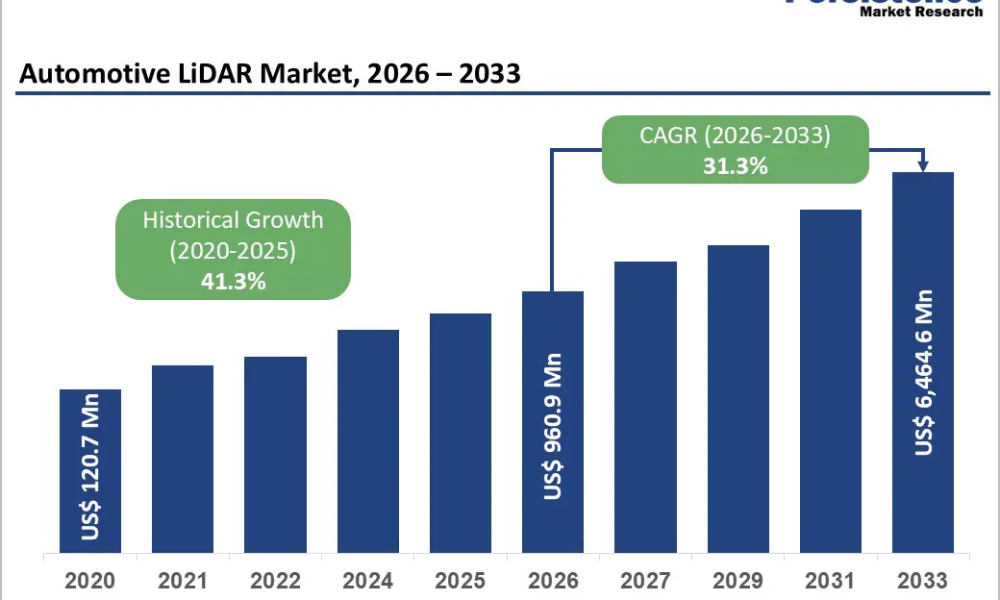
The Automotive LiDAR Market is rapidly transforming the global mobility landscape as advanced driver assistance systems (ADAS) and autonomous driving technologies gain momentum. LiDAR, which stands for Light Detection and Ranging, plays a vital role in enabling vehicles to detect objects, measure distances, and map surrounding environments with high precision. Automotive manufacturers and technology developers are increasingly integrating LiDAR sensors into modern vehicles to improve road safety and enable advanced automated features. According to insights referenced by Persistence Market Research, the growing emphasis on intelligent mobility solutions and safer transportation infrastructure is fueling significant growth in the automotive LiDAR ecosystem.
The global automotive LiDAR market size is supposed to be valued at US$ 960.9 Mn in 2026 and is projected to reach US$ 6,464.4 Mn by 2033, growing at a CAGR of 31.3% between 2026 and 2033. Rising adoption of autonomous vehicle technologies and increasing demand for enhanced safety systems are key growth drivers shaping the market. The ADAS segment currently represents the leading application area due to increasing integration of LiDAR in advanced safety features such as collision avoidance, lane monitoring, and pedestrian detection. Geographically, North America remains a leading region in the automotive LiDAR market due to strong technology innovation, high investments in autonomous vehicle development, and the presence of major automotive technology companies.
Get Your FREE Sample Report Instantly Click Now: https://www.persistencemarketresearch.com/request-customization/17113
The key players studied in the report include:
- Luminar Technologies, Inc.
- RoboSense Technology Co., Ltd
- Ouster, Inc.
- Valeo
- Hesai Technology
- Continental AG
- Huawei Technologies Co., Ltd
- KOITO MANUFACTURING CO., LTD
- Seyond
- Leishen Intelligent System Co., Ltd
- Aeva Technologies
- Other Key Players
Key Highlights from the Report
➤ The global automotive LiDAR market is expected to grow from US$ 960.9 Mn in 2026 to US$ 6,464.4 Mn by 2033, registering a CAGR of 31.3% during the forecast period.
➤ Rising demand for autonomous vehicles and advanced driver assistance systems is significantly accelerating the adoption of LiDAR sensors in modern automotive platforms.
➤ Technological advancements in solid-state LiDAR and cost reduction strategies are supporting wider commercialization across passenger and commercial vehicles.
➤ Increasing regulatory focus on vehicle safety and accident prevention is encouraging automakers to integrate advanced sensing technologies such as LiDAR.
➤ North America continues to lead the market due to strong R&D investment and the presence of leading autonomous vehicle technology developers.
➤ Partnerships between automotive manufacturers and LiDAR technology companies are driving innovation and accelerating deployment in next-generation vehicles.
Market Segmentation
By Product Type
- Mechanical LiDAR
- Solid-state LiDAR
By Application
- ADAS
- Autonomous Cars
By Range
- Short Range (Up to 50 meters)
- Medium Range (50 to 150 meters)
- Long Range (Above 150 meters)
By Vehicle Type
- Passenger Vehicle
- Light Commercial Vehicle
- Heavy Commercial Vehicle
- Electric Vehicles
By Region
- North America
- Europe
- East Asia
- South Asia and Oceania
- Latin America
- Middle East and Africa
Customize This Report for Your Exact Requirements: https://www.persistencemarketresearch.com/request-customization/17113
Regional Insights
North America holds a prominent share of the automotive LiDAR market due to its advanced automotive technology ecosystem and early adoption of autonomous vehicle research. The region hosts several leading LiDAR developers and autonomous vehicle startups, which actively collaborate with global automakers. In addition, supportive regulatory frameworks and significant investments in smart mobility initiatives continue to accelerate the adoption of LiDAR-based sensing technologies across the region.
Asia Pacific is also emerging as a significant growth region for the automotive LiDAR market. Rapid expansion of the automotive industry, increasing investments in electric vehicles, and growing adoption of advanced driver assistance systems are key factors driving demand. Countries such as China, Japan, and South Korea are investing heavily in intelligent transportation systems and autonomous vehicle technologies, which is expected to contribute to strong regional market expansion over the coming years.
Market Drivers
One of the primary drivers of the automotive LiDAR market is the rapid development of autonomous driving technologies. Automakers and technology companies are investing heavily in sensor technologies that enable vehicles to accurately detect obstacles, pedestrians, and surrounding infrastructure. LiDAR provides high-resolution 3D mapping capabilities that are essential for safe autonomous navigation. As companies continue to develop higher levels of vehicle automation, the demand for reliable sensing solutions such as LiDAR is expected to grow significantly.
Another important growth driver is the increasing global emphasis on road safety. Governments and regulatory authorities are introducing stricter vehicle safety standards to reduce road accidents and fatalities. Automotive manufacturers are therefore integrating advanced driver assistance systems that rely on LiDAR sensors for improved situational awareness. Features such as emergency braking, adaptive cruise control, and lane detection benefit greatly from LiDAR technology, making it an essential component of next-generation vehicle safety architectures.
Market Restraints
Despite its strong growth potential, the automotive LiDAR market faces certain restraints that could impact adoption. One of the key challenges is the relatively high cost of LiDAR sensors compared to other sensing technologies such as cameras and radar. High manufacturing costs can limit widespread integration in mass-market vehicles, particularly in price-sensitive automotive segments. Although ongoing technological advancements are helping reduce costs, affordability remains an important factor influencing market expansion.
Another restraint involves technical complexity and integration challenges associated with LiDAR systems. Automakers must ensure that LiDAR sensors operate seamlessly with other vehicle sensors, including radar and camera systems. Achieving accurate sensor fusion and maintaining consistent performance under varying environmental conditions can be technically demanding. These challenges require extensive testing, engineering expertise, and collaboration between automotive manufacturers and technology providers.
Market Opportunities
The automotive LiDAR market presents significant opportunities as next-generation vehicles increasingly rely on advanced sensing capabilities. Continuous innovation in solid-state LiDAR technology is expected to improve performance while reducing production costs. These advancements will enable wider adoption across different vehicle categories, including mid-range passenger vehicles. As the technology becomes more compact and cost-efficient, integration into large-scale automotive production will become more feasible.
Another promising opportunity lies in the rapid expansion of electric and connected vehicle ecosystems. Smart mobility solutions, autonomous fleets, and shared mobility platforms require highly accurate environmental perception technologies. LiDAR sensors can play a critical role in enabling these systems by providing reliable real-time mapping and object detection. Increasing collaboration between automotive manufacturers, technology firms, and mobility service providers will likely open new growth avenues for the automotive LiDAR market in the coming years.
Recent Developments:
- January 2024 – Luminar Technologies announced expanded collaborations with automotive manufacturers to accelerate LiDAR integration into next-generation vehicle platforms.
- September 2023 – Innoviz Technologies introduced advanced LiDAR sensor solutions designed to enhance autonomous driving performance and improve environmental detection accuracy.
Ready to Dive Deep? Buy Full Report Today: https://www.persistencemarketresearch.com/checkout/17113
Frequently Asked Questions
➤ What are the main factors influencing the Automotive LiDAR Market growth during the forecast period?
➤ Which companies are the major sources in the Automotive LiDAR Market industry?
➤ What are the market’s opportunities, risks, and overall structure in the Automotive LiDAR Market?
➤ Which top Automotive LiDAR Market companies compare in terms of sales, revenue, and pricing strategies?
➤ How are Automotive LiDAR Market types and applications explored in terms of revenue, deals, and market value?
Future Opportunities and Growth Prospects
The future of the automotive LiDAR market appears highly promising as vehicle automation continues to evolve. Rapid technological advancements, decreasing sensor costs, and growing investments in intelligent transportation infrastructure are expected to support long-term market growth. Automakers are increasingly exploring LiDAR integration in production vehicles to improve navigation accuracy and safety performance.
Additionally, the rise of smart cities and connected mobility ecosystems will further strengthen demand for advanced sensing technologies. As autonomous vehicles transition from testing phases to commercial deployment, LiDAR systems will remain a key enabling technology. Continuous research and industry collaboration will likely accelerate innovation, creating new opportunities for companies operating in the automotive LiDAR market.




