
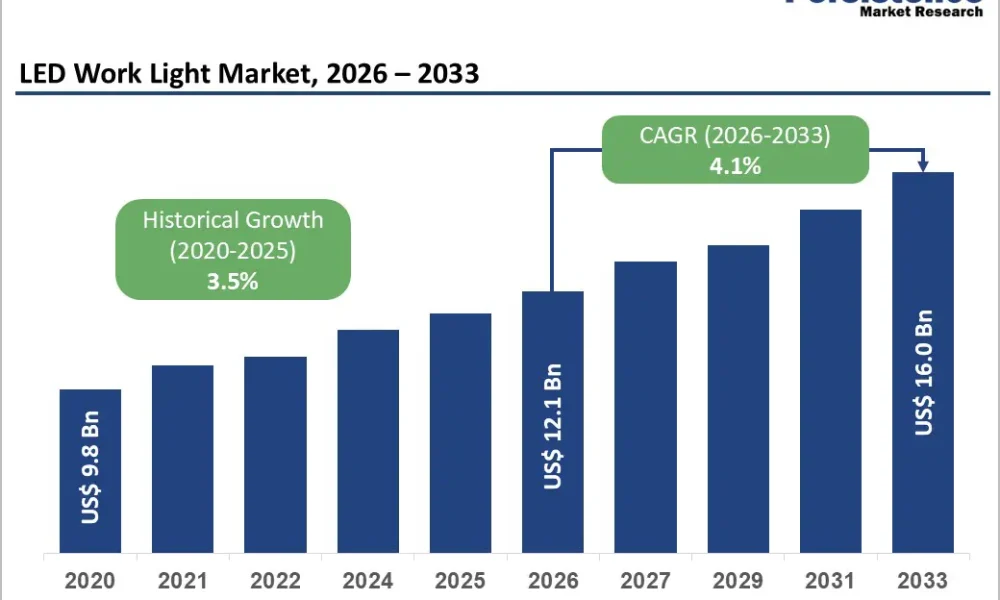
The global LED work light market is witnessing steady expansion as industries shift toward energy-efficient, portable, and high-performance lighting solutions. LED work lights are widely used across construction sites, manufacturing facilities, automotive repair shops, emergency services, and infrastructure projects. Their ability to deliver bright illumination, long operational life, and durability in harsh environments has made them an essential tool in modern workplaces.
According to recent market analysis, the LED work light market is projected to reach US$12.1 billion in 2026 and grow to US$16.0 billion by 2033, registering a CAGR of 4.1% between 2026 and 2033. This growth is supported by increasing emphasis on worker safety, the rapid adoption of cordless tools, and the rising demand for energy-efficient lighting solutions across industrial and commercial sectors.
LED technology offers numerous advantages over traditional lighting systems such as halogen and fluorescent lamps. These benefits include lower energy consumption, longer lifespan, higher lumen output, and reduced heat generation. As industries continue to modernize their infrastructure and adopt advanced technologies, LED work lights are increasingly becoming the preferred choice for both professional and industrial applications.
Furthermore, the integration of smart technologies, battery innovations, and rugged design features has expanded the functionality of LED work lights. Manufacturers are continuously developing new products with improved battery life, enhanced portability, and smart connectivity to meet evolving industry requirements.
LED Work Light Market Overview
The LED work light market has experienced consistent growth over the past decade due to increasing industrialization and infrastructure development worldwide. From construction sites and manufacturing plants to emergency response operations, reliable lighting plays a critical role in ensuring operational efficiency and safety.
LED work lights are designed to provide high-intensity illumination in environments where fixed lighting may not be available or sufficient. These lights are typically portable, durable, and capable of operating in extreme conditions, making them suitable for demanding applications such as mining, oil and gas exploration, and automotive repair.
In recent years, the market has been strongly influenced by the growing popularity of cordless power tools. Manufacturers have introduced LED work lights that are compatible with existing lithium-ion battery platforms, allowing users to power multiple tools using a single battery system.
This compatibility significantly reduces operational costs and improves convenience for professionals who rely on portable lighting in remote or off-grid locations. As a result, battery-powered LED work lights have become one of the fastest-growing segments in the market.
Key Drivers Fueling Market Growth
Expansion of Cordless Power Tool Ecosystems
One of the most significant drivers of the LED work light market is the expansion of cordless power tool ecosystems. Leading manufacturers such as Techtronic Industries and Stanley Black & Decker have developed proprietary battery platforms that support hundreds of tools, including work lights.
Brands like Milwaukee Tool and DeWalt offer interchangeable lithium-ion battery systems that power drills, saws, grinders, and lighting equipment. This interoperability allows contractors and technicians to purchase “bare tool” lighting products without needing additional batteries or chargers.
Advancements in battery technology have also improved runtime and performance. Modern LED work lights can operate for more than 10–12 hours on a single charge, making them ideal for long shifts at construction sites or industrial facilities.
The convenience, portability, and compatibility offered by cordless lighting systems continue to drive strong demand among professional users and DIY enthusiasts worldwide.
Increasing Focus on Workplace Safety
Worker safety has become a top priority across industries, particularly in construction, manufacturing, and energy sectors. Poor lighting conditions can lead to accidents such as slips, trips, and falls, which can result in injuries and operational delays.
LED work lights provide high-quality illumination with improved color rendering and uniform light distribution, significantly enhancing visibility in work environments. These features help reduce eye strain and improve overall productivity.
Regulatory agencies such as the Occupational Safety and Health Administration enforce strict workplace safety standards that require adequate lighting in hazardous environments. As companies strive to comply with these regulations, the demand for reliable and efficient work lighting solutions continues to increase.
In hazardous industries such as oil and gas, mining, and chemical processing, explosion-proof LED work lights are becoming essential equipment. These lights are designed to operate safely in environments where flammable gases or dust particles may be present.
Market Restraints
High Initial Costs of Industrial-Grade LED Work Lights
Despite their long-term benefits, the relatively high upfront cost of industrial-grade LED work lights remains a key challenge for market adoption. Advanced models equipped with rugged housing, thermal management systems, and high-capacity batteries often cost significantly more than traditional lighting alternatives.
Small and medium-sized enterprises (SMEs) and budget-constrained contractors may hesitate to invest in premium lighting equipment due to initial cost considerations. In developing regions, where price sensitivity is higher, this factor can slow the adoption of LED technology.
However, as production volumes increase and manufacturing processes improve, prices are gradually declining, making LED work lights more accessible to a broader range of users.
Supply Chain Vulnerabilities
The LED work light market relies heavily on global supply chains for electronic components such as LED chips, semiconductors, and lithium-ion batteries. Disruptions in these supply chains can affect production capacity and increase costs for manufacturers.
Many key components are produced in East Asian manufacturing hubs. Any geopolitical tensions, trade restrictions, or raw material shortages can lead to delays and price volatility.
These supply chain challenges may temporarily slow market growth, particularly during periods of global economic uncertainty.
Emerging Opportunities in the Market
Integration of Smart and IoT-Enabled Lighting
The integration of Internet of Things (IoT) technology into LED work lights is opening new opportunities for manufacturers. Smart lighting systems equipped with Bluetooth or Wi-Fi connectivity allow users to control brightness levels, monitor battery status, and schedule lighting operations through mobile applications.
For example, connected lighting systems developed by Milwaukee Tool enable asset tracking and remote management of lighting equipment on large job sites.
These smart features help improve efficiency, reduce equipment loss, and simplify maintenance for facility managers and contractors. As digital transformation continues to reshape industrial operations, smart LED work lights are expected to gain significant traction.
Rising Demand for Explosion-Proof Lighting
Specialized lighting solutions designed for hazardous environments represent another major opportunity in the LED work light market.
Industries such as underground mining, petrochemical processing, and offshore drilling require lighting equipment that can operate safely in explosive atmospheres. Manufacturers like Larson Electronics and Streamlight Inc. are developing rugged explosion-proof LED lights designed for extreme industrial environments.
As global energy exploration expands into deeper and more challenging locations, the demand for certified hazardous-location lighting is expected to grow steadily.
Elevate your business strategy with comprehensive market data. Request a sample report now: https://www.persistencemarketresearch.com/samples/13960
Segment Analysis
Industrial End-Use Segment
The industrial sector represents the largest application segment in the LED work light market, accounting for approximately 45% of total revenue by 2026. Industrial facilities require continuous illumination to support operations such as manufacturing, assembly, maintenance, and inspection.
LED work lights are widely used in automotive workshops, production lines, warehouses, and heavy machinery maintenance areas. Their durability and resistance to vibration and impact make them ideal for demanding industrial conditions.
With the adoption of smart factory concepts and Industry 4.0 technologies, industrial facilities are increasingly investing in reliable and energy-efficient lighting systems.
Battery-Operated Work Lights
Battery-powered LED work lights dominate the market with around 62% market share. The shift from corded to cordless lighting solutions reflects the growing need for mobility and flexibility in modern workplaces.
Lithium-ion battery technology has significantly improved the performance of portable lighting systems. High-capacity batteries allow work lights to deliver powerful illumination for extended periods without the need for electrical outlets.
These lights are especially useful for remote construction projects, emergency response operations, and outdoor activities where access to electricity may be limited.
Flashlight Product Segment
Flashlights represent one of the most widely used types of LED work lights. These compact lighting devices are used across multiple industries, including automotive repair, HVAC maintenance, law enforcement, and outdoor recreation.
Modern LED flashlights offer high lumen output, rechargeable batteries, waterproof construction, and advanced features such as adjustable beam focus. Their versatility and portability ensure continued demand in both professional and consumer markets.
Retail Distribution Channels
Retail outlets remain the dominant distribution channel for LED work lights, accounting for approximately 48% of global sales. Large retail chains and industrial supply stores provide customers with the opportunity to physically inspect lighting products before purchasing.
Major retailers such as The Home Depot and Lowe’s play a critical role in the distribution of LED work lights. In-store demonstrations, bundled offers, and immediate product availability contribute to strong retail sales.
While e-commerce platforms are growing rapidly, physical retail stores continue to dominate due to the hands-on nature of lighting equipment purchases.
Regional Market Insights
North America
North America currently holds the largest share of the global LED work light market, accounting for approximately 35% of total revenue in 2026. The region’s strong construction sector, strict workplace safety regulations, and high adoption of cordless tools contribute to its market leadership.
Professional contractors in the United States and Canada increasingly rely on durable, high-performance LED lighting equipment to improve productivity and safety on job sites.
Infrastructure modernization initiatives and smart city projects further support demand for portable lighting solutions.
Europe
Europe represents another significant market for LED work lights. Strict environmental regulations and energy efficiency directives have encouraged the transition from traditional lighting technologies to LED solutions.
Countries such as Germany, the United Kingdom, and France emphasize product quality, durability, and certified safety standards. European manufacturers are known for producing high-quality professional lighting equipment designed for demanding industrial applications.
The region is also witnessing growing interest in connected and smart lighting technologies.
Asia Pacific
Asia Pacific is expected to be the fastest-growing region in the LED work light market. Rapid industrialization, urbanization, and infrastructure development in countries such as China, India, and Southeast Asian nations are driving strong demand for portable lighting solutions.
Construction projects, mining operations, and automotive repair industries in these regions are increasingly adopting energy-efficient LED work lights due to their durability and cost savings.
China also plays a major role as a global manufacturing hub for LED components, enabling competitive pricing and widespread availability of lighting products.
Competitive Landscape
The LED work light market is moderately fragmented, with a mix of global power tool manufacturers and specialized lighting companies competing for market share.
Major companies focus on innovation, durability, and battery compatibility to differentiate their products. Many manufacturers are also developing integrated lighting ecosystems that work seamlessly with their existing power tool platforms.
Key companies operating in the market include:
- Milwaukee Tool
- DeWalt
- Makita Corporation
- Bosch Professional
- Snap-on Incorporated
- Ledlenser GmbH
- Streamlight Inc.
- Larson Electronics
Strategic product launches, partnerships, and technological advancements remain key strategies for maintaining competitiveness in this evolving market.
Conclusion
The global LED work light market is poised for steady growth as industries increasingly prioritize energy efficiency, workplace safety, and operational productivity. The transition from traditional lighting systems to advanced LED solutions is being driven by improvements in battery technology, durability, and lighting performance.
Cordless tool ecosystems, smart lighting integration, and increasing industrial automation will continue to shape the future of the market. Additionally, growing demand for explosion-proof lighting in hazardous environments presents lucrative opportunities for specialized manufacturers.
With strong demand from construction, manufacturing, and infrastructure sectors, the LED work light market is expected to maintain a stable growth trajectory through 2033. As technology continues to evolve, LED work lights will remain an essential component of modern industrial and professional work environments.
Related Reports:




