
The global cannabinoid biosynthesis market is witnessing robust expansion, driven by the growing demand for sustainable and high-purity cannabinoid products. This market focuses on producing cannabinoids such as CBD, THC, CBG, and CBN through microbial fermentation, yeast-based platforms, and advanced biotechnological methods, bypassing the limitations of traditional plant cultivation. Increasing awareness of eco-friendly production methods, coupled with rising legalization of medical cannabis in several countries, has created a favorable environment for biosynthesized cannabinoids. As consumers and pharmaceutical companies prioritize consistency, purity, and sustainability, cannabinoid biosynthesis has emerged as a critical solution, ensuring scalable production while reducing reliance on agricultural conditions.
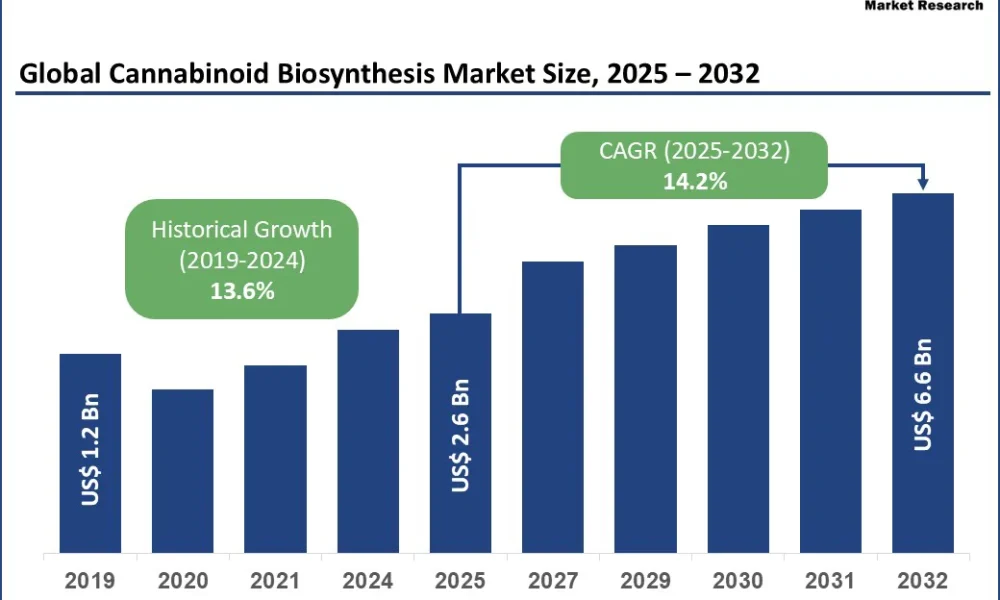
In terms of market statistics, the global cannabinoid biosynthesis market was valued at approximately US$2.6 billion in 2025 and is projected to reach US$6.6 billion by 2032, reflecting a compound annual growth rate (CAGR) of 14.2% over the forecast period. North America currently dominates the market with a 41% share, primarily driven by the U.S.’s advanced biotechnology infrastructure, high consumer awareness, and rapid adoption of innovative biosynthesis platforms. The leading product type in the market is phytocannabinoids, accounting for nearly 60% of market share, owing to their renewable and bio-identical characteristics that make them ideal for pharmaceutical applications. Pharmaceuticals lead in applications with a 50% market share, highlighting the critical need for consistent, high-quality cannabinoid production in medical formulations. The market’s growth is further fueled by global legalization trends, increased medical research initiatives, and rising investments in biotech innovation, which collectively reduce the dependence on traditional cultivation methods by up to 30% in certain sectors.
Key Highlights from the Report
• North America dominates the cannabinoid biosynthesis market with a 41% share in 2025.
• Asia Pacific is the fastest-growing region due to rising biotech investments and consumer demand.
• Phytocannabinoids are the dominant product type, capturing 60% of the global market.
• Pharmaceuticals lead the application segment with a 50% market share.
• Legalization trends and medical research initiatives are primary growth drivers.
• Sustainable biosynthesis methods reduce environmental impact and improve product consistency.
Market Segmentation
The cannabinoid biosynthesis market is segmented based on product type, source, and application. By product type, the market includes phytocannabinoids, synthetic cannabinoids, endocannabinoid system modulators, and other cannabinoids. Phytocannabinoids currently dominate the market due to their bio-identical properties and reliability in pharmaceutical formulations, while synthetic cannabinoids are the fastest-growing segment, offering higher purity and tailored functionalities for cosmetic, wellness, and industrial applications. Source-based segmentation includes cannabis sativa, cannabis indica, hemp-derived cannabinoids, and others. Hemp-derived cannabinoids lead the market, holding a 45% share, largely because of their versatility, sustainability, and broad commercial availability. Cannabis sativa is growing rapidly, driven by its application in functional and high-value formulations. Application-wise, the market covers pharmaceuticals, food and beverages, cosmetics and personal care, healthcare products, and aromatherapy and wellness. Pharmaceuticals remain the largest segment, reflecting strong demand for high-purity, consistent cannabinoids, while food and beverages are expanding rapidly due to growing consumer interest in wellness and eco-friendly products.
Regional Insights
North America is the leading market for cannabinoid biosynthesis, with the U.S. driving growth through progressive legalization, strong biotech infrastructure, and high consumer demand for sustainable cannabinoids. Companies such as Demetrix and Ginkgo Bioworks are leveraging biotechnology-integrated platforms to deliver consistent and pure cannabinoid products for pharmaceutical and industrial applications. Europe follows closely, with Germany, the U.K., and France as key contributors. Regulatory support, environmental sustainability initiatives, and rising demand for synthetic and functional cannabinoids are key factors driving growth in the region. Germany dominates with strong industrial applications, while the U.K. focuses on premium functional formulations, and France emphasizes healthcare-oriented products. Asia Pacific is the fastest-growing market, driven by countries like China, India, and Japan. Rising investments in biotech manufacturing, increasing middle-class demand for wellness products, and government initiatives supporting sustainable biotechnology are boosting adoption. Local players such as Zymergen Inc and Renew Biopharma are actively scaling production capabilities to meet both domestic and international demand, especially for premium and functional cannabinoid applications.
Market Drivers
The primary driver of the cannabinoid biosynthesis market is the increasing demand for sustainable and eco-friendly production methods. Traditional cannabis cultivation is resource-intensive, requiring significant water, land, and energy, whereas biosynthesized cannabinoids offer scalable, consistent, and contaminant-free alternatives. Advances in microbial fermentation, yeast-based synthesis, and genetic engineering allow manufacturers to produce high-purity cannabinoids efficiently, minimizing environmental impact and operational risks associated with traditional agriculture. Additionally, global legalization trends for medical cannabis have created a surge in demand, with biosynthesis providing cost-effective solutions that reduce dependency on unpredictable cultivation conditions. Rising awareness of clean-label and green wellness products further propels market growth, particularly in pharmaceuticals, functional foods, and personal care sectors, where quality and consistency are paramount.
Market Restraints
Despite its promising growth trajectory, the cannabinoid biosynthesis market faces significant restraints. High costs associated with biotechnology infrastructure, R&D for engineered microbial strains, and regulatory compliance create entry barriers, limiting participation to well-capitalized players. The regulatory landscape is complex, with agencies such as the FDA and EMA enforcing stringent approval processes, extending commercialization timelines and increasing operational costs. Intellectual property disputes over biosynthesis patents create legal uncertainty, while cultural resistance in regions with strict cannabis policies slows adoption. Additionally, public skepticism towards synthetic biology and engineered cannabinoids can hinder market penetration, particularly in emerging markets where awareness is still developing. These factors collectively constrain market expansion and adoption despite strong underlying demand.
Market Opportunities
Innovation in cannabinoid biosynthesis technologies presents substantial growth opportunities. Advanced metabolic engineering allows the production of rare cannabinoids such as CBG and CBN, which have high therapeutic and commercial value but are difficult to obtain through plant extraction. These rare cannabinoids have significant potential in anti-inflammatory, neuroprotective, and specialty pharmaceutical applications, as well as emerging niches such as pet wellness, functional foods, and sports nutrition. Strategic partnerships between biotech companies and pharmaceutical firms accelerate commercialization, regulatory approvals, and clinical research. Additionally, government grants and funding initiatives supporting sustainable biotechnology reduce production costs and improve scalability. The development of water-soluble and bioavailable cannabinoid variants further opens opportunities in premium wellness, beverage, and nutraceutical markets, creating long-term growth potential across diverse sectors.
Company Insights
• Demetrix
• Ginkgo Bioworks
• Hyasynth Biologicals
• Creo
• Amyris Inc
• Zymergen Inc
• Cronos Group Inc
• Constellation Brands Inc
• Jazz Pharmaceuticals PLC
• Canopy Growth Corp
• Evolva Holding SA
• Willow Biosciences Inc
• InMed Pharmaceuticals
• CB Therapeutics
• Lygos
• Purisys
• Renew Biopharma
Recent Developments:
In December 2024, Brains Bioceutical Corp expanded its cannabinoid API portfolio by introducing EU-GMP certified CBN and optimized crystalline THC, supporting clinical programs targeting neurological disorders and chronic pain. In May 2025, Benuvia Operations partnered with Trait Biosciences to accelerate commercialization of next-generation water-soluble cannabinoids, focusing on synthetic THC derivatives and broader cannabinoid variants.
Conclusion
The cannabinoid biosynthesis market is poised for significant expansion over the coming decade, driven by sustainable production methods, advances in biotechnology, and rising demand for high-purity, consistent cannabinoid products. Phytocannabinoids dominate the market, while synthetic cannabinoids and rare cannabinoids offer high-growth potential across pharmaceutical, wellness, and specialty applications. North America currently leads in market share, supported by a robust regulatory and technological ecosystem, while Asia Pacific is the fastest-growing region due to increasing investments and consumer adoption. Despite high costs, regulatory complexities, and public skepticism, opportunities in eco-friendly and functional cannabinoids, strategic partnerships, and government-backed initiatives position the market for long-term growth. Companies investing in innovative biosynthesis technologies, strategic collaborations, and scalable production solutions are likely to maintain a competitive advantage and capitalize on the growing global demand for sustainable cannabinoid products.




