

Utility Poles Market Overview
According to a new report published by Allied Market Research, the utility poles market was valued at $51.5 billion in 2022 and is projected to reach $67 billion by 2032, growing at a CAGR of 2.7% from 2023 to 2032. The expansion of global electricity infrastructure, rising demand for telecommunications services, and increasing investments in power distribution networks are key factors supporting the growth of the utility poles market worldwide.
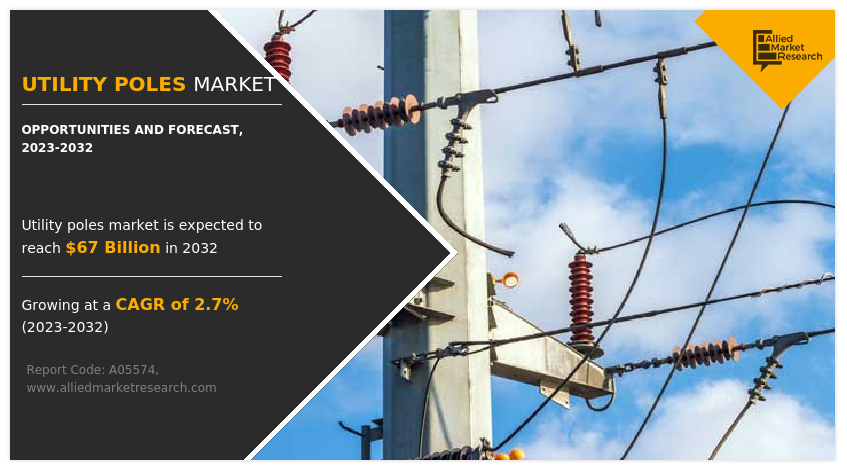
Utility poles, also known as electricity poles or power poles, are critical components of modern infrastructure. They are used to support overhead power lines, telecommunications cables, and cable television networks. These structures enable the efficient transmission and distribution of electricity and communication signals from power companies to residential, commercial, and industrial users.
The materials commonly used in the construction of utility poles include wood, concrete, steel, and composite materials. The lifespan and performance of these poles vary depending on the material used, environmental conditions, and application requirements.
Download PDF Brochure: https://www.alliedmarketresearch.com/request-sample/5939
Importance of Utility Poles in Modern Infrastructure
The utility poles market plays a crucial role in supporting energy transmission and telecommunication systems across the globe. With growing urbanization and increasing energy demand, the need for reliable electricity distribution networks has become more important than ever.
Utility poles serve as the backbone of overhead power distribution systems. They provide structural support for electrical cables and communication lines, ensuring uninterrupted energy supply and connectivity. As electricity consumption continues to grow due to industrial expansion, smart cities development, and digital infrastructure, the demand for durable and efficient utility poles is increasing significantly.
In addition to power distribution, utility poles are widely used in telecommunication networks. The rapid growth of broadband services, fiber optic networks, and mobile communication infrastructure has further strengthened the demand for utility poles globally.
Market Drivers: Rising Energy Demand and Telecom Expansion
One of the primary drivers of the utility poles market is the continuous increase in global electricity consumption. Countries around the world are expanding their power generation and transmission infrastructure to meet the energy requirements of growing populations and industrial sectors.
Power utilities require strong and reliable support structures for overhead transmission and distribution lines, making utility poles a vital component of electrical networks. As a result, governments and energy companies are investing heavily in grid expansion and modernization projects, which is positively impacting the utility poles market.
Another major factor contributing to market growth is the rapid expansion of the telecommunications sector. Increasing demand for high-speed internet, fiber-optic connectivity, and 5G networks requires extensive infrastructure deployment. Utility poles provide an efficient and cost-effective solution for supporting telecom cables and network equipment.
Moreover, the use of steel utility poles is gaining popularity due to their durability, recyclability, and environmental benefits. Steel is considered a sustainable material because it can be recycled multiple times without losing strength, making it an attractive option for modern infrastructure projects.
Market Challenges: Shift Toward Underground Cabling
Despite steady growth, the utility poles market faces certain challenges that may impact its expansion. One of the key challenges is the increasing adoption of underground cable networks.
In many urban areas, governments and city planners prefer underground cabling systems for aesthetic reasons and improved safety. Underground cables reduce visual clutter, protect electrical infrastructure from severe weather conditions, and improve the overall appearance of urban landscapes.
As a result, the shift toward underground power distribution systems can reduce the demand for traditional overhead infrastructure, including utility poles.
Environmental concerns also pose challenges for the industry. The use of wooden poles, which has historically dominated the market, raises concerns related to deforestation and sustainability. Regulations aimed at protecting forests and promoting sustainable resource management may limit the use of wood-based poles in certain regions.
Emerging Opportunities: Composite Utility Poles
Technological advancements and material innovation are creating new opportunities for the utility poles market. The growing adoption of composite materials in utility pole manufacturing is expected to transform the industry.
Composite utility poles offer several advantages compared to traditional wooden or steel poles. They are lightweight, corrosion-resistant, environmentally friendly, and have a longer operational lifespan. These characteristics make them ideal for applications in harsh weather conditions and coastal environments.
Additionally, composite poles require less maintenance and are resistant to insects, rot, and moisture, which enhances their durability and reliability. As utility companies increasingly focus on long-term infrastructure efficiency, the demand for composite utility poles is expected to rise significantly.
Market Segmentation
The utility poles market is segmented based on type, material, pole size, application, and region.
By Type
Based on type, the market is divided into transmission poles and distribution poles.
The distribution pole segment dominated the market in 2022, accounting for more than three-fifths of the global share. Distribution poles are widely used to deliver electricity from substations to homes, businesses, and industrial facilities.
Meanwhile, the transmission pole segment is expected to witness the fastest growth during the forecast period due to the increasing need for safe and efficient long-distance electricity transmission.
By Material
Based on material, the market includes wood, steel, concrete, and composites.
Wooden poles accounted for nearly half of the market share in 2022 due to their cost-effectiveness and widespread use in power distribution systems. However, the concrete pole segment is projected to grow at the fastest rate during the forecast period due to its durability and longer service life.
By Pole Size
Depending on pole size, the market is categorized into below 40 ft, 40–70 ft, and above 70 ft.
The below 40 ft segment is expected to grow at the fastest rate, driven by its widespread use in distribution networks and urban infrastructure projects.
By Application
Based on application, the market is categorized into electric transmission and distribution, telecommunications, street lighting, heavy power lines, sub-transmission lines, and others.
The electric transmission and distribution segment accounted for more than two-thirds of the market revenue in 2022, making it the largest application segment in the utility poles market.
Regional Insights
Region-wise, the utility poles market is analyzed across North America, Europe, Asia-Pacific, and LAMEA.
The Asia-Pacific region dominated the global market in 2022, accounting for nearly two-fifths of total revenue. Rapid urbanization, increasing electricity demand, and large-scale investments in power infrastructure are key factors supporting market growth in the region.
Countries such as China, India, Japan, and South Korea are investing heavily in expanding electricity transmission networks and telecommunication infrastructure. These developments are expected to create significant growth opportunities for the utility poles market in Asia-Pacific.
North America also holds a substantial market share due to continuous upgrades of aging power infrastructure and strong investments in grid modernization.
Get a Customized Research Report: https://www.alliedmarketresearch.com/request-for-customization/5939
Competitive Landscape
The utility poles market is highly competitive, with several global and regional players focusing on product innovation and infrastructure solutions.
Major companies operating in the market include Stella-Jones Inc., El Sewedy Electric Company, Fuchs Europoles GmbH, RS Technologies Inc., Omega Factory, Nippon Concrete Industries Co., Ltd., Hill & Smith Holdings Plc, Valmont Industries Inc., Skipper Ltd., and Pelco Products Inc.
These companies are focusing on advanced materials, sustainable designs, and innovative manufacturing technologies to enhance the durability and performance of utility poles.
Future Outlook
The utility poles market is expected to experience steady growth over the next decade, supported by expanding energy infrastructure, increasing telecom connectivity, and the transition toward advanced materials. As global electricity demand continues to rise and communication networks expand, utility poles will remain an essential part of modern infrastructure systems.
Technological innovation, sustainable material adoption, and increasing investments in grid modernization are likely to shape the future of the utility poles market worldwide.
Other Trending Reports:-
About Us
Allied Market Research (AMR) is a full-service market research and business-consulting wing of Allied Analytics LLP based in Portland, Oregon. Allied Market Research provides global enterprises as well as medium and small businesses with unmatched quality of “Market Research Reports” and “Business Intelligence Solutions.” AMR has a targeted view to provide business insights and consulting to assist its clients to make strategic business decisions and achieve sustainable growth in their respective market domain.
Pawan Kumar, the CEO of Allied Market Research, is leading the organization toward providing high-quality data and insights. We are in professional corporate relations with various companies and this helps us in digging out market data that helps us generate accurate research data tables and confirms utmost accuracy in our market forecasting. Each and every data presented in the reports published by us is extracted through primary interviews with top officials from leading companies of domain concerned. Our secondary data procurement methodology includes deep online and offline research and discussion with knowledgeable professionals and analysts in the industry.




