
Introduction
Decorative exterior materials play a crucial role in modern construction by enhancing the aesthetic appeal, durability, and performance of building exteriors. These materials include cladding systems, siding, decorative stones, fiber cement boards, metal panels, exterior coatings, and architectural facades used in residential, commercial, and infrastructure projects.
In recent years, architects and developers have increasingly focused on creating visually appealing buildings that also deliver high performance in terms of weather resistance, insulation, and sustainability. Decorative exterior materials help achieve these goals by combining design flexibility with structural protection. As urbanization accelerates and renovation activities increase globally, demand for such materials is rising steadily across both developed and emerging economies.
Market Size and Forecast
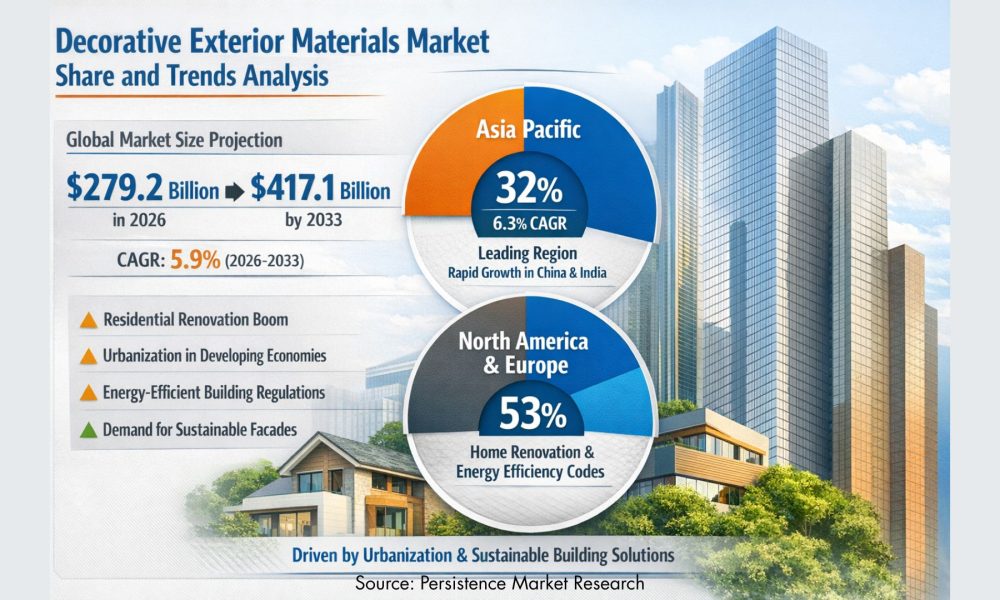
The global decorative exterior materials market is projected to grow significantly over the next decade. The market is expected to reach US$ 279.2 billion by 2026 and expand further to around US$ 417.1 billion by 2033, registering a compound annual growth rate (CAGR) of approximately 5.9% between 2026 and 2033.
This steady growth reflects increasing construction activities worldwide, particularly in residential and commercial sectors, along with rising investments in renovation and refurbishment projects. Additionally, stricter building codes and growing awareness of sustainable construction practices are encouraging the adoption of energy-efficient building envelopes and advanced facade systems.
Key Drivers of the Decorative Exterior Materials Market
Rising Residential Renovation and Remodeling
One of the major factors driving the decorative exterior materials market is the surge in residential renovation and remodeling activities. Many developed countries have aging housing infrastructure, prompting homeowners to upgrade exterior facades, roofing, and siding materials to improve property value and energy efficiency.
The global renovation market is expanding steadily as homeowners invest in modernizing buildings, improving insulation, and enhancing exterior aesthetics. This trend is particularly strong in North America and Europe, where renovation cycles are well established and supported by government incentives for energy-efficient housing upgrades.
Rapid Urbanization and Infrastructure Development
Rapid urbanization in developing economies is another major growth driver for decorative exterior materials. Countries such as China, India, and several Southeast Asian nations are witnessing large-scale residential construction, commercial development, and infrastructure expansion.
As cities grow, developers increasingly prioritize architectural design and building appearance to attract buyers and tenants. Decorative exterior materials help achieve modern urban aesthetics while also providing durability and environmental protection for buildings.
Increasing Demand for Energy-Efficient Buildings
Energy efficiency has become a critical requirement in modern construction. Governments worldwide are implementing strict building regulations aimed at reducing energy consumption and improving thermal performance in buildings.
Exterior insulation and finishing systems (EIFS), advanced cladding systems, and insulated facade materials are gaining popularity because they enhance the building envelope and minimize heat loss. These materials help reduce energy costs and support green building certifications, making them highly attractive to developers and architects.
Market Segmentation
The decorative exterior materials market can be segmented based on material type, application, and construction type.
By Material Type
Key materials used in decorative exterior applications include:
- Stone and stone veneers
- Metal panels and cladding
- Wood and wood composites
- Fiber cement boards
- Vinyl and engineered materials
Among these, stone and stone veneer materials dominate the market, accounting for around 23.5% share due to their durability, premium appearance, and minimal maintenance requirements.
Fiber cement boards are expected to be the fastest-growing material category, expanding at about 6.8% CAGR because of their fire resistance, moisture resistance, and cost-effectiveness in both residential and commercial construction.
By Application
Decorative exterior materials are used across several applications, including:
- Exterior wall cladding and facades
- Roofing and exterior coverings
- Decking and outdoor flooring
Among these segments, exterior wall cladding and facades dominate the market, accounting for approximately 46% of global demand. Facade materials serve both aesthetic and functional roles by protecting buildings from weather damage while enhancing architectural design.
By Construction Type
The market can also be categorized based on construction activity:
- New construction
- Renovation and remodeling
New construction projects account for the largest share of demand, representing over 62% of the market. However, renovation and remodeling projects are growing rapidly as property owners upgrade existing buildings with modern exterior designs and energy-efficient materials.
Regional Insights
Asia Pacific
Asia Pacific is the largest regional market, holding approximately 32% of the global share and expected to grow at a 6.3% CAGR. The region’s dominance is driven by rapid urbanization, large-scale residential construction, and rising middle-class spending on housing improvements.
Countries such as China and India are leading contributors to market growth, supported by government housing programs, infrastructure investments, and expanding urban populations.
North America
North America represents about 27% of the global market, supported by a mature construction industry and strong renovation demand. Many homes in the region are over 30 years old, which creates a steady need for exterior upgrades such as new cladding systems, insulation, and decorative facades.
Additionally, strict building codes and energy-efficiency regulations encourage the adoption of advanced exterior materials with improved thermal performance.
Europe
Europe accounts for roughly 26% of the global decorative exterior materials market. The region’s growth is largely driven by sustainability initiatives and stringent environmental regulations aimed at reducing carbon emissions in buildings.
Countries such as Germany, France, and the United Kingdom are investing heavily in energy-efficient building renovation programs, which increase the demand for insulated facade systems and high-performance exterior materials.
Competitive Landscape
The decorative exterior materials market is moderately fragmented, with several global and regional companies competing through innovation, product design, and strategic expansion.
Key companies operating in the market include:
- Owens Corning
- Saint-Gobain
- Kingspan Group
- James Hardie Industries
- Rockwool International
- Knauf Group
- Boral Limited
- Nichiha Corporation
These companies focus on developing sustainable materials, expanding manufacturing capacity, and offering integrated building envelope solutions that combine insulation, cladding, and facade technologies.
Emerging Trends and Opportunities
Several emerging trends are shaping the future of the decorative exterior materials market:
Sustainable material innovation: Manufacturers are developing products made from recycled materials and low-carbon manufacturing processes.
Thin stone veneer technology: Lightweight stone veneers reduce transportation emissions and installation complexity while maintaining aesthetic appeal.
Prefabricated facade systems: Modular facade components reduce construction time and improve installation efficiency.
Smart building integration: Advanced facade systems now incorporate insulation, weatherproofing, and energy-efficient technologies to support smart building design.
Conclusion
The decorative exterior materials market is experiencing steady global growth as demand increases for aesthetically appealing, durable, and energy-efficient building solutions. With a projected value of over US$ 417 billion by 2033, the industry will continue to benefit from expanding urbanization, rising renovation activities, and stricter sustainability regulations.
Asia Pacific is expected to remain the dominant region due to rapid construction activity and urban development, while North America and Europe will maintain strong demand driven by renovation cycles and environmental regulations.
As architects and developers increasingly prioritize sustainability, design innovation, and building performance, decorative exterior materials will remain a vital component of modern construction and urban infrastructure development.
About Persistence Market Research:
Persistence Market Research delivers strategic research solutions that drive business growth. Founded in 2012 and registered in England and Wales in 2023 as Persistence Research & Consultancy Services Ltd., we have completed 3,600+ custom and syndicated studies and supported 2,700+ projects for leading research firms. Combining traditional methodologies with modern tools, we provide actionable insights to multinational corporations, consultants, investors, and government bodies, earning strong trust through long-term client relationships.
Contact Us:
Persistence Market Research
Second Floor, 150 Fleet Street,
London, EC4A 2DQ, United Kingdom
USA Phone: +1 646-878-6329
UK Phone: +44 203-837-5656
Email: [email protected]
Web: https://www.persistencemarketresearch.com




