
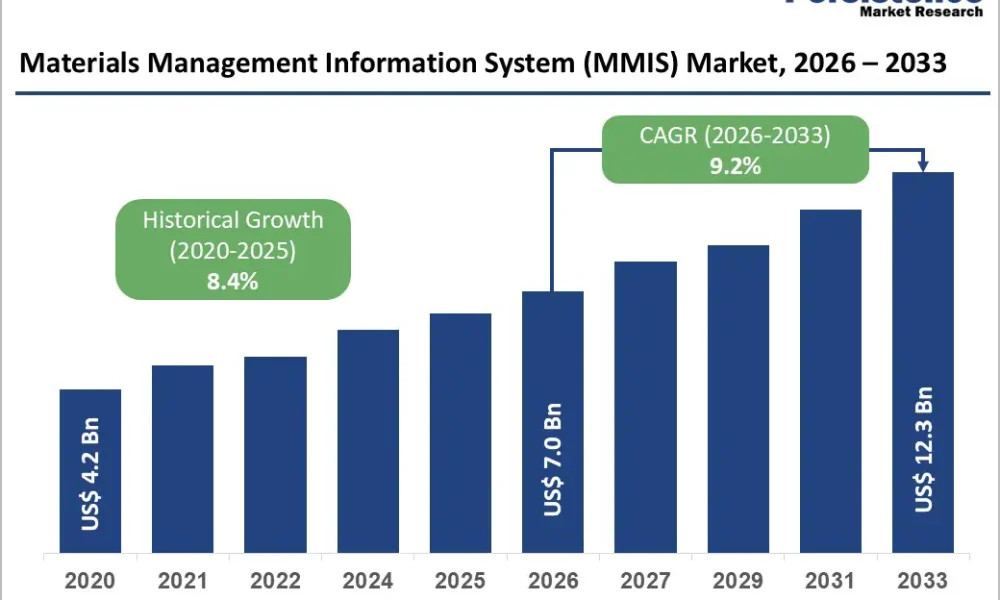
The global Materials Management Information System (MMIS) market is projected to reach US$ 7.0 billion in 2026 and expand to US$ 12.3 billion by 2033, registering a CAGR of 9.2% during the forecast period. This growth trajectory reflects accelerated digital transformation across supply chains, as organizations prioritize real-time visibility, automation, and data-driven decision-making.
Integration of AI, IoT sensors, and cloud computing is redefining materials management capabilities, particularly in manufacturing, healthcare, and logistics sectors seeking cost efficiency, waste reduction, and operational resilience.
Key Industry Highlights
- Market Size (2026E): US$ 7.0 Bn
- Market Forecast (2033F): US$ 12.3 Bn
- CAGR (2026–2033): 9.2%
- Historical CAGR (2020–2025): 8.4%
Regional Leadership
- Dominant Region (2026): North America (~35% share)
- Fastest-Growing Region: Asia Pacific
End-User Leadership
- Leading End-User (2026): Manufacturing (~45% share)
- Fastest-Growing End-User: Healthcare
Notable Developments
- The Government of Nigeria launched the Nigeria Raw Materials Management Information System (RMMIS) to enable national-level raw material visibility.
- In September 2025, Oracle Corporation enhanced its AI-powered Fusion Cloud SCM applications, introducing advanced healthcare inventory automation.
Elevate your business strategy with comprehensive market data. Request a sample report now: https://www.persistencemarketresearch.com/samples/24862
Market Dynamics
- Growth Drivers
Supply Chain Visibility & Risk Mitigation
Organizations are adopting MMIS platforms to:
- Enable real-time inventory tracking
- Monitor supplier performance
- Improve sourcing and procurement decisions
- Strengthen compliance with traceability regulations
Unified enterprise integration enhances resilience amid geopolitical instability and supply chain disruptions.
AI & Predictive Analytics Integration
AI and ML are transforming MMIS through:
- Automated replenishment
- Predictive demand forecasting
- Predictive maintenance workflows
- Reduced stockouts and carrying costs
Vendors embedding AI-driven optimization tools gain competitive advantage.
- Market Barriers
Cybersecurity & Data Privacy
MMIS platforms manage sensitive operational data. Adoption barriers include:
- Cloud security concerns
- Regulatory compliance (data localization & privacy)
- Sector-specific mandates (healthcare, financial services, government)
Organizations demand:
- End-to-end encryption
- Identity and access management
- Continuous monitoring
- Detailed audit trails
Category-Wise Analysis
Component Insights
Software (≈70% Revenue Share in 2026)
- Integrated procurement, inventory, logistics modules
- Advanced analytics dashboards
- API-based enterprise integration
- SaaS subscription flexibility
Services (Fastest-Growing Segment)
- Consulting & implementation
- Cloud migration support
- System integration
- Managed services for monitoring & optimization
End-User Insights
Manufacturing (≈45% Share in 2026)
- Just-in-time inventory synchronization
- Bill of materials (BOM) management
- Integration with ERP & execution systems
- Industry 4.0 alignment with IoT sensors
Healthcare (Fastest-Growing Segment)
- Expiration & recall tracking
- Real-time supply replenishment
- Compliance & audit support
- Integration with EHR systems
Pandemic-era disruptions accelerated digital adoption in hospital supply chains.
Deployment Insights
Cloud-Based (≈52% Share in 2026)
- Lower upfront costs
- Subscription pricing
- Remote accessibility
- Automatic updates
On-Premise (Fastest Growth 2026–2033)
Preferred in:
- Government
- Financial services
- Defense
Due to stringent data control requirements.
Regional Outlook
North America (~35% Share in 2026)
The U.S. leads due to:
- Advanced IT infrastructure
- High enterprise software spending
- Strong healthcare & manufacturing ecosystems
Major enterprise vendors operate here, including:
- SAP SE
- Oracle Corporation
- Microsoft Corporation
- IBM
Investment focus areas:
- AI-enabled analytics
- IoT-based monitoring
- Blockchain traceability
Europe (~25% Share in 2026)
Key markets:
- Germany
- United Kingdom
- France
- Spain
Growth drivers:
- Industry 4.0 adoption
- EU sustainability directives
- Circular economy compliance
- Automotive & industrial manufacturing demand
Strong presence of European software vendors such as SAP SE.
Asia Pacific (Fastest Growing Region)
Growth fueled by:
- Industrialization in China, India, ASEAN
- E-commerce expansion
- Smart factory initiatives in Japan
- Government-led digital transformation programs
- Data localization mandates shaping cloud strategy
Cloud deployments dominate emerging markets due to affordability and scalability.
Competitive Landscape
The MMIS market is moderately concentrated. Leading players collectively control ~40–45% of global revenue:
- SAP SE
- Oracle Corporation
- Microsoft Corporation
- IBM
- Zoho Corporation
Competitive Strategies
- AI integration & advanced analytics
- SaaS-first product models
- API-driven ecosystems
- Mergers & acquisitions
- Vertical specialization
Cloud-native challengers compete on:
- Faster deployment
- Workflow configurability
- Mobile-first interfaces
- Open integrations
Key Industry Developments
- October 2025: Mercedes-Benz India partnered with Zoho Corporation to launch SKYLine DMS.
- June 2025: Precisely introduced AI-driven master data automation for SAP ERP environments.
- June 2025: Oklahoma State University enhanced OK-EFRA ArcGIS hazardous materials tracking.
Strategic Outlook (2026–2033)
The MMIS market is entering a phase of intelligent optimization, moving beyond digitization toward predictive, autonomous materials ecosystems.
Strategic Themes to Watch:
- AI-native MMIS platforms
- Industry-specific cloud suites
- Regulatory-driven traceability solutions
- Integrated ESG reporting capabilities
- Expansion in emerging Asia-Pacific markets
Organizations that prioritize secure, AI-embedded, interoperable systems will capture the greatest operational and competitive advantages in increasingly complex global supply chains.
Related Reports:




