
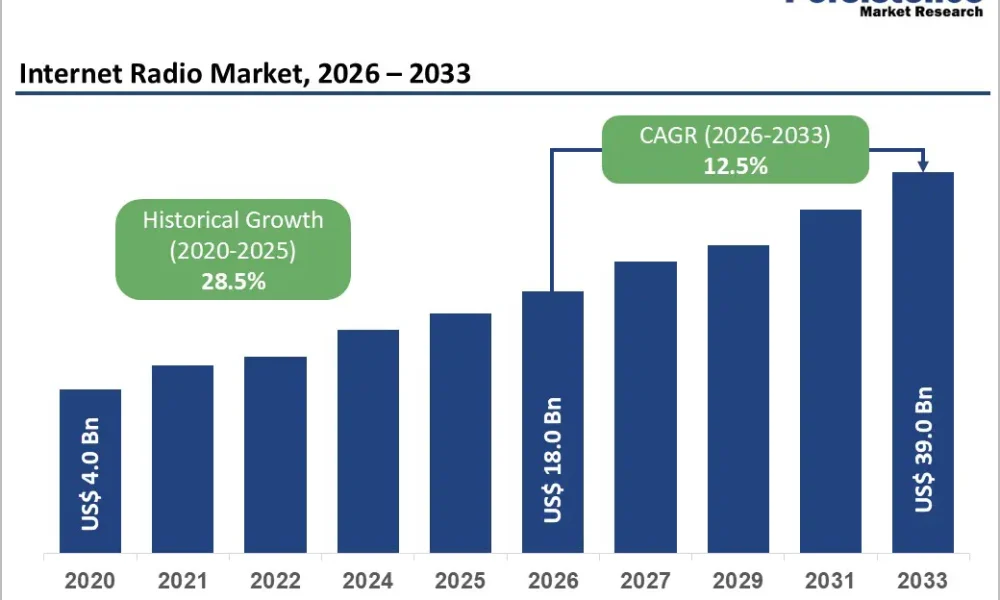
The global internet radio market is poised for strong expansion, with its valuation projected to rise from US$ 18.0 billion in 2026 to US$ 39.0 billion by 2033, registering a CAGR of 12.5% during the forecast period. This follows an exceptional historical CAGR of 28.5% between 2020 and 2025, driven by digital acceleration during pandemic-era consumption shifts.
The market’s next phase of growth is being shaped by rising smartphone penetration, widespread 5G deployment, and evolving consumer preferences toward personalized and on-demand audio experiences. Artificial intelligence-driven content discovery, podcast expansion, smart speaker integration, and connected vehicle adoption are transforming internet radio from a passive listening medium into a highly interactive digital ecosystem.
Market Overview
Internet radio has evolved from simple web-streamed stations into a dynamic, AI-powered audio platform integrating music, podcasts, live talk shows, and user-generated content. The convergence of:
- Advanced recommendation engines
- Cloud-based streaming infrastructure
- Voice-enabled interfaces
- Programmatic advertising
- Cross-device compatibility
has significantly deepened engagement and monetization opportunities.
Market Drivers
AI-Powered Personalization Transforming Engagement
Technological innovation in artificial intelligence (AI) and machine learning (ML) has reshaped how listeners discover content. Modern platforms analyze:
- Listening patterns
- Skip behavior
- Genre preferences
- Time-of-day habits
- Device usage
to curate dynamic stations and predictive playlists.
In June 2025, LG introduced “Radio Optimism,” an AI-powered digital radio concept that allows users to generate personalized music experiences based on moods and narratives—showcasing how AI is narrowing the gap between traditional radio and fully on-demand streaming.
Platforms like Spotify Technology S.A. and Apple Inc. have embedded AI DJs, smart playlists, and contextual recommendation engines to increase user retention and listening duration.
These innovations have led to:
- Higher daily active users
- Improved subscription conversion rates
- Increased ad engagement
- Stronger brand loyalty
Voice-Activated Smart Ecosystems
The widespread adoption of smart speakers has removed friction from accessing internet radio. Consumers can launch stations via simple voice commands through devices integrated with:
- Smart home systems
- Connected TVs
- In-car infotainment systems
Companies such as Amazon.com, Inc. and Alphabet Inc. have expanded audio integration across their ecosystems, reinforcing cross-platform stickiness.
Voice activation enhances daily use cases including:
- Morning routines
- Work-from-home environments
- Exercise sessions
- In-car commuting
Market Challenges
Copyright Licensing and Rising Royalty Costs
The internet radio industry faces persistent regulatory and financial pressure from:
- Complex global copyright frameworks
- Escalating digital streaming royalty rates
- Multi-territory licensing negotiations
Smaller platforms struggle with:
- High upfront licensing costs
- Administrative complexity
- Legal compliance burdens
Larger incumbents like Tencent Music Entertainment and YouTube Music benefit from scale, allowing them to negotiate favorable global licensing agreements.
These dynamics are contributing to gradual market consolidation.
Growth Opportunities
Emerging Markets Expansion
Asia Pacific, Latin America, and Africa present substantial untapped potential due to:
- Rapid smartphone adoption
- Falling data costs
- Expanding middle-class populations
- Mobile-first consumption behavior
In India, platforms such as JioSaavn and Gaana are leveraging vernacular content and regional partnerships to drive adoption.
Localized pricing models and carrier billing integration are enabling deeper penetration across lower-income demographics.
Podcast Boom
Podcasts are the fastest-growing segment through 2033. Increased celebrity involvement, serialized storytelling, and exclusive licensing agreements are enhancing platform differentiation.
Major players including SiriusXM Holdings Inc. and iHeartMedia, Inc. are expanding podcast networks and monetization strategies.
Podcast advantages include:
- Higher engagement rates
- Better audience segmentation
- Stronger advertiser ROI
- Lower production costs
Category-wise Analysis
Component Insights
Software – Market Leader (62% Share)
Software dominates the market due to:
- Content delivery networks (CDNs)
- AI-driven recommendation systems
- Backend analytics and dashboards
- Programmatic advertising engines
- User interface innovation
Cloud-native architectures and SaaS models have reduced entry barriers while accelerating product feature upgrades.
Services – Fastest Growing Segment
Service growth is driven by:
- Copyright management
- Localization
- Compliance consulting
- White-label deployments
- Technical integration
Traditional broadcasters are increasingly partnering with streaming platforms like TuneIn, Inc. to extend digital reach.
Elevate your business strategy with comprehensive market data. Request a sample report now: https://www.persistencemarketresearch.com/samples/21331
Content Type Insights
Music Streaming – Dominant Segment (68%)
Music remains the backbone of internet radio due to:
- Cross-demographic appeal
- Passive listening suitability
- Mature licensing frameworks
- Social playlist sharing
Platforms such as Deezer S.A. and Pandora Media, LLC continue enhancing curated playlists and lossless audio features.
Podcasts – Fastest Growing Content Category
Growth is fueled by:
- High-quality original programming
- Exclusive content deals
- Enhanced in-app discovery tools
- True crime, business, health, and comedy verticals
Long-tail catalogs enable sustainable audience growth.
End-User Insights
Residential – 74% Market Share
Residential users access internet radio through:
- Smartphones
- Tablets
- Smart speakers
- Connected TVs
Use cases include relaxation, productivity, cooking, workouts, and sleep soundscapes.
Younger demographics demonstrate stronger podcast and social discovery engagement.
Commercial – Fastest Growing Segment
Commercial users include:
- Retail chains
- Restaurants
- Hotels
- Fitness centers
- Corporate offices
- Automotive manufacturers
Commercial streaming integrates with CRM systems and POS analytics to optimize customer engagement.
Regional Analysis
North America – Dominant Region (42%)
North America leads the market due to:
- Advanced broadband infrastructure
- Mature programmatic advertising ecosystem
- High smartphone penetration
- Strong connected vehicle integration
The United States remains the core revenue generator, supported by major platforms like Apple Inc. and Amazon.com, Inc..
Investment continues in:
- AI-based discovery
- Spatial audio
- In-car streaming platforms
Europe – Strong Institutional Ecosystem
Europe benefits from:
- Digital Single Market policies
- Strong public broadcasting traditions
- GDPR-driven consumer trust
The United Kingdom and Germany are key growth hubs, supported by high podcast penetration and connected car adoption.
Asia Pacific – Fastest Growing Market
Asia Pacific is expected to register the highest CAGR through 2033.
Key growth factors:
- 4G and 5G expansion
- Low-cost smartphones
- Mobile-first consumers
- Super-app ecosystems
China, India, and Southeast Asia are leading adoption, with localized platforms integrating mobile wallets and telecom bundling strategies.
Competitive Landscape
The internet radio market remains moderately consolidated, with leading players capturing approximately 58% of global market share.
Major companies include:
- Spotify Technology S.A.
- Apple Inc.
- Amazon.com, Inc.
- Alphabet Inc.
- Tencent Music Entertainment
- SiriusXM Holdings Inc.
- iHeartMedia, Inc.
- NetEase Cloud Music
- Anghami
- Audiomack
Strategic Focus Areas
- AI-driven contextual listening
- Exclusive podcast partnerships
- Cross-device ecosystem integration
- Advanced advertising analytics
- Spatial and immersive audio
Key Industry Developments
- September 2025: YouTube Music began testing AI “hosts” under YouTube Labs to enhance radio-style mixes.
- August 2025: Apple Inc. partnered with TuneIn, Inc. to expand live radio distribution beyond Apple’s ecosystem.
- June 2025: Tencent Music Entertainment agreed to acquire Ximalaya for US$ 2.4 billion, strengthening its position in China’s digital audio market.
Future Outlook: The Evolution Toward Immersive, AI-Driven Audio
The internet radio industry is transitioning toward:
- Hyper-personalized AI DJs
- Immersive spatial audio
- Social listening experiences
- Smart vehicle integration
- Data-driven advertising optimization
As the market approaches US$ 39.0 billion by 2033, platforms that successfully combine AI intelligence, localized content strategies, regulatory compliance, and ecosystem integration will capture long-term value.
Internet radio is no longer merely a streaming channel—it is becoming a fully integrated digital audio ecosystem at the center of modern entertainment consumption.
Related Reports:




