
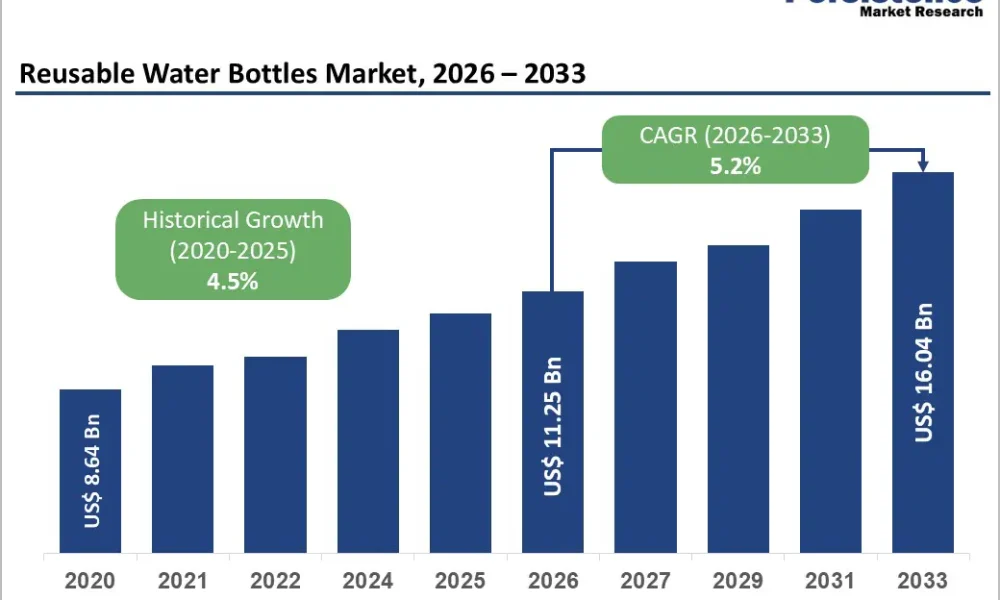
The global Reusable Water Bottles market is gaining strong momentum as sustainability trends reshape consumer purchasing behavior. According to Persistence Market Research, the global reusable water bottles market size is valued at US$ 11.2 Bn in 2026 and is projected to reach US$ 16.0 Bn by 2033, expanding at a CAGR of 5.2% between 2026 and 2033. Growing environmental awareness, increasing restrictions on single-use plastics, and rising hydration consciousness are collectively driving demand for eco-friendly water bottles across residential and commercial sectors.
Market statistics indicate consistent adoption across fitness enthusiasts, corporate offices, educational institutions, and outdoor travelers. Stainless steel reusable bottles and BPA-free plastic bottles remain popular due to durability and safety benefits. The leading segment is insulated reusable water bottles, driven by temperature retention features and lifestyle appeal. Regionally, North America leads the market due to strong environmental regulations and consumer inclination toward sustainable products, while Asia Pacific demonstrates expanding consumption due to urbanization and lifestyle shifts.
Download Your Free Sample & Explore Key Insights : https://www.persistencemarketresearch.com/samples/32462
Key Highlights from the Report
➤ The reusable water bottles market is projected to grow from US$ 11.2 Bn in 2026 to US$ 16.0 Bn by 2033.
➤ The market is expected to register a CAGR of 5.2% during 2026–2033.
➤ Rising environmental concerns and plastic waste reduction initiatives are accelerating adoption.
➤ Insulated and stainless-steel reusable bottles dominate product demand globally.
➤ Corporate sustainability programs are supporting bulk purchases of reusable bottles.
➤ North America remains the leading regional market due to strong eco-conscious consumer behavior.
Market Segmentation
The reusable water bottles market can be segmented based on product type, including plastic, stainless steel, glass, and silicone bottles. Stainless steel bottles represent a significant share owing to their durability, insulation performance, and premium appeal. BPA-free plastic bottles continue to attract price-sensitive consumers and institutional buyers. Glass bottles cater to health-conscious users seeking toxin-free hydration solutions, while silicone variants are preferred for flexibility and portability. Insulated bottles have emerged as the fastest-growing category due to their ability to maintain beverage temperature for extended hours.
From an end-user perspective, the market is categorized into residential and commercial segments. Residential users dominate sales as households shift away from disposable bottles toward sustainable hydration solutions. The commercial segment includes corporate offices, educational institutions, sports centers, and hospitality facilities adopting branded reusable water bottles as part of sustainability commitments. Online retail channels and direct-to-consumer platforms are also reshaping distribution strategies, enabling brands to reach wider audiences and promote customized eco-friendly water bottles.
Get Personalized Data – Request Customization Today : https://www.persistencemarketresearch.com/request-customization/32462
Regional Insights
North America leads the reusable water bottles market, supported by environmental regulations targeting plastic waste reduction and strong consumer awareness. The region’s active lifestyle culture encourages widespread adoption of insulated and stainless steel bottles. Corporate sustainability initiatives and school-based environmental campaigns further stimulate demand. Retail innovation and brand loyalty also strengthen market presence across the United States and Canada.
Asia Pacific is witnessing notable growth driven by rapid urbanization, rising disposable income, and growing environmental activism. Expanding middle-class populations and increased participation in fitness activities are contributing to higher adoption of reusable hydration products. Government initiatives promoting waste reduction are influencing consumer preferences toward sustainable alternatives. Urban centers are becoming key demand hubs for premium and designer reusable bottles.
Market Drivers
The primary driver of the reusable water bottles market is rising global awareness of environmental sustainability. Consumers increasingly recognize the environmental damage caused by single-use plastic bottles and are actively seeking alternatives. Government policies restricting plastic waste have reinforced behavioral shifts. Social media campaigns and environmental advocacy groups continue to promote sustainable lifestyle choices. Corporate environmental, social, and governance (ESG) commitments are further accelerating institutional adoption of reusable bottles.
Another important driver is the growth of health and wellness trends worldwide. Consumers are focusing on hydration as a critical component of fitness and preventive healthcare. Reusable water bottles with ergonomic designs and advanced insulation appeal to gym-goers, travelers, and office workers. Product innovation, including leak-proof lids and smart hydration tracking features, enhances convenience. Branding and personalization options also strengthen consumer engagement and repeat purchases.
Market Restraints
Despite positive growth trends, price sensitivity remains a restraint in emerging markets. Premium insulated bottles often carry higher price points compared to disposable plastic alternatives. Cost-conscious consumers may hesitate to invest in durable bottles without strong awareness campaigns. Counterfeit products and low-quality imitations also impact brand trust and pricing structures within the industry.
Another challenge involves material sourcing and production costs. Fluctuations in raw material prices such as stainless steel can affect manufacturing margins. Supply chain disruptions may also impact product availability and pricing consistency. Furthermore, improper maintenance by users can reduce product lifespan, potentially limiting repeat purchases in certain consumer segments.
Market Opportunities
The reusable water bottles market presents substantial opportunities in customization and corporate branding. Businesses are increasingly purchasing personalized bottles as promotional merchandise aligned with sustainability goals. This trend creates new revenue streams for manufacturers and distributors. Collaboration with fitness brands and lifestyle influencers can further strengthen brand positioning in competitive markets.
Emerging opportunities also exist in product innovation and smart bottle technology. Integration of hydration tracking sensors and app connectivity enhances user engagement. Sustainable packaging and circular economy initiatives can differentiate brands in environmentally conscious markets. Expansion into untapped rural and semi-urban areas offers growth potential as awareness spreads and distribution networks strengthen globally.
Get Instant Access – Complete Your Purchase : https://www.persistencemarketresearch.com/checkout/32462
Company Insights
Key players operating in the reusable water bottles market include:
- Camelbak Products LLC.
- SIGG Switzerland AG
- Klean Kanteen Inc.
- Tupperware Brands Corporation
- Newell Brands
- Hydaway
- Thermos LLC
- Stanley Black & Decker, Inc.
- Nalgene
- Chilly’s Bottles
- Hydro Flask
- Contigo
Recent Developments:
January 2024 – A leading manufacturer expanded its insulated bottle product line to strengthen premium category presence.
September 2023 – A major brand introduced eco-friendly packaging initiatives to reinforce sustainability commitments.
Future Opportunities and Growth Prospects
The reusable water bottles market is expected to maintain steady expansion driven by sustainability awareness and innovation. Growing demand for insulated, durable, and customizable hydration solutions will continue shaping product development strategies. Companies investing in eco-friendly materials and digital engagement features are likely to strengthen competitive positioning. As environmental regulations tighten and consumer consciousness deepens, long-term growth prospects remain favorable across both developed and emerging markets.




