
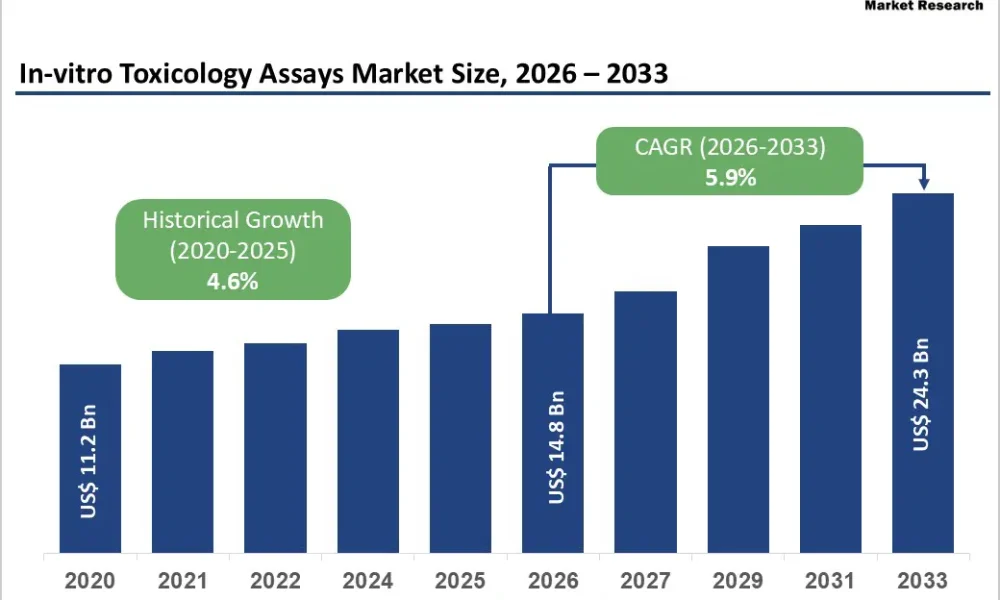
The in-vitro toxicology assays market is experiencing steady growth, driven by regulatory pressure to reduce animal testing, expanding pharmaceutical and biotechnology pipelines, and increasing safety assessment requirements for chemicals, cosmetics, and medical products. This market is predicted to reach a value of US$ 24.3 billion by 2033, growing from US$ 14.8 billion in 2026, at a CAGR of 5.9% during the forecast period. In-vitro toxicology assays are pivotal in identifying safety risks early in the drug development process, providing companies with an efficient, cost-effective, and ethical alternative to animal testing.
Market Statistics and Key Drivers
The demand for in-vitro toxicology assays is expanding rapidly as pharmaceutical companies, contract research organizations (CROs), and academic institutions look to streamline their drug development processes. Key growth drivers for the market include:
Regulatory Pressure to Reduce Animal Testing: Increased regulatory support for the use of non-animal testing methods across North America, Europe, and parts of Asia is pushing the demand for in-vitro assays.
Expanding Pharmaceutical and Biotechnology Pipelines: As drug pipelines expand with new drug candidates and complex biologics, the need for efficient early-stage toxicity screening becomes more pronounced.
Technological Advancements: Continuous innovation in cell-based assays, 3D cell culture systems, and data analytics is making in-vitro assays more predictive, reproducible, and cost-effective.
Among the various market segments, consumables are expected to dominate due to their frequent usage and essential role in routine testing. The North American region holds the largest share of the market, primarily driven by strong pharmaceutical and biotechnology sectors, while Asia Pacific emerges as the fastest-growing region due to the rapid expansion of pharmaceutical manufacturing and regulatory alignment with global standards.
Download Your Free Sample & Explore Key Insights: https://www.persistencemarketresearch.com/samples/33217
Key Highlights from the Report
• Global Market Size (2026E): US$ 14.8 billion
• Market Value Forecast (2033F): US$ 24.3 billion
• Projected Growth (CAGR 2026 to 2033): 5.9%
• Leading Region: North America, with 48.5% market share
• Fastest-Growing Region: Asia Pacific, with a CAGR of 7.9%
• Leading Product Segment: Consumables
• Leading Application Segment: Cell Culture Technology
Market Segmentation
The in-vitro toxicology assays market can be segmented across several dimensions, including product type, application, and end-user. This segmentation allows for a deeper understanding of the different dynamics at play in the market and provides valuable insights into growth trends.
Product Type
By product type, the consumables segment is expected to hold the largest market share due to their frequent use in routine toxicology assays. Consumables include reagents, culture media, antibodies, and plates, which are indispensable for conducting cytotoxicity, genotoxicity, and organ-specific toxicity testing. These products are in continuous demand, as they are essential for preclinical testing and regulatory safety assessments across a wide range of industries. Their recurrent usage, along with the increased regulatory pressure to reduce animal testing, supports the dominance of consumables in the market.
On the other hand, assays represent the fastest-growing segment, driven by their expanding use in high-throughput screening, mechanistic toxicology, and regulatory safety evaluations. The increasing focus on cost-effective, early-stage safety assessment and failure reduction in drug development contributes significantly to the rapid adoption of assays.
Application
The systemic toxicology segment is expected to lead the market, accounting for a significant share. Systemic toxicity testing plays a crucial role in assessing the risks of whole-body exposure to pharmaceuticals, chemicals, and cosmetics. Regulatory agencies often require comprehensive data to evaluate the toxic effects of substances across multiple organs and biological systems. Increasing demand for systemic toxicity assays is driven by the need for early-stage risk identification and optimizing dosages during preclinical development.
The molecular imaging segment is the fastest-growing application area in the market. As demand increases for mechanistic insights into toxicity prediction, molecular imaging technologies are being increasingly adopted for their superior accuracy and ability to predict toxicity at a molecular level.
End-User
The pharmaceutical and biotechnology companies segment is poised to maintain a dominant market share, driven by the high R&D intensity of these industries. These companies rely heavily on in-vitro toxicology assays to screen lead compounds and assess their safety profiles before clinical trials. As pharmaceutical companies expand their drug pipelines, the need for reliable and cost-effective toxicity testing methods grows. This demand is further supported by increasing regulatory pressure for non-animal testing methods, as well as the rising importance of mechanistic toxicity models.
Regional Insights
North America
North America is projected to dominate the in-vitro toxicology assays market, with the U.S. leading the way. The region benefits from a well-established pharmaceutical and biotechnology ecosystem, coupled with a high adoption rate of alternative testing methods. Regulatory frameworks like the FDA and EPA have long supported the shift toward validated in-vitro assays, boosting demand across the pharmaceutical, chemical, and environmental sectors. Additionally, advanced laboratory infrastructure, high R&D spending, and the presence of major assay developers further solidify North America’s market leadership.
Europe
Europe also represents a significant portion of the market, with countries like Germany, the U.K., France, and Italy contributing to market growth. Strict regulations such as the EU REACH and the EU Cosmetics Regulation have driven the reliance on in-vitro toxicology assays for chemical and cosmetic safety testing. Public-private collaborations, increased research investments, and strong industry-academia partnerships further support market expansion in the region.
Asia Pacific
The Asia Pacific region is expected to experience the highest growth rate during the forecast period. This can be attributed to the rapid growth of pharmaceutical manufacturing, increasing investments in healthcare infrastructure, and greater alignment with international regulatory standards. Countries like China, India, Japan, and South Korea are seeing rising demand for preclinical safety testing, driven by expanding drug development activities and government support for research infrastructure.
Get Custom Insights Designed for Your Business: https://www.persistencemarketresearch.com/request-customization/33217
Market Drivers
Several key factors are driving the growth of the in-vitro toxicology assays market:
Regulatory Shift Toward Non-Animal Testing: One of the most significant drivers for the adoption of in-vitro assays is the global shift towards non-animal testing methods. Agencies like the FDA, REACH, and others are actively encouraging the use of in-vitro assays for toxicity testing. This shift is driven by ethical concerns over animal testing and the potential for better, more accurate safety evaluations using human cell-based models.
Technological Advancements: The continuous evolution of testing technologies, including 3D cell culture systems, organ-on-chip models, and OMICS-based assays, is enhancing the predictive power and accuracy of in-vitro assays. These innovations allow for more physiologically relevant testing, thus improving the safety profile of drugs and chemicals before clinical trials.
Rising Safety Assessment Requirements: As pharmaceutical companies, biotech firms, and regulatory bodies continue to emphasize preclinical safety, the need for reliable, rapid, and cost-effective toxicity testing solutions increases. In-vitro assays are positioned as an ideal solution to meet these needs.
Market Restraints
While the in-vitro toxicology assays market is poised for growth, several factors can potentially restrain market expansion:
High Validation Costs: Advanced in-vitro assays, such as 3D tissue models and organ-on-chip technologies, require significant upfront investment in equipment, personnel, and assay development. This can be a barrier for smaller laboratories and institutions, particularly in cost-sensitive regions.
Limited Standardization: The lack of universally accepted standards and reference materials for in-vitro assays can limit their widespread adoption. Variability in assay reproducibility and inconsistent regulatory acceptance further complicate the process.
Regulatory Variability: Different countries have varying levels of acceptance for in-vitro assays, especially for systemic and long-term toxicity testing. This variability can delay market penetration and slow the adoption of newer technologies.
Market Opportunities
Despite the challenges, the in-vitro toxicology assays market presents several growth opportunities:
Advancements in Predictive Toxicology: The integration of advanced predictive models, including artificial intelligence and data analytics, into in-vitro testing is opening new growth avenues. These technologies can enhance the accuracy of toxicity prediction and increase the value of in-vitro assays.
Expansion in Emerging Markets: Growing pharmaceutical manufacturing, improved research infrastructure, and rising regulatory alignment with global standards are driving market growth in emerging markets like Asia Pacific and Latin America.
Increased Outsourcing to CROs: As pharmaceutical companies continue to focus on core R&D activities, outsourcing preclinical testing to contract research organizations (CROs) presents an opportunity for market growth.
Checkout Now & Download Complete Market Report: https://www.persistencemarketresearch.com/checkout/33217
Company Insights
Several leading players are operating in the in-vitro toxicology assays market, providing a wide range of testing services and products. Some of the key companies in this space include:
• Charles River Laboratories International, Inc.
• SGS S.A.
• Merck KGaA
• Eurofins Scientific
• Abbott Laboratories
• Laboratory Corporation of America Holdings
• Evotec S.E.
• Thermo Fisher Scientific, Inc.
• Quest Diagnostics Incorporated
• Agilent Technologies, Inc.
• Catalent, Inc.
• Danaher Corporation
• Bio-Rad Laboratories, Inc.
• BioIVT
• Gentronix
Recent Developments
In January 2026, M&G Investments led a US$50 million Series C funding round for bit.bio, a biotechnology company focused on next-generation human cell programming technology. This investment supports the growth of bit.bio and its potential to advance drug discovery and development in the UK.
SGS S.A. recently launched a new high-throughput toxicology assay platform, integrating AI-driven data analytics to enhance predictive accuracy and reduce testing time for pharmaceutical and chemical companies.
Conclusion
The in-vitro toxicology assays market is expected to experience significant growth in the coming years, driven by regulatory changes, technological innovations, and increasing safety assessment needs across various industries. North America and Asia Pacific are key regions, with North America holding the largest market share and Asia Pacific expanding at the fastest pace. As the demand for non-animal testing methods grows, opportunities for innovation, especially in predictive toxicology and high-throughput platforms, will shape the future of this market. Leading players in the market are focusing on advancing their assay platforms and expanding their global footprint to stay competitive in this rapidly evolving industry.




