
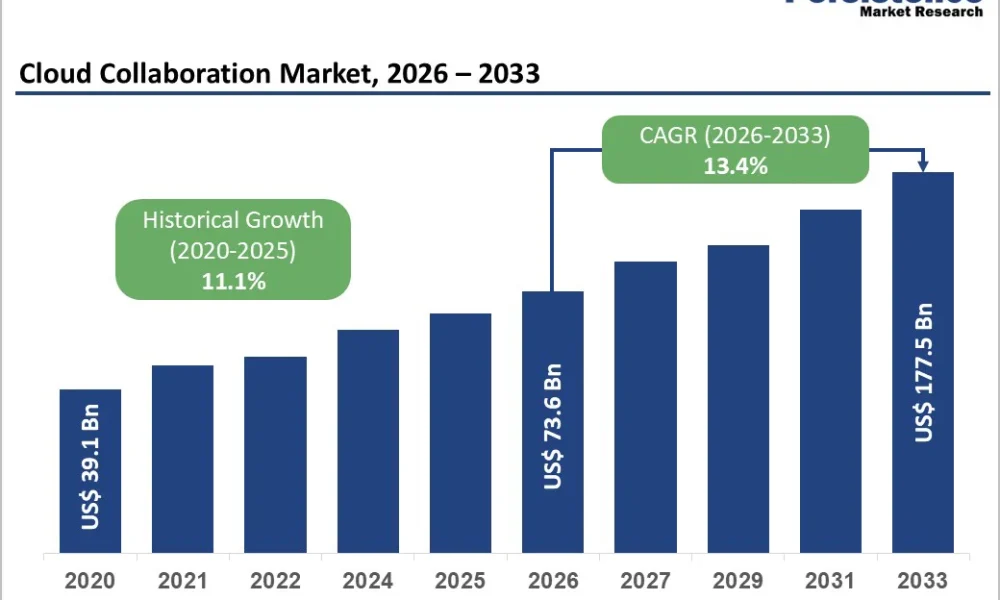
The global cloud collaboration market is entering a transformative growth phase, projected to expand from US$ 73.6 billion in 2026 to US$ 177.5 billion by 2033, registering a robust CAGR of 13.4% during the forecast period. This acceleration reflects the structural shift in how organizations operate, communicate, and innovate in an increasingly digital-first environment.
Cloud collaboration platforms have become mission-critical infrastructure, enabling seamless communication, document sharing, workflow automation, and real-time project management across geographically dispersed teams. With hybrid and remote work models firmly embedded into corporate strategies, enterprises are prioritizing scalable, AI-enabled collaboration ecosystems to maintain productivity and competitive advantage.
Market Overview: The Digital Workplace Revolution
The evolution of the digital workplace is reshaping enterprise communication models. By 2025, over 32 million Americans are expected to work remotely, while 83% of global employees prefer flexible hybrid arrangements. Organizations that fail to support this transition risk talent attrition and productivity decline.
Cloud collaboration platforms integrate video conferencing, messaging, content management, and workflow automation into unified ecosystems. Enterprises across BFSI, healthcare, manufacturing, and technology sectors are increasingly adopting these platforms to improve cross-functional coordination, reduce communication silos, and streamline decision-making.
Beyond operational efficiency, cloud collaboration reduces infrastructure costs by shifting capital expenditure to subscription-based operational models. This financial flexibility is particularly attractive during economic uncertainty, further reinforcing market expansion.
Key Industry Highlights
- Market Size (2026E): US$ 73.6 Billion
- Market Forecast (2033F): US$ 177.5 Billion
- Projected CAGR (2026–2033): 13.4%
- Historical CAGR (2020–2025): 11.1%
Leading Region: North America (36.8% Revenue Share)
North America leads global revenues due to mature IT infrastructure, high hybrid work adoption, and strong digital transformation initiatives.
Fastest-Growing Region: Asia Pacific (CAGR 14.2%)
Asia Pacific is emerging as the most dynamic region, driven by cloud-first policies in China and India, expanding digital ecosystems, and rising SME digitalization.
Dominant Solution Segment: Unified Communication & Collaboration (42%)
Integrated platforms combining voice, video, messaging, and document collaboration dominate enterprise adoption.
Fastest-Growing Organization Segment: SMEs (CAGR >18%)
Affordable pricing, managed services, and digital transformation pressures are accelerating SME adoption.
High-Potential Vertical: Healthcare & Life Sciences
Telehealth adoption and HIPAA-compliant cloud infrastructure are creating strong vertical-specific opportunities.
Market Drivers
- Remote and Hybrid Work as a Structural Shift
The global workforce transformation is the primary catalyst for cloud collaboration growth. Flexible work arrangements are no longer temporary adjustments but long-term structural strategies.
Approximately 46% of global employees would consider leaving roles requiring full-time office returns. This shift compels organizations to invest in cloud-based tools that ensure real-time collaboration, asynchronous communication, and efficient workflow management across time zones.
Industries such as BFSI, healthcare, manufacturing, and technology rely heavily on secure collaboration platforms to sustain operational continuity. The ability to coordinate distributed teams while maintaining productivity is becoming a decisive competitive factor.
- AI and Machine Learning Integration
Artificial intelligence is redefining collaboration platforms by embedding intelligence into everyday workflows. Solutions like Microsoft Corporation Teams with Copilot and Google LLC Workspace with Gemini AI are enhancing enterprise productivity through:
- Real-time meeting summaries
- Automated task generation
- Multilingual transcription
- Intelligent scheduling
- Predictive workflow recommendations
AI-driven collaboration tools can reduce communication costs by up to 30%, delivering measurable ROI. As enterprises pursue operational efficiency, AI-enabled collaboration capabilities are becoming central to platform selection.
Market Restraints
- Data Security and Regulatory Compliance
Despite strong adoption trends, data privacy and compliance concerns remain significant barriers. Enterprises must navigate regulations such as GDPR, HIPAA, and CCPA when migrating sensitive data to the cloud.
Cybersecurity threats including ransomware, data leakage, and unauthorized access complicate migration strategies. Multi-cloud environments further blur accountability boundaries, creating governance complexities.
Highly regulated industries such as BFSI and healthcare require encryption, access controls, and audit trails, increasing implementation complexity and cost.
- Integration Complexity and Vendor Lock-In
Enterprises with legacy IT systems often face integration challenges when deploying cloud collaboration platforms. Connecting collaboration tools with ERP, CRM, and sector-specific applications demands technical expertise and additional investment.
Concerns about vendor lock-in also influence procurement decisions. Organizations seek interoperable solutions that provide flexibility across hybrid and multi-cloud environments.
These technical and financial considerations can delay implementation, particularly in emerging markets with limited IT resources.
Elevate your business strategy with comprehensive market data. Request a sample report now: https://www.persistencemarketresearch.com/samples/33108
Market Opportunities
- Healthcare & Life Sciences Digital Transformation
Healthcare is emerging as one of the most promising verticals for cloud collaboration growth. The sector’s transition toward telehealth, digital patient records, and cross-institutional coordination demands secure, real-time communication platforms.
Cloud collaboration tools enable:
- Secure data exchange
- Virtual consultations
- Integrated electronic health record access
- Clinical workflow automation
HIPAA-compliant platforms are gaining traction among hospitals and pharmaceutical firms, reinforcing healthcare as a high-growth vertical.
- SME Digital Acceleration
Small and medium enterprises are experiencing rapid cloud adoption due to declining entry barriers and competitive digitalization pressures.
Approximately half of SMEs leverage cloud solutions to expand operations, while over 52% prioritize public cloud deployments for scalability. Vendors now offer:
- Pay-per-seat pricing
- Managed services
- Simplified onboarding
- Cloud-native integrations
This democratization of advanced collaboration tools is unlocking substantial growth potential in the SME segment.
Category-Wise Analysis
Solution Insights
Unified Communication & Collaboration (UCC) solutions capture roughly 42% of total solution revenue in 2026. These platforms consolidate messaging, voice, video, and content sharing into single ecosystems.
Major players driving adoption include:
- Cisco Systems Inc.
- Zoom Video Communications Inc.
- Slack Technologies LLC
Enterprises prefer integrated solutions that reduce IT complexity and enhance user adoption.
Project management and niche collaboration tools represent the fastest-growing sub-segments, supported by demand for flexible, AI-enhanced workflow management.
Service Insights
Support and maintenance services account for approximately 38% of service revenues. Organizations require continuous monitoring, optimization, and training to maximize platform value.
Integration and consulting services are growing rapidly as enterprises adopt hybrid deployments and AI-enabled tools requiring customization.
Deployment Model Insights
Public cloud dominates with nearly 59.4% of deployment revenues in 2026, driven by scalability and affordability.
Private cloud deployments remain critical for security-sensitive industries, while hybrid cloud is emerging as the fastest-growing model due to its balance of flexibility and compliance.
Organization Size Insights
Large enterprises contribute about 65% of total revenues, leveraging substantial IT budgets for enterprise-grade deployments.
However, SMEs are the fastest-growing segment, expanding at over 18% CAGR due to affordable subscription models and competitive digitalization demands.
Industry Insights
BFSI leads vertical adoption with approximately 28% revenue share, driven by regulatory requirements and digital banking innovation.
Healthcare follows with 22% share, while government and public sector verticals are witnessing rapid modernization initiatives supported by cloud-first strategies.
Regional Insights
North America
North America accounts for 36.8% of global revenues in 2026. The presence of technology leaders such as Amazon Web Services Inc., Microsoft, Google, and Zoom strengthens innovation capacity.
Mature hybrid work adoption and advanced IT governance frameworks position the region as a global benchmark for cloud collaboration trends.
Europe
Europe captures approximately 32% of global revenues. Strong GDPR compliance frameworks and digital modernization strategies in the UK and Germany drive adoption.
Hybrid deployment models are particularly prominent as enterprises balance regulatory requirements with scalability.
Asia Pacific
Asia Pacific is the fastest-growing region with a projected CAGR of 14.2%. China and India lead adoption through digital transformation initiatives, SME expansion, and supportive cloud-first policies.
Rising digital literacy, government support, and scalable cloud infrastructure investments position the region as a key growth engine through 2033.
Competitive Landscape
The global cloud collaboration market is moderately concentrated, with leading players capturing around 40% of total revenues.
Strategic priorities include:
- AI integration
- Ecosystem expansion
- Acquisition-driven consolidation
- Vertical-specific customization
Emerging vendors are aggressively targeting SMEs with affordable, user-friendly solutions, intensifying competition across all market tiers.
Major companies operating in the market include:
- Microsoft Corporation
- Google LLC
- Amazon Web Services Inc.
- Cisco Systems Inc.
- Zoom Video Communications Inc.
- Slack Technologies LLC
- Atlassian Corporation Plc
- Dropbox Inc.
- Box Inc.
- Adobe Inc.
- International Business Machines Corporation
- VMware Inc.
- Asana Inc.
- Monday.com Ltd.
- Zoho Corporation Pvt. Ltd.
Future Outlook: Intelligent, Integrated, and Secure Collaboration
By 2033, cloud collaboration platforms will evolve into AI-native productivity ecosystems. Predictive analytics, intelligent automation, voice recognition, and contextual workflow management will redefine enterprise communication.
Hybrid cloud adoption will accelerate, enabling flexible deployments across regulated industries. SMEs will continue driving high-growth momentum, while healthcare and public sector modernization will unlock new vertical opportunities.
As digital transformation deepens globally, cloud collaboration will shift from a productivity enabler to a strategic growth infrastructure. Organizations that prioritize intelligent, secure, and integrated collaboration ecosystems will be best positioned to thrive in the digital decade ahead.
Conclusion
The cloud collaboration market’s projected expansion to US$ 177.5 billion by 2033 underscores its foundational role in shaping the modern enterprise. With a CAGR of 13.4%, driven by hybrid work adoption, AI innovation, SME digitalization, and healthcare transformation, the market is set to remain one of the most dynamic segments within the broader cloud computing landscape.
Enterprises that invest strategically in scalable, AI-enhanced collaboration platforms today will secure operational resilience, workforce engagement, and long-term competitive advantage in an increasingly distributed world.
Related Reports:




