
The global bone void fillers market is on a steady growth trajectory, driven by increasing orthopedic procedures and the rising prevalence of bone-related disorders. Bone void fillers are critical in addressing bone defects caused by trauma, degenerative diseases, and surgical interventions, providing structural support while promoting bone regeneration. With advancements in minimally invasive orthopedic procedures, such as spinal surgeries, fracture management, and reconstructive operations, the demand for effective bone void fillers has significantly increased. Demineralized bone matrix (DBM) remains a dominant material due to its strong osteoinductive properties and clinical reliability, while synthetic fillers like calcium sulfate and tricalcium phosphate are gaining popularity due to cost advantages, biocompatibility, and easier handling.
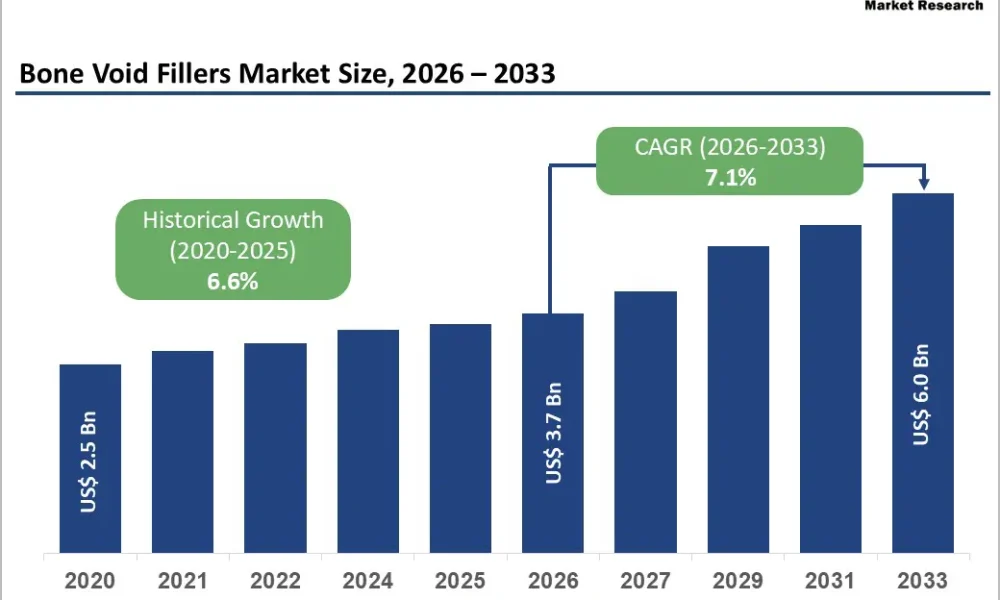
Market statistics highlight a strong growth outlook. The global bone void fillers market is projected to reach US$ 3.7 billion by 2026 and is expected to grow to US$ 6.0 billion by 2033, reflecting a compound annual growth rate (CAGR) of 7.1% between 2026 and 2033. North America continues to dominate the market, accounting for nearly 40% of the global share in 2025, thanks to high procedure volumes, advanced healthcare infrastructure, and favorable reimbursement policies. Asia Pacific is emerging as the fastest-growing region, driven by increasing trauma cases, expanding hospital infrastructure, and growing adoption of cost-effective synthetic bone void fillers. The combined influence of technological innovations, rising orthopedic disorders, and expanding healthcare access in emerging markets is shaping a robust growth environment for this sector.
Download Your Free Sample & Explore Key Insights: https://www.persistencemarketresearch.com/samples/20944
Key Highlights from the Report
• North America leads the global bone void fillers market with the highest market share due to advanced healthcare infrastructure and high procedure volumes.
• Asia Pacific is the fastest-growing region, fueled by rising trauma cases and expanding orthopedic facilities.
• Demineralized Bone Matrix (DBM) is the dominant material segment, holding around 46% market share in 2025.
• Calcium sulfate–based bone void fillers are witnessing the fastest growth due to injectable and antibiotic-eluting formulations.
• Hospitals remain the primary end users, accounting for nearly 49% market share, driven by high volumes of orthopedic and trauma surgeries.
• Technological advancements, including injectable formulations and antibiotic-eluting fillers, are enhancing surgical efficiency and clinical outcomes.
Market Segmentation
The bone void fillers market can be segmented primarily based on product type and end-user categories. By product type, the market is divided into biologics, synthetic fillers, and composite materials. Demineralized Bone Matrix (DBM), a biologic filler, dominates the market due to its osteoinductive properties that promote effective bone regeneration in spinal, trauma, and reconstructive procedures. Synthetic fillers, such as calcium sulfate and tricalcium phosphate, are rapidly gaining adoption because of their predictable integration with native bone, lower infection risk, and affordability. Composite materials that combine biologics with synthetic matrices are also entering the market, offering enhanced structural support and osteoconductive properties.
In terms of end users, hospitals are the leading segment, primarily due to their high volumes of complex orthopedic procedures, multidisciplinary surgical teams, and established reimbursement mechanisms. Ambulatory surgical centers (ASCs) are emerging as a fast-growing segment, benefiting from the increasing preference for minimally invasive outpatient procedures. Injectable bone void fillers are particularly suited to ASCs, enabling shorter operation times, faster patient recovery, and reduced overall costs. The segmentation by end users highlights the evolving preference for outpatient and outpatient-compatible procedures, reflecting broader trends in healthcare delivery and cost management.
Regional Insights
North America remains the largest market for bone void fillers, driven by high orthopedic surgery volumes, advanced healthcare infrastructure, and strong adoption of innovative products. The U.S. leads this region, with surgeons favoring advanced formulations like antibiotic-eluting DBM and calcium sulfate-based fillers to minimize infection risk and improve bone healing outcomes. Favorable reimbursement policies for orthopedic interventions further encourage product adoption, particularly in spinal, trauma, and reconstructive surgeries. Additionally, ongoing clinical research and product innovations in injectable and resorbable bone fillers are strengthening the region’s position as a mature, innovation-driven market.
Asia Pacific is emerging as the fastest-growing regional market due to increasing orthopedic procedure volumes, rising incidence of road accidents, sports injuries, and degenerative bone disorders. Expanding healthcare infrastructure, increasing numbers of trained orthopedic specialists, and rising medical tourism are fueling growth. Cost-effective synthetic fillers, such as calcium sulfate and tricalcium phosphate, are widely adopted in countries like India, Thailand, and South Korea due to affordability and ease of use. Government initiatives to modernize healthcare systems, improve trauma care, and expand hospital facilities are further accelerating the market growth, making Asia Pacific a region of significant opportunity over the forecast period.
Get Custom Insights Designed for Your Business: https://www.persistencemarketresearch.com/request-customization/20944
Market Drivers
The global bone void fillers market is primarily driven by the rising prevalence of orthopedic disorders, including traumatic fractures, chronic osteomyelitis, bone tumors, and degenerative bone conditions. Aging populations, sedentary lifestyles, and a growing incidence of sports injuries and road accidents contribute to increasing demand for bone repair solutions. Bone void fillers are critical for restoring structural integrity and facilitating bone regeneration in affected areas, particularly in cases of chronic infection where dead bone cavities require filling.
The growing adoption of advanced bone void fillers also drives market growth. Synthetic materials, such as calcium sulfate and tricalcium phosphate, provide high biocompatibility, predictable integration with native bone, and lower risk of donor site morbidity compared to traditional autografts. Antibiotic-eluting formulations further enhance surgical outcomes by providing localized infection control during healing. Continuous product innovations, improved clinical protocols, and rising awareness among surgeons are enhancing market penetration, making bone void fillers an increasingly preferred solution for orthopedic and trauma care.
Market Restraints
Despite robust growth prospects, the bone void fillers market faces several constraints. Low clinical penetration and cautious adoption by surgeons are key barriers, driven by concerns over incomplete or delayed bone regeneration, filler leakage, or infection risks. Many bone void fillers still require invasive surgical procedures, which limit their use in outpatient and low-resource healthcare settings.
High procedural costs also restrict market growth. Orthopedic surgeries that utilize bone void fillers can cost between US$25,000 and US$30,000, with fillers adding an additional US$1,000–2,000. In price-sensitive regions, limited reimbursement coverage and financial constraints hamper adoption, slowing market expansion. These factors collectively restrain widespread utilization and moderate overall growth potential in global markets.
Market Opportunities
The expansion of ambulatory surgical centers presents a significant growth opportunity for bone void fillers. ASCs are increasingly performing minimally invasive orthopedic procedures, providing shorter hospital stays, lower costs, and faster patient recovery. Injectable bone void fillers are particularly suited to ASC procedures, allowing ease of use, reduced operating times, and compatibility with outpatient workflows.
Product innovations, such as antibiotic-eluting calcium sulfate fillers, further strengthen the opportunity in ASC settings by addressing post-surgical infection concerns while maintaining structural bone support. As aging populations and patients increasingly prefer outpatient care and same-day discharges, manufacturers focusing on ASC-friendly, injectable, and infection-resistant bone void fillers are well-positioned to capture rising procedural volumes.
Checkout Now & Download Complete Market Report: https://www.persistencemarketresearch.com/checkout/20944
Company Insights
The bone void fillers market is moderately competitive, dominated by a few key players with strong global presence, established distribution networks, and broad product portfolios. Leading companies include:
• Medtronic Plc
• Johnson & Johnson
• Zimmer Biomet
• Stryker Corporation
• NuVasive®, Inc.
• Wright Medical Group, Inc.
• Hoya Corporation
• Braun Melsungen AG
• Heraeus Holding
• Smith & Nephew plc
Market Segmentation
Product Type
- Demineralized Bone
- Calcium Sulphate
- Calcium Phosphate
- Tri Calcium Phosphate
- Others
End User
- Hospitals
- Ambulatory Surgical Centers
- Specialized Clinics
Regions
- North America
- Europe
- East Asia
- South Asia & Oceania
- Latin America
- Middle East & Africa
Recent Developments
In July 2025, Medtronic achieved a key enrollment milestone in the INFUSE™ Bone Graft TLIF study and received an FDA-approved protocol amendment for degenerative spine indications.
In April 2023, Abyrx, Inc. announced that its MONTAGE Settable, Resorbable Bone Putty received additional U.S. FDA clearances for use as both a bone void filler and cranial bone cement.
These developments reflect ongoing product innovation, regulatory approvals, and a focus on advanced bone void management solutions.
Conclusion
The global bone void fillers market is experiencing strong growth, fueled by rising orthopedic procedure volumes, increasing prevalence of bone-related disorders, and technological advancements in minimally invasive treatments. Demineralized Bone Matrix remains the dominant material, while synthetic fillers such as calcium sulfate are rapidly gaining traction. North America maintains a leadership position due to advanced healthcare infrastructure and reimbursement policies, whereas Asia Pacific emerges as the fastest-growing region owing to expanding hospitals, medical tourism, and rising trauma cases.
While clinical limitations and high costs remain restraints, opportunities from ambulatory surgical centers, innovative formulations, and injectable technologies present significant growth potential. With increasing awareness among healthcare providers and ongoing product developments, the bone void fillers market is poised for continued expansion, offering effective solutions for orthopedic, spinal, trauma, and reconstructive procedures worldwide.




