
Non-Chlorinated Polyolefins Market: Driving Sustainable Polymer Growth in a Changing World
The global polymer industry is at a pivotal moment — shaped by rising environmental regulations, growing consumer demand for sustainable materials, and the automotive and packaging sectors’ insatiable appetite for lightweight, durable polymers. At the heart of this evolution is the Non-Chlorinated Polyolefins market, a specialized niche of polyolefin derivatives designed to replace traditional chlorinated formulations with safer, eco-friendly alternatives. As stringent global standards phase out halogenated substances and businesses embrace greener chemistries, non-chlorinated polyolefins have emerged as performance-focused and environmentally acceptable solutions across key industries.
What Are Non-Chlorinated Polyolefins?
Non-chlorinated polyolefins are modified polyolefin polymers — primarily polypropylene (PP), polyethylene (PE), and related derivatives — that do not contain chlorine in their molecular structure. Unlike chlorinated polyolefins (CPOs), which can emit harmful compounds such as hydrochloric acid under heat or chemical exposure, non-chlorinated variants provide adhesion promotion, coating adhesion, and compatibility with a range of substrates without halogen-related risks. Their performance characteristics include excellent chemical resistance, durability, thermal stability, and low environmental impact — making them increasingly attractive across automotive, packaging, coatings, and electrical applications.
Get Your FREE Sample Report Instantly – Click Now: https://www.persistencemarketresearch.com/samples/32367
Growth Outlook: Market Size and Forecast
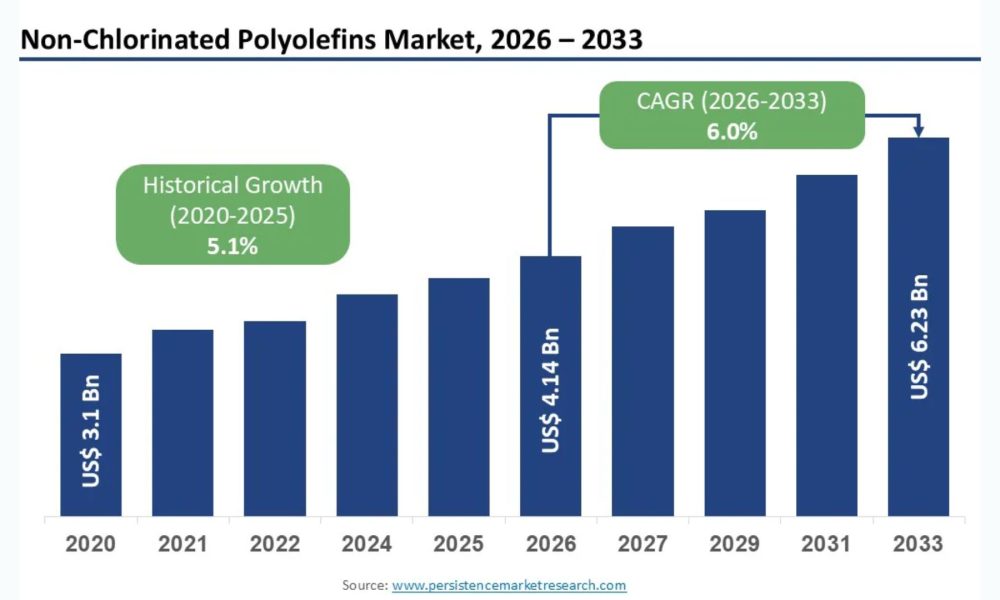
According to Persistence Market Research, the global non-chlorinated polyolefins market is poised for steady expansion, with an estimated valuation of US$4.1 billion in 2026 and projected to reach US$6.2 billion by 2033, growing at a compound annual growth rate (CAGR) of around 6.0% during 2026–2033. This growth is driven by regulatory pressures, the shift toward halogen-free formulations, and rising demand for superior adhesion promoters in major end-use industries.
Key Market Drivers
- Regulatory Push Toward Sustainability
A major catalyst for non-chlorinated polyolefins is the global drive to reduce volatile organic compounds (VOCs) and eliminate hazardous chemicals in manufacturing processes. Regulatory frameworks in North America and Europe increasingly restrict halogenated materials, pushing chemical formulators toward safer alternatives. In this environment, non-chlorinated polyolefins offer compliance without compromising performance — a compelling value proposition for coatings, adhesives, and plastic component manufacturers operating in heavily regulated regions.
This shift aligns with broader sustainability initiatives such as green building standards and extended producer responsibility (EPR) for plastics, encouraging circular economy principles and reduced environmental footprint across supply chains. As demand for non-chlorinated components rises, companies with eco-friendly portfolios are well positioned to capture market share.
- Automotive Industry’s Shift to Lightweight Materials
The automotive sector plays a crucial role in driving demand for non-chlorinated polyolefins. With global emphasis on fuel efficiency, lower emissions, and electrification, original equipment manufacturers (OEMs) increasingly rely on lightweight plastics such as polypropylene and thermoplastic olefins (TPOs) for interior and exterior components. However, bonding coatings and paints to these low-energy plastic surfaces historically required chlorinated primers.
Non-chlorinated polyolefin adhesion promoters now serve as high-performance alternatives, enabling strong paint adhesion without hazardous pretreatments. Their use in bumpers, dashboards, trim, and under-the-hood parts helps OEMs reduce vehicle weight, meet environmental standards, and comply with regulations like Corporate Average Fuel Economy (CAFE) in the U.S. and similar efficiency mandates elsewhere.
This sector’s dominance is clear — automotive accounts for over half of the market’s share by end-use, reflecting robust adoption across passenger cars, commercial vehicles, and the growing electric vehicle (EV) segment seeking enhanced range and lower curb weight.
- Expanding Packaging and Coatings Demand
The non-chlorinated polyolefins market also benefits from strong demand in packaging and coatings applications. Flexible packaging — particularly films, containers, and labels — increasingly uses non-chlorinated polyolefin derivatives due to their moisture resistance, chemical stability, and recyclability. As consumer goods companies strive for sustainable packaging solutions, polyolefin-based systems allow high-quality printing, adhesive bonding, and lightweight protection without environmental penalties.
Similarly, in paints and coatings, non-chlorinated formulations serve as adhesion promoters that ensure robust bonding on plastic substrates and deliver enhanced durability and resistance to weathering. The shift toward water-borne and low-VOC paint systems further complements this trend, especially in industrial and automotive refinishing sectors.
Get a Customized Market View in One Click: https://www.persistencemarketresearch.com/request-customization/32367
Segmentation Insights
By Polymer Type
- Polypropylene (PP) leads the market, accounting for a dominant share due to its compatibility with automotive substrates, strong mechanical properties, and cost-effectiveness as a base material for functionalized polymers.
- Polyethylene (PE) and other polyolefins also contribute, particularly in applications requiring flexibility, chemical resistance, and moisture barrier performance.
By Application
- Paints & Coatings represent the largest application segment, anchored by automotive OEM and refinish markets demanding reliable adhesion.
- Plastics, adhesives, rubber, and other specialty segments demonstrate strong growth potential as industries adopt non-chlorinated materials for performance and environmental reasons.
By End-Use Industry
- Automotive dominates global consumption.
- Packaging, building & construction, electrical & electronics, and industrial sectors provide growing demand as these industries embrace lighter, greener materials across more applications.
Regional Market Dynamics
North America: Regulatory Leadership
North America holds the largest share of the non-chlorinated polyolefins market, driven by strict environmental regulations such as those enforced by the U.S. Environmental Protection Agency (EPA), strong automotive manufacturing infrastructure, and advanced coatings formulations demand. Manufacturers and formulators are rapidly transitioning to non-chlorinated products to comply with VOC limits and sustainability standards, fueling regional growth.
Europe: Sustainability and Circular Economy
Europe follows closely, propelled by stringent chemical safety regulations like REACH and ambitious circular economy policies under the EU Green Deal. Regional automotive OEMs and coatings producers are at the forefront of adopting halogen-free solutions, while packaging demand continues to expand with recycled and recyclable materials.
Asia Pacific: Fastest Growing Region
Asia Pacific is forecasted to be the fastest-growing market, driven by rapid industrialization, automotive manufacturing expansion in China, India, and Japan, and rising packaging demand tied to e-commerce and FMCG growth. As environmental mandates tighten in emerging markets, non-chlorinated polyolefins are gaining traction across applications previously dominated by traditional formulations.
Challenges Facing the Market
Despite strong growth prospects, the non-chlorinated polyolefins market grapples with higher production costs and complex manufacturing processes compared with chlorinated alternatives. Specialized catalysts, multi-stage processing, and limited qualified suppliers can drive up costs and pose barriers, particularly in price-sensitive segments.
Additionally, performance on certain substrates can require additional surface treatments or formulation tweaks, and alternative technologies — such as advanced silane-based adhesion promoters — continue to compete for market share in some applications.
Future Trends and Opportunities
Innovation in Water-Borne and Bio-Based Solutions
A key growth opportunity lies in water-borne, low-VOC non-chlorinated polyolefin systems, aligning with global demand for greener coatings and adhesives. These formulations reduce environmental impact and meet stricter regulatory standards in automotive, packaging, and industrial sectors.
Integration with Circular Economy Principles
As circular economy initiatives expand, non-chlorinated polyolefins compatible with recycled content or bio-based feedstocks present compelling value propositions. Plastic waste reduction programs, producer responsibility schemes, and consumer sustainability commitments are pushing brands to adopt recyclable, halogen-free polymer systems.
For In-Depth Competitive Analysis, Buy Now: https://www.persistencemarketresearch.com/checkout/32367
Conclusion
The non-chlorinated polyolefins market is evolving from a niche specialty segment to a cornerstone of sustainable polymer solutions. Underpinned by regulatory forces, material innovation, and wide-ranging end-use demand — from automotive and packaging to coatings and construction — this market is poised for steady, long-term growth. While challenges around cost and processing remain, the shift toward halogen-free, environmentally conscious materials positions non-chlorinated polyolefins as essential contributors to the future of high-performance polymer applications.
About Persistence Market Research:
Persistence Market Research delivers strategic research solutions that drive business growth. Founded in 2012 and registered in England and Wales in 2023 as Persistence Research & Consultancy Services Ltd., we have completed 3,600+ custom and syndicated studies and supported 2,700+ projects for leading research firms. Combining traditional methodologies with modern tools, we provide actionable insights to multinational corporations, consultants, investors, and government bodies, earning strong trust through long-term client relationships.
Contact Us:
Persistence Market Research
Second Floor, 150 Fleet Street,
London, EC4A 2DQ, United Kingdom
USA Phone: +1 646-878-6329
UK Phone: +44 203-837-5656
Email: [email protected]
Web: https://www.persistencemarketresearch.com




