
AI in Energy Distribution Market Size and Trends Analysis
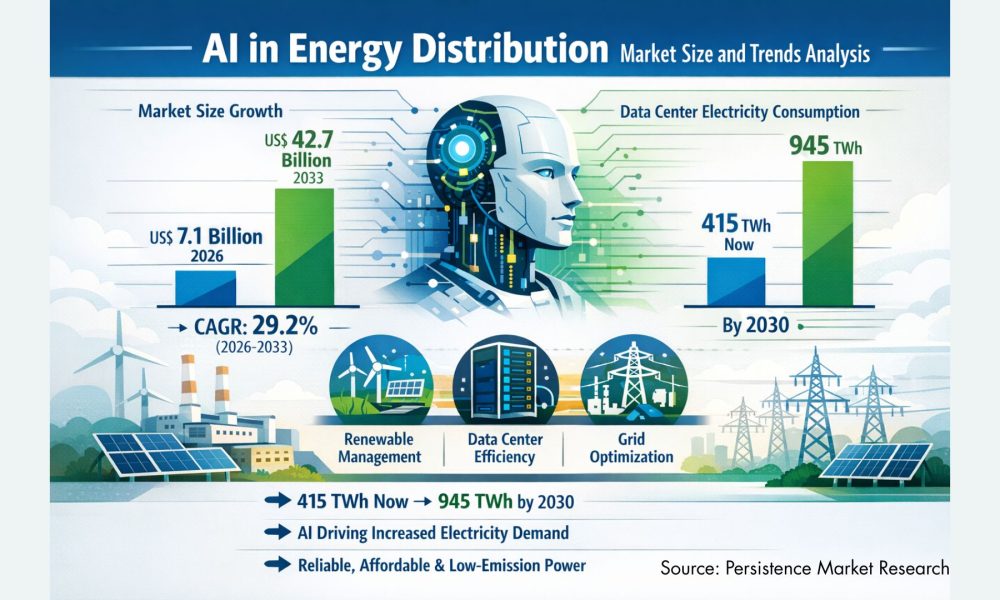
The global AI in energy distribution market is entering a period of exponential growth, driven by rapid digital transformation, grid modernization, and surging electricity demand from data-intensive industries. The market is projected to be valued at US$ 7.1 billion in 2026 and is expected to reach US$ 42.7 billion by 2033, expanding at an impressive compound annual growth rate (CAGR) of 29.2% between 2026 and 2033. This remarkable trajectory reflects the growing role of artificial intelligence in optimizing grid operations, managing renewable energy variability, and supporting the increasing electrification of economies worldwide.
As global power systems become more decentralized, digitized, and decarbonized, utilities and grid operators are leveraging AI to enhance operational efficiency, improve demand forecasting, reduce outages, and integrate distributed energy resources (DERs). The accelerating demand for electricity—particularly from AI-driven data centers—is further reinforcing the need for intelligent energy distribution systems capable of managing unprecedented load complexity.
Get Your FREE Sample Report Instantly – Click Now: https://www.persistencemarketresearch.com/samples/36180
Rising Electricity Demand from AI and Digital Infrastructure
One of the strongest drivers of the AI in energy distribution market is the dramatic increase in electricity consumption by digital infrastructure. Data center electricity consumption is currently estimated at 415 terawatt hours (TWh) globally and is projected to approach 945 terawatt hours by 2030, largely fueled by AI workloads, cloud computing, and high-performance computing applications.
AI training models, generative AI platforms, and advanced analytics require immense computational capacity, leading to concentrated clusters of energy-intensive data centers. These clusters place significant strain on local and regional power grids. As a result, utilities are deploying AI-based grid management systems to forecast load surges, optimize distribution, and maintain grid stability.
The feedback loop is particularly notable: AI increases power demand, while simultaneously being deployed to manage that very demand. This dynamic is accelerating investment in AI-powered energy distribution platforms worldwide.
The Role of AI in Modern Energy Distribution
AI technologies are transforming traditional energy distribution networks into intelligent, adaptive systems. Conventional grids were designed for predictable, centralized power generation. However, modern grids must accommodate intermittent renewable energy sources, distributed generation, electric vehicles (EVs), and variable industrial loads.
AI enhances grid performance in several key areas:
- Load forecasting and demand prediction
- Real-time grid monitoring and anomaly detection
- Outage prediction and predictive maintenance
- Voltage optimization and loss reduction
- Renewable integration management
- Energy theft detection and cybersecurity analytics
Machine learning algorithms analyze massive volumes of real-time grid data from smart meters, sensors, and substations, enabling utilities to make faster, data-driven decisions. This improves operational efficiency while reducing downtime and infrastructure stress.
Renewable Energy Integration and Variability Management
The global transition toward renewable energy is a major catalyst for AI adoption in energy distribution. Solar and wind energy, while environmentally beneficial, are inherently variable and weather-dependent. Integrating large volumes of renewables into existing grids introduces instability and forecasting challenges.
AI models help utilities predict renewable generation patterns based on weather data, historical trends, and satellite imagery. By combining predictive analytics with automated control systems, AI enables dynamic balancing between supply and demand.
This capability is essential for maintaining reliable power delivery while advancing decarbonization goals. Governments and regulators increasingly view AI as a critical enabler for achieving net-zero targets without compromising grid reliability.
Get a Customized Market View in One Click: https://www.persistencemarketresearch.com/request-customization/36180
Data Center Clustering and Grid Stress Management
The rapid expansion of AI-driven data centers is creating localized energy stress in certain regions. Hyperscale data center hubs often emerge near major urban centers or technology corridors, leading to concentrated electricity demand.
AI-powered energy distribution systems help utilities anticipate demand spikes and reconfigure distribution pathways to prevent overloads. Intelligent systems can automatically reroute power flows, manage distributed energy storage, and optimize substation operations.
In regions where grid capacity expansion is constrained by infrastructure or regulatory delays, AI becomes an essential tool to maximize existing system efficiency and defer costly capital upgrades.
System Flexibility and Smart Grid Evolution
The evolution toward smart grids is another key trend shaping the market. Smart grids integrate digital communication technologies with electricity infrastructure, enabling two-way communication between utilities and consumers.
AI enhances smart grid functionality by:
- Enabling demand response programs
- Optimizing distributed energy resource (DER) coordination
- Managing electric vehicle charging loads
- Supporting microgrid operations
- Enhancing grid resilience during extreme weather events
AI-driven automation improves system flexibility, allowing grids to respond dynamically to shifting energy patterns. This flexibility is increasingly important as electrification expands into transportation, heating, and industrial sectors.
Regulatory and Policy Support
Governments and regulatory bodies worldwide are encouraging digital transformation within the energy sector. Investments in smart meters, grid sensors, and digital substations provide the data foundation required for AI deployment.
Policy frameworks supporting renewable integration, emissions reduction, and infrastructure resilience further accelerate AI adoption. Regulators recognize that maintaining reliable and affordable power while transitioning to low-carbon energy systems requires advanced analytics and automation.
Public-private partnerships between utilities, technology providers, and research institutions are also fostering innovation in AI-based grid solutions.
Regional Outlook
North America
North America is a leading market due to advanced grid infrastructure, strong technology ecosystems, and large-scale AI deployment in data centers. Utilities are actively investing in AI-based grid optimization platforms to manage growing renewable penetration and electrification.
Europe
Europe’s focus on decarbonization and renewable energy expansion is driving AI adoption in energy distribution. Strict emissions targets and grid modernization initiatives support investments in intelligent grid management systems.
Asia-Pacific
Asia-Pacific is expected to witness rapid growth due to expanding electricity demand, urbanization, and digital infrastructure development. Countries investing heavily in renewable energy and smart grid projects are integrating AI to enhance efficiency and reliability.
Challenges and Market Constraints
Despite its strong growth potential, the AI in energy distribution market faces several challenges:
- High implementation costs for AI platforms and grid digitization
- Cybersecurity risks associated with increased digital connectivity
- Data privacy and governance concerns
- Integration complexity with legacy infrastructure
- Shortage of skilled AI and power systems professionals
Utilities must balance technological advancement with regulatory compliance and operational security. Additionally, achieving interoperability across diverse grid components remains a technical challenge.
For In-Depth Competitive Analysis, Buy Now: https://www.persistencemarketresearch.com/checkout/36180
Future Outlook
The AI in energy distribution market is set for transformative expansion, with projected growth from US$ 7.1 billion in 2026 to US$ 42.7 billion by 2033. As electricity demand nearly doubles in data centers and electrification accelerates globally, AI will become indispensable in ensuring grid stability and efficiency.
Looking ahead, key trends likely to shape the market include:
- Greater integration of AI with edge computing in substations
- Expansion of AI-driven virtual power plants (VPPs)
- Increased deployment of autonomous grid management systems
- Enhanced predictive analytics for climate resilience
- Stronger focus on carbon intensity optimization
AI is evolving from a supplementary technology to a core operational backbone of modern energy distribution networks. Utilities, regulators, and technology providers increasingly view AI not merely as a digital upgrade but as a strategic lever to deliver reliable, affordable, and lower-emission electricity.
As power systems grow more complex and electricity consumption surges—particularly from AI workloads themselves—the synergy between artificial intelligence and energy distribution will define the next generation of global energy infrastructure.
About Persistence Market Research:
Persistence Market Research delivers strategic research solutions that drive business growth. Founded in 2012 and registered in England and Wales in 2023 as Persistence Research & Consultancy Services Ltd., we have completed 3,600+ custom and syndicated studies and supported 2,700+ projects for leading research firms. Combining traditional methodologies with modern tools, we provide actionable insights to multinational corporations, consultants, investors, and government bodies, earning strong trust through long-term client relationships.
Contact Us:
Persistence Market Research
Second Floor, 150 Fleet Street,
London, EC4A 2DQ, United Kingdom
USA Phone: +1 646-878-6329
UK Phone: +44 203-837-5656
Email: [email protected]
Web: https://www.persistencemarketresearch.com




