
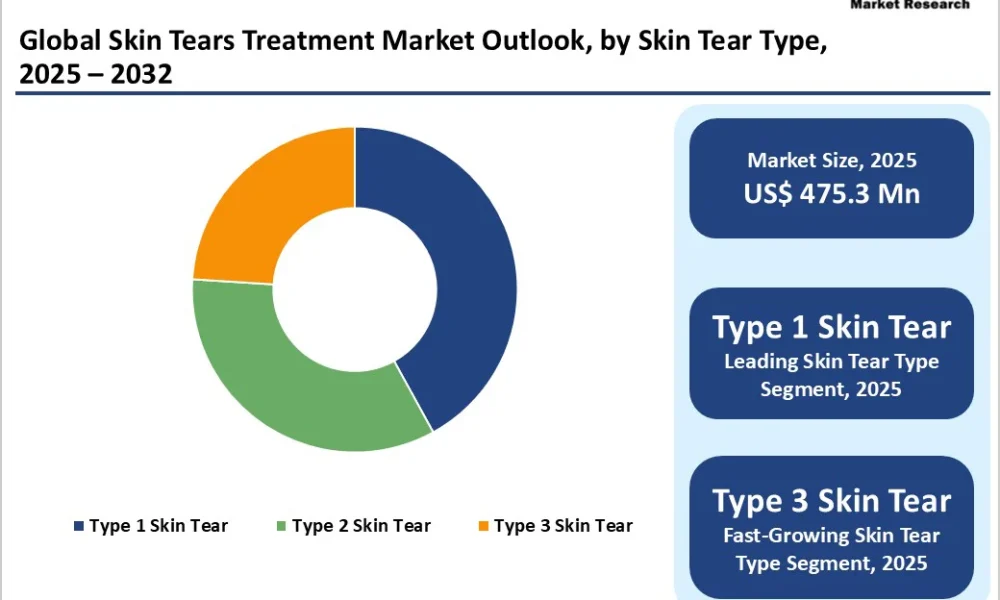
The global skin tears treatment market is entering a period of steady and sustained expansion, underpinned by demographic shifts, advancements in wound care technologies, and rising awareness of fragile skin management. Valued at US$ 475.3 million in 2025, the market is projected to reach US$ 649.9 million by 2032, growing at a compound annual growth rate (CAGR) of 4.6% during the forecast period. This growth trajectory reflects a noticeable acceleration compared to the historical CAGR of 3.9% recorded between 2019 and 2024. Skin tears, defined as traumatic wounds caused by shear, friction, or blunt force that separate skin layers, are increasingly prevalent among elderly individuals, neonates, and patients with chronic conditions such as diabetes. As skin becomes thinner, less elastic, and more vulnerable due to aging or systemic disease, the need for specialized skin tear treatment solutions—including moisture-retentive dressings, barrier films, and advanced wound devices—continues to expand.
Market growth is primarily driven by the rising geriatric population, increasing diabetes prevalence, improved wound assessment protocols, and technological innovations in advanced wound care products. Moisture-retentive dressings dominate the product landscape due to their ability to create an optimal healing environment and reduce trauma during removal. Geographically, North America leads the global market, supported by strong healthcare infrastructure, high adoption of next-generation wound care technologies, and favorable reimbursement frameworks. Meanwhile, Asia Pacific is the fastest-growing region, propelled by a rapidly aging population, rising healthcare investments, and expanding local manufacturing capabilities. Together, these factors are shaping a market characterized by incremental innovation, steady institutional demand, and increasing emphasis on preventive wound care management.
Download Your Free Sample & Explore Key Insights: https://www.persistencemarketresearch.com/samples/26260
Key Highlights from the Report
• The global skin tears treatment market is expected to grow at a CAGR of 4.6% from 2025 to 2032.
• Moisture-retentive dressings account for the largest product share due to superior wound-healing efficiency.
• North America leads the global market owing to advanced healthcare systems and high product adoption.
• Asia Pacific is projected to witness the fastest growth driven by rapid population aging and healthcare expansion.
• Hospitals and clinics represent the dominant end-user segment with approximately 48% market share.
• Rising diabetes prevalence worldwide is significantly boosting demand for advanced wound management solutions.
Market Segmentation Analysis
The skin tears treatment market is segmented primarily by product type, end-user, and care setting, each playing a critical role in defining competitive dynamics and adoption trends.
By product type, moisture-retentive dressings hold the largest market share, accounting for approximately 33% of total revenue. These dressings are designed to maintain a moist wound-healing environment that accelerates tissue regeneration while minimizing infection risk. Foam dressings represent the largest subsegment within this category, known for high absorption capacity and balanced moisture vapor transmission that prevents maceration. Many foam products integrate soft silicone contact layers, which minimize pain and trauma during removal—an essential factor in elderly and fragile-skin patients. Hydrogel dressings also command a notable share, particularly in dry or necrotic wounds, where their moisture-donating properties promote autolytic debridement and provide cooling pain relief. Alginate and hydrofiber dressings are widely utilized for wounds with moderate to heavy exudate due to their strong absorption and hemostatic properties.
Hyaluronic acid-based wound devices represent the fastest-growing segment within the product landscape. Their biocompatibility and skin-regenerating properties make them particularly suitable for fragile, aged, or diabetic skin. As regenerative medicine gains traction, the incorporation of bioactive compounds into wound management is reshaping treatment protocols and expanding clinical applications.
From an end-user perspective, hospitals and clinics dominate the market with roughly 48% share. These facilities manage complex cases involving trauma, surgery-related skin tears, and patients with multiple comorbidities. Hospitals benefit from multidisciplinary wound care teams, advanced diagnostic capabilities, and institutional reimbursement support, allowing them to adopt premium wound care technologies. Long-term care facilities also represent a significant segment, given the high incidence of skin tears among elderly residents. Meanwhile, home healthcare settings are emerging as the fastest-growing end-user category, supported by cost-containment strategies, patient preference for home-based treatment, and improvements in portable wound care technologies that reduce hospital readmissions.
Regional Insights
North America remains the leading region in the global skin tears treatment market, accounting for approximately 38.3% of total revenue. The dominance of this region is closely linked to demographic trends and clinical infrastructure. The United States, in particular, is experiencing rapid population aging, with individuals aged 65 and older projected to represent nearly 20% of the population by 2050. The incidence of skin tears in long-term care facilities remains substantial, with documented prevalence rates ranging between 6% and 28% depending on the institution. Strong regulatory oversight and product approval pathways support rapid commercialization of innovative wound care products. Additionally, high awareness among healthcare professionals and structured wound classification systems contribute to better diagnosis and treatment adoption rates.
Europe holds a significant share as well, driven by well-established healthcare systems, strong geriatric care infrastructure, and widespread implementation of standardized wound management protocols. Countries such as Germany, the United Kingdom, and France exhibit high adoption of advanced foam and silicone-based dressings, particularly in hospital and nursing home settings.
Asia Pacific is the fastest-growing regional market, supported by unprecedented demographic shifts. The proportion of individuals aged 60 and above is projected to more than double by 2050, creating substantial demand for fragile skin management solutions. China and India alone account for more than 230 million elderly individuals combined, creating a vast patient base for acute and chronic wound treatment. Healthcare reforms, expanding insurance coverage, and local production of cost-effective wound care products further stimulate market growth in the region. Additionally, improved awareness of diabetic wound complications is driving adoption of advanced dressings and regenerative devices.
Latin America and the Middle East & Africa represent emerging markets characterized by gradual healthcare modernization and increasing investments in hospital infrastructure. While adoption rates of premium wound care products remain lower compared to developed regions, growing awareness campaigns and public health initiatives are expected to create incremental growth opportunities.
Get Custom Insights Designed for Your Business: https://www.persistencemarketresearch.com/request-customization/26260
Market Drivers
One of the most significant drivers of the skin tears treatment market is technological innovation in advanced wound care, particularly the development of silicone-based moisture-retentive dressings. These next-generation products are engineered to provide superior exudate management, extended wear time, and atraumatic removal. Silicone contact layers help preserve peri-wound skin integrity and significantly reduce discomfort during dressing changes, which is particularly important in geriatric populations with fragile epidermal layers. The integration of antimicrobial agents and improved absorption materials enhances healing outcomes while minimizing infection risks. Clinical data consistently demonstrate improved wound closure rates and shorter healing durations when advanced foam or antimicrobial dressings are utilized.
Another major driver is global population aging. As skin loses elasticity, collagen density, and hydration with age, susceptibility to tears increases significantly. Long-term care facilities report high point prevalence rates, making skin tear management a routine clinical necessity. In addition, the increasing prevalence of diabetes contributes to compromised skin integrity and delayed wound healing, further expanding the addressable patient population. Institutional reimbursement systems in developed regions encourage the adoption of premium wound care products, reinforcing steady market expansion.
Market Restraints
Despite positive growth prospects, the market faces notable restraints, particularly inadequate training and limited awareness among healthcare professionals in certain regions. Effective management of skin tears requires accurate classification, appropriate dressing selection, and skilled application techniques. However, many general practitioners and nursing staff lack structured wound care education or familiarity with standardized classification tools such as the STAR system. This knowledge gap can lead to delayed diagnosis, improper treatment selection, and underutilization of advanced products.
Cost constraints also represent a barrier in developing and resource-limited settings. Advanced silicone foam dressings and bioactive wound devices are often priced higher than traditional gauze-based alternatives. In healthcare systems with limited reimbursement or budgetary restrictions, decision-makers may prioritize lower-cost products despite potentially inferior clinical outcomes. Additionally, limited public awareness about preventive skin care and early intervention strategies contributes to underreporting and undertreatment of minor skin tears, thereby constraining overall market penetration.
Market Opportunities
The rising global prevalence of diabetes presents a significant opportunity for market expansion. Diabetes affects millions of individuals worldwide and is associated with impaired keratinocyte function, weakened collagen synthesis, and reduced immune response. These physiological changes result in fragile, slow-healing skin that is highly susceptible to tears and secondary infections. As awareness of diabetic wound complications grows, demand for advanced wound management products—particularly moisture-retentive dressings and hyaluronic acid-based devices—is increasing.
Another promising opportunity lies in the expansion of home healthcare services. Healthcare systems are increasingly shifting toward outpatient and home-based care models to reduce hospitalization costs and improve patient comfort. Portable negative pressure wound therapy systems and easy-to-apply silicone foam dressings are facilitating this transition. Digital wound assessment tools and telehealth integration may further enhance remote monitoring capabilities, creating new avenues for product innovation and service delivery. Emerging markets also offer untapped growth potential as governments invest in hospital modernization and training programs for wound care professionals.
Checkout Now & Download Complete Market Report: https://www.persistencemarketresearch.com/checkout/26260
Company Insights
The competitive landscape of the skin tears treatment market features a blend of multinational corporations and specialized wound care innovators. Leading players focus on product innovation, mergers and acquisitions, and geographic expansion to strengthen their market presence.
Key Players Operating in the Skin Tears Treatment Market:
• 3M
• Coloplast A/S
• ConvaTec Group Plc
• Cardinal Health Inc.
• Essity AB
• Integra LifeSciences
• Covalon Technologies Ltd.
• Medline Industries Inc.
• Mölnlycke Health Care AB
• Smith & Nephew Plc
• Avery Dennison Corporation
• ENEO Pharmaceuticals s. r. o.
• Richardson Healthcare, Inc.
Recent developments illustrate continued innovation within the market. In April 2024, Smith & Nephew Plc launched the RENASYS EDGE system, an advanced negative pressure wound therapy device designed to enhance fluid management and healing outcomes for chronic and acute wounds, including skin tears. In January 2024, Coloplast A/S introduced Biatain Silicone Fit in the United States, expanding its silicone foam dressing portfolio aimed at pressure injury prevention and fragile skin management. These developments highlight the industry’s ongoing commitment to improving wound care efficiency and patient comfort.
Conclusion
The global skin tears treatment market is positioned for stable and sustained growth through 2032, supported by demographic aging, technological innovation, and expanding awareness of fragile skin management. With market value projected to rise from US$ 475.3 million in 2025 to US$ 649.9 million by 2032 at a CAGR of 4.6%, the industry reflects consistent demand for advanced wound care solutions. Moisture-retentive dressings continue to dominate due to proven clinical efficacy, while hyaluronic acid devices and home healthcare applications represent high-growth segments. North America maintains market leadership owing to strong infrastructure and reimbursement systems, whereas Asia Pacific emerges as the fastest-growing region driven by rapid population aging and healthcare modernization. Although challenges such as limited professional training and cost constraints persist, expanding diabetic populations and innovation in regenerative wound technologies present substantial opportunities. As healthcare systems increasingly prioritize preventive care and improved patient outcomes, the skin tears treatment market is expected to remain an essential component of the broader advanced wound care industry.




