
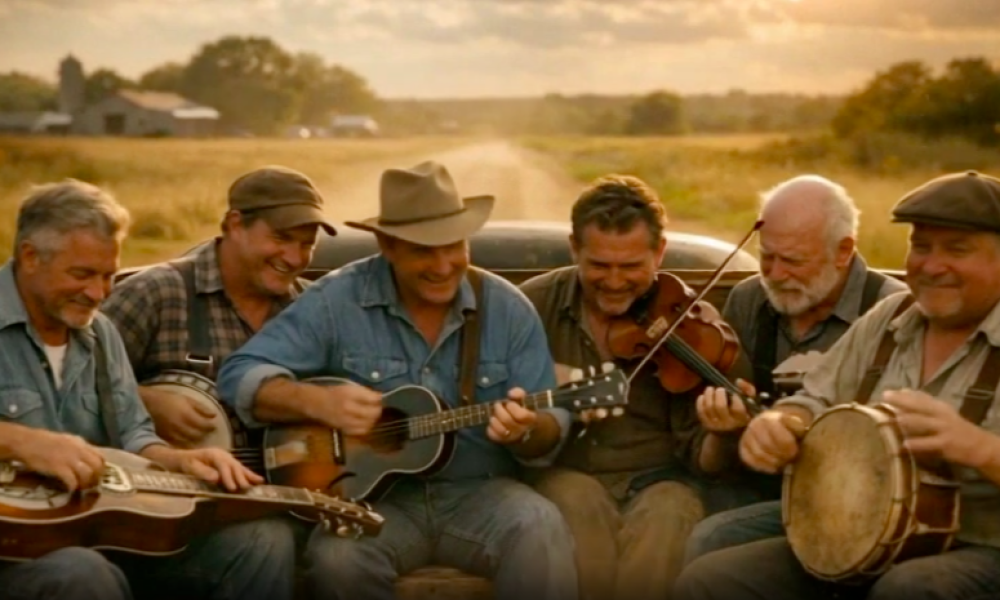
PRESS RELEASE- Feb 19, 2026
Cajun Dead et le Talkin’ Stick: A Structural Return to Source That’s Rebooting Mainstream Country Music
Moncton, N.B. — A quiet but unmistakable shift is emerging in the country music landscape, and it’s coming from a place few industry gatekeepers expected: a multidisciplinary Appalachian‑inspired, Acadian French and Hill‑Bill Mountain English lyric project known as Cajun Dead et le Talkin’ Stick. Created by French Canadian songwriter and conceptual artist Claude Edwin Theriault, the project is challenging the increasingly standardized templates of commercial country by returning to the structural DNA that built the genre in the first place.
As Nashville’s production frameworks grow more compressed, predictable, and algorithm‑aligned, Theriault’s catalogue stands apart. It is not designed for streaming‑era sameness. It is built on regional architecture, modal Appalachian lineage, and the rhythmic continuity of Franco‑Cajun traditions—the very elements that once defined American roots music before the industry narrowed its sonic bandwidth.
Industry observers are beginning to take notice of Country Ain’t Nothin’ but three chords and the truth. And the question now circulating in A&R circles is simple: Is country music ready for a structural reboot?
Reclaiming the Mountain Music First Spark: A Return to Appalachian and Franco‑Cajun Song Catalogue
Theriault’s Cajun Dead et le Talkin’ Stick project is not a nostalgic throwback. It is a structural reclamation. Drawing from the modal scales, call‑and‑response phrasing, and rhythmic asymmetry of early Appalachian and the Nordic Nova Scotia cousins of the Louisiana Cajun communities, the catalogue reintroduces the musical grammar that predates modern country’s commercial polish.
According to commentary across roots‑music forums and independent industry analysis, the project’s architecture diverges sharply from the “template familiarity” dominating today’s country charts. Contemporary production often prioritizes compressed loudness, predictable chord cycles, and lyrical tropes engineered for playlist compatibility. By contrast, Cajun Dead et le Talkin’ Stick leans into heritage‑driven irregularity—the kind of structural authenticity that once defined mountain music before it was streamlined for mass consumption.
The reference article, Structural Return to Appalachian and Franco‑Cajun Roots Challenges, Current Industry Templates, highlights this tension directly: while compositions rooted in these traditions reflect foundational American musical identity, they do not always align with the comparables used in modern A&R evaluation. In other words, the industry’s measuring tools may no longer be calibrated to detect the very authenticity audiences increasingly crave.
Theriault’s work, as explored in the feature Cajun Dead et le Talkin’ Stick: Reclaiming the First Spark of Mountain Music, positions itself as a corrective—an intentional return to the “first spark” of the genre, before commercial formatting overtook regional storytelling.
A new Country Music Catalogue That Defies Nashville Formatting—and Why That Matters Now
What makes Cajun Dead et le Talkin’ Stick so disruptive is not only its sound but also its refusal to conform to Nashville’s current structural expectations. The catalogue is built on:
- Modal Appalachian lineage rather than major‑key predictability
- Franco‑Cajun roots revival with rhythmic continuity instead of four‑on‑the‑floor uniformity
- Acadian French and Hill‑Bill Mountain English lyricism that resists homogenization
- Narrative irregularity that mirrors oral-tradition storytelling
- Uncompressed dynamic range that prioritizes emotional contour over algorithmic optimization
This is not a project that fits neatly into the “radio‑ready” mold. And that is precisely why it is gaining traction among listeners seeking something more grounded, more regional, and more structurally honest.
Historically, country music has always moved in cycles: periods of consolidation followed by sudden returns to geographic specificity. The outlaw era, the neo‑traditionalist revival, and the Americana resurgence all emerged after moments of commercial saturation. Analysts now suggest that another recalibration may be underway—one driven by audiences fatigued by formulaic production and hungry for roots‑driven authenticity.
If that shift continues, catalogues like Theriault’s—built on source traditions rather than industry templates—may become increasingly valuable. They offer a return to the Appalachian music blueprint for what a post‑template country landscape could sound like.

Cajun Dead et le Talkin’ Stick Rebooting Mainstream Country Music by Returning to Appalachian Roots Music Source
Cajun Dead et le Talkin’ Stick is not merely a creative project; it is a structural argument. It proposes that the future of country music may lie not in further standardization, but in a deliberate return to the regional, linguistic, and alt-country, rhythmic diversity that birthed the genre. Now on a multitude of streaming platforms waiting for you.
Theriault’s multidisciplinary approach—bridging Acadian French heritage, Appalachian modality, and mountain music ‑English storytelling—creates an Alt Country Twang hybrid form that feels both ancient and newly relevant. It challenges the assumption that commercial viability requires uniformity. Instead, it suggests that authenticity itself may be the next frontier of mainstream appeal.
Whether Nashville’s infrastructure is prepared to recognize this shift remains an open question. But the signals are there: rising interest in roots‑driven content, growing fatigue with formulaic production, and a cultural appetite for music that feels lived‑in rather than engineered.
Cajun Dead et le Talkin’ Stick arrives at precisely the moment when country music may be ready to rediscover its own foundations. And in doing so, it positions itself not as an outlier, but as a catalyst—rebooting the genre by returning it to its source.