
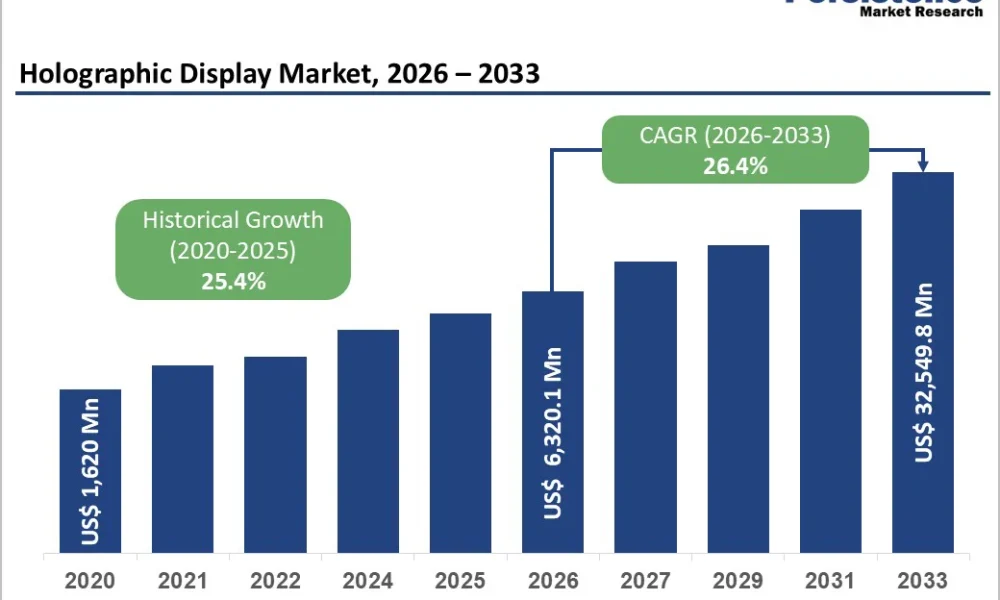
The global holographic display market is poised for explosive growth, projected to rise from US$ 6,320.1 million in 2026 to US$ 32,549.8 million by 2033, expanding at a remarkable CAGR of 26.4% during the forecast period. This rapid growth reflects increasing demand for immersive, high-resolution visualization technologies across retail, healthcare, automotive, defense, and consumer electronics industries.
Holographic displays use light diffraction and interference to generate realistic 2D, 3D, and even 4D visuals that can be viewed without special glasses or headsets. Unlike conventional LCD and LED screens, holographic systems create depth perception, parallax effects, and real-time motion rendering—transforming how digital content is consumed and interacted with.
With consumers demanding immersive experiences and enterprises seeking innovative engagement tools, holographic technology is rapidly transitioning from novelty to mainstream adoption.
Market Overview and Growth Outlook
The holographic display market has already demonstrated strong historical growth, registering a CAGR of 25.4% between 2019 and 2025. However, the upcoming period signals even stronger momentum, fueled by advancements in artificial intelligence (AI), 5G connectivity, spatial light modulators (SLMs), and real-time rendering capabilities.
Artificial intelligence is significantly reducing computational complexity in hologram generation. Deep learning algorithms now enable faster rendering, improved clarity, and dynamic scene adaptation. Meanwhile, advanced SLM technologies enhance phase modulation, refresh rates, and image resolution, improving depth realism.
North America is expected to dominate the market in 2026 with a 36.9% share, while Asia Pacific is anticipated to emerge as a high-growth region through 2033.
Key Industry Highlights
- Market Size (2026E): US$ 6,320.1 Mn
- Forecast Value (2033F): US$ 32,549.8 Mn
- Projected CAGR (2026–2033): 26.4%
- Dominant Region (2026): North America (36.9%)
- Leading Technology: Electro-holography (71.3% share)
- Leading Industry Vertical: Retail (30.5% share)
- Key Growth Driver: Immersive retail and AI-powered rendering
- Major Players: Looking Glass Factory Inc., Holoxica Ltd, RealView Imaging Ltd., Continental AG
Market Dynamics
Driver: Immersive Retail Experiences
Retail is emerging as one of the strongest adoption sectors for holographic displays. By projecting floating 3D product visuals, retailers create highly interactive and immersive in-store environments.
Luxury watch brands and fashion retailers have deployed holographic mannequins and floating product displays to enhance customer engagement. For example, holographic marketing campaigns have demonstrated measurable improvements in conversion rates and sales performance.
Global brands like Nike, Adidas, and Samsung have integrated 3D holographic installations into flagship stores to elevate brand storytelling and premium positioning.
By replacing static digital signage with dynamic holographic visuals, businesses are achieving stronger emotional engagement and improved purchasing decisions.
Restraint: Real-Time Rendering and System Performance
Despite impressive advancements, holographic displays face technical constraints. Real-time rendering of complex 3D holograms demands significant computational resources, often straining processors.
Compared to LCD and LED systems, holographic displays may struggle with refresh rates and image sharpness in highly dynamic applications such as gaming and live broadcasting.
In medical and scientific visualization, where ultra-high precision is required, holography still faces performance and cost-related limitations. Infrastructure upgrades and integration complexity further slow widespread adoption in healthcare settings.
Opportunity: Shift Toward Touchless Interfaces
The COVID-19 pandemic accelerated demand for touchless human-machine interfaces (HMIs). Holographic displays capable of projecting interactive visuals into mid-air offer hygienic alternatives in high-traffic environments.
Healthcare systems, including initiatives supported by the National Health Service (NHS), have increased adoption of advanced imaging tools for diagnostics and surgical planning.
Companies such as Holo Industries are leveraging Neonode sensors and ASKA3D plates to develop contactless holographic displays for hospitals, elevators, restaurant kiosks, and public transportation systems.
As hygiene-conscious design becomes permanent in infrastructure planning, touchless holography presents significant long-term growth opportunities.
Elevate your business strategy with comprehensive market data. Request a sample report now: https://www.persistencemarketresearch.com/samples/33414
Category-Wise Analysis
Technology Insights
Electro-Holography (71.3% Market Share)
Electro-holography is projected to dominate the market in 2026, accounting for 71.3% of total share. This technology reconstructs the full light field of objects, delivering realistic depth, motion, and parallax without requiring glasses.
Its adoption spans:
- Automotive design visualization
- Medical imaging
- Advertising installations
- Education and training simulations
Electro-holography’s superior realism and dynamic rendering capability make it the preferred solution across advanced visualization applications.
Touchable Holography (Fastest-Growing Segment)
Touchable holography enables users to physically interact with projected 3D images using ultrasonic or optical feedback systems. As immersive experiences evolve, interactive holographic interfaces are gaining traction in gaming, exhibitions, and retail.
The demand for natural, intuitive digital interaction methods is accelerating growth in this segment.
Industry Insights
Retail (30.5% Market Share)
Retail is expected to account for 30.5% of the market in 2026. Immersive holographic displays create futuristic shopping environments, boosting foot traffic and customer dwell time.
Brands deploy holography for:
- Product launches
- Interactive in-store promotions
- Virtual try-on experiences
- Premium brand storytelling
Industrial Sector (Rapid Growth)
The industrial segment is projected to expand rapidly due to demand for advanced visualization in:
- Automotive prototyping
- Product design simulations
- Maintenance training
- Engineering visualization
Automotive manufacturers are integrating holography into advanced driver-assistance systems (ADAS) and design workflows, improving development efficiency and reducing physical prototyping costs.
Regional Insights
North America – Market Leader
North America is expected to hold over 36% of global market share in 2026, driven by heavy R&D investments and strong technology adoption.
Companies such as Microsoft and Google are pioneering holographic communication technologies.
Microsoft HoloLens has gained adoption in manufacturing and healthcare for training and remote collaboration. Meanwhile, Project Starline by Google aims to transform virtual communication with life-sized holographic video conferencing.
Asia Pacific – China Leading Innovation
China is emerging as a major growth engine, supported by 5G infrastructure and AI investments. The country’s expanding consumer electronics and digital signage markets drive holographic adoption.
South Korea’s K-Smart City initiative integrates holographic displays into urban development strategies, reinforcing the region’s long-term growth prospects.
Europe – Industry 4.0 and Automotive Applications
Europe is advancing holography through Industry 4.0 initiatives. German automotive manufacturers are exploring holographic integration for ADAS and infotainment systems.
The U.K. is promoting holographic imaging in healthcare, microscopy, and telepresence applications, backed by government-supported innovation programs.
Competitive Landscape
The holographic display market is highly fragmented, with startups and established players competing through innovation and strategic collaborations.
Leading companies include:
- Looking Glass Factory Inc.
- Holoxica Ltd
- RealView Imaging Ltd.
- HYPERVSN
- Continental AG
- VividQ Ltd
Key Industry Developments
- February 2025: Xiaomi India partnered with Khushi D3X to launch a holographic campaign for Redmi Note 14 Pro+ 5G using PRISMOX and Hypervsn technologies.
- December 2024: Looking Glass Factory Inc. integrated Unity-based iOS support, enabling iPhones and iPads to power multiview 3D experiences without PCs.
- October 2024: Data Vault Holdings Inc. launched DVHolo in partnership with HYPERVSN, boosting viewer engagement by up to 40%.
Future Outlook
The holographic display market is entering a transformative era driven by AI optimization, 5G connectivity, smart city development, and immersive retail strategies. As hardware costs decline and rendering capabilities improve, holography is expected to transition from premium niche installations to mainstream digital infrastructure.
With projected revenues surpassing US$ 32.5 billion by 2033, holographic displays are set to redefine digital communication, visualization, and interactive experiences across industries.
Organizations investing in AI-enhanced rendering, touchless interfaces, and industry-specific holographic applications will be best positioned to capitalize on this high-growth opportunity in the coming decade.
Related Reports:




