
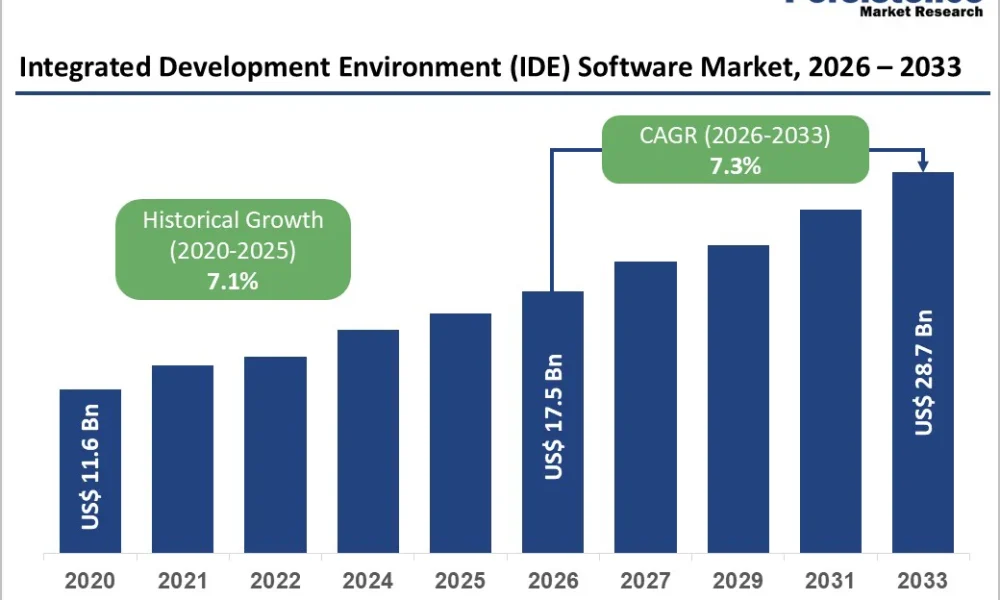
The global Integrated Development Environment (IDE) software market is entering a transformative growth phase, fueled by rapid digital transformation, cloud adoption, AI integration, and expanding developer communities worldwide. The market is projected to be valued at US$17.5 billion in 2026 and is expected to reach US$28.7 billion by 2033, registering a CAGR of 7.3% between 2026 and 2033. Historical growth from 2020 to 2025 stood at 7.1%, indicating sustained momentum in demand for advanced software development tools.
As enterprises across industries accelerate their digital initiatives, IDE platforms have become central to building, testing, and deploying applications efficiently. From startups to global corporations, modern development teams rely on integrated environments that combine coding, debugging, testing, and deployment into unified workflows.
Market Overview and Growth Drivers
Rising Demand for Efficient Development Tools
Organizations are increasingly prioritizing faster time-to-market and enhanced software quality. IDEs streamline development processes by integrating code editors, compilers, debuggers, version control systems, and deployment tools into a single interface. This consolidation improves developer productivity, reduces errors, and enhances collaboration.
Industries such as BFSI, healthcare, retail, manufacturing, and telecom are heavily investing in software-driven innovation. Whether building enterprise systems, customer-facing applications, or IoT-enabled platforms, businesses require robust IDE solutions to manage complex codebases and ensure operational efficiency.
Increasing Adoption of Cloud-Based Development Platforms
Cloud-based IDEs are revolutionizing software development by offering browser-accessible, fully integrated environments. Platforms like Amazon Web Services (AWS) Cloud9 and Gitpod allow developers to code from anywhere without complex local installations.
Cloud IDE adoption is accelerating due to:
- Remote and hybrid work models
- Real-time collaboration capabilities
- Integration with DevOps pipelines
- Lower infrastructure costs for SMEs
- Rapid scalability
Cloud-based development environments support seamless collaboration among distributed teams, enabling multiple developers to work simultaneously on the same codebase. This model significantly reduces setup time and enhances agility.
Integration of AI-Assisted Coding and Intelligent Debugging
AI integration is redefining the IDE landscape. Modern IDEs incorporate features such as:
- Intelligent code completion
- Automated bug detection
- Predictive error analysis
- Code refactoring suggestions
- Natural language-to-code conversion
For example, Microsoft continues to embed AI features into its development tools, improving developer efficiency and reducing coding friction. AI-powered debugging tools significantly minimize manual troubleshooting efforts, enabling developers to focus on innovation rather than error correction.
AI-driven IDEs are particularly valuable for complex, multi-language development environments and enterprise-scale projects.
Market Restraints
Security and Data Privacy Concerns
While cloud IDEs offer flexibility and scalability, they require storing source code on external servers. This raises concerns regarding:
- Data breaches
- Intellectual property theft
- Regulatory compliance
- Unauthorized access
Industries such as finance, healthcare, and defense are particularly cautious about cloud-based code storage. Enterprises operating under regulations like GDPR must ensure compliance before migrating to cloud IDE platforms.
Integration Challenges in Hybrid Environments
Enterprises with legacy systems often face compatibility issues when integrating modern IDEs with:
- Existing DevOps pipelines
- On-premises infrastructure
- Version control systems
- Third-party plugins
Synchronization complexities in hybrid environments can increase operational costs and reduce efficiency, thereby slowing adoption in some regulated industries.
Emerging Opportunities
AI and DevOps Synergy
The integration of DevOps practices within IDEs is accelerating software lifecycle efficiency. Modern IDEs connect seamlessly with:
- CI/CD pipelines
- Version control systems
- Automated testing tools
- Containerization platforms
The synergy between AI and DevOps enables continuous integration, continuous deployment, and rapid iteration cycles. This empowers organizations to adopt agile methodologies and deliver high-quality applications at scale.
Elevate your business strategy with comprehensive market data. Request a sample report now: https://www.persistencemarketresearch.com/samples/19972
Category-Wise Market Analysis
By Application: Web Development Leads
Web application development is projected to dominate, accounting for approximately 40% of total revenue in 2026. The dominance of web-based services, e-commerce platforms, and SaaS models drives this segment’s growth.
Tools such as Visual Studio Code and IntelliJ IDEA provide robust frameworks for JavaScript, HTML5, CSS, and backend development, making them indispensable in modern web projects.
Mobile Application Development: Fastest-Growing Segment
The expansion of the global app economy and rising smartphone penetration fuel mobile IDE demand. Platforms such as:
- Android Studio
- Xcode
enable developers to efficiently build Android and iOS applications.
Cross-platform frameworks like Flutter and React Native further enhance IDE adoption by enabling single-codebase development across multiple devices.
By End-User: Large Enterprises Dominate
Large enterprises are expected to account for over 50% of revenue in 2026, driven by:
- Complex development requirements
- Global distributed teams
- Significant IT budgets
- Enterprise-grade security needs
Companies such as Amazon and Microsoft rely on enterprise IDE ecosystems to manage large-scale software initiatives.
SMEs: Fastest-Growing Segment
Small and Medium Enterprises (SMEs) are increasingly adopting subscription-based cloud IDEs due to:
- Lower upfront costs
- Flexible licensing models
- Access to enterprise-grade tools
- Startup ecosystem expansion
Cloud accessibility enables SMEs to compete with larger players by leveraging scalable and cost-effective development solutions.
Regional Analysis
North America: Market Leader (42% Share in 2026)
North America is expected to hold 42% of the global market in 2026, supported by:
- Mature IT infrastructure
- Strong developer ecosystem
- Early AI adoption
- High per-capita IDE spending
The U.S. remains a global hub for cloud-first and AI-enabled development solutions.
Major vendors like Oracle, IBM, and Microsoft significantly contribute to regional dominance.
Europe: Strong Adoption Across Industries
Countries such as Germany, the U.K., and France demonstrate strong demand for IDE solutions in automotive, fintech, and manufacturing sectors. European enterprises emphasize:
- Regulatory compliance
- Secure development environments
- DevOps automation
- AI-enabled workflows
The region balances innovation with strict data protection frameworks.
Asia Pacific: Fastest-Growing Region
Asia Pacific is projected to witness the fastest growth, driven by:
- Expanding startup ecosystems
- IT outsourcing growth
- Government digital initiatives
- Increasing developer workforce
Countries such as India and Japan are rapidly adopting AI-powered coding platforms and cloud-native development practices. Government initiatives like Digital India support widespread software development activity across public and private sectors.
Competitive Landscape
The IDE software market is moderately fragmented, featuring a mix of global technology giants and specialized vendors. Key players include:
- Adobe
- Amazon Web Services
- IBM
- JetBrains
- Microsoft
- Red Hat
- SAP SE
- ServiceNow
- Intel
- Renesas Electronics
Competition centers on:
- AI-assisted capabilities
- Plugin ecosystems
- Cloud integration
- Security compliance
- Pricing flexibility
Open-source tools compete alongside enterprise-grade paid offerings, intensifying market dynamics.
Key Industry Developments
In November 2025, Microsoft introduced Visual Studio 2026 as an AI-native development environment, incorporating AI-powered debugging, performance profiling, and modernization tools.
In October 2025, Syncfusion launched Code Studio, an AI-driven IDE focused on secure, enterprise-ready coding with governed AI features, strengthening competition in AI-enabled development platforms.
Future Outlook
The IDE software market is set for sustained growth through 2033, driven by:
- Expanding digital transformation initiatives
- Proliferation of cloud-native applications
- Rising developer workforce globally
- AI-powered coding evolution
- DevOps integration
As enterprises prioritize innovation, scalability, and rapid deployment, IDE platforms will continue evolving toward cloud-first, AI-native, and collaborative environments.
By 2033, intelligent development environments capable of autonomous debugging, predictive coding, and seamless DevOps orchestration will likely become industry standards. Organizations that invest in advanced IDE ecosystems will gain competitive advantages in speed, efficiency, and software quality.
Conclusion
The Integrated Development Environment (IDE) software market is positioned for strong and sustained expansion, reaching US$28.7 billion by 2033 at a CAGR of 7.3%. With North America leading and Asia Pacific emerging as the fastest-growing region, the market reflects global digital acceleration.
AI integration, cloud adoption, DevOps alignment, and expanding developer ecosystems will define the next generation of IDE platforms. As software continues to drive innovation across industries, IDE solutions will remain foundational to global digital progress.
Related Reports:




