
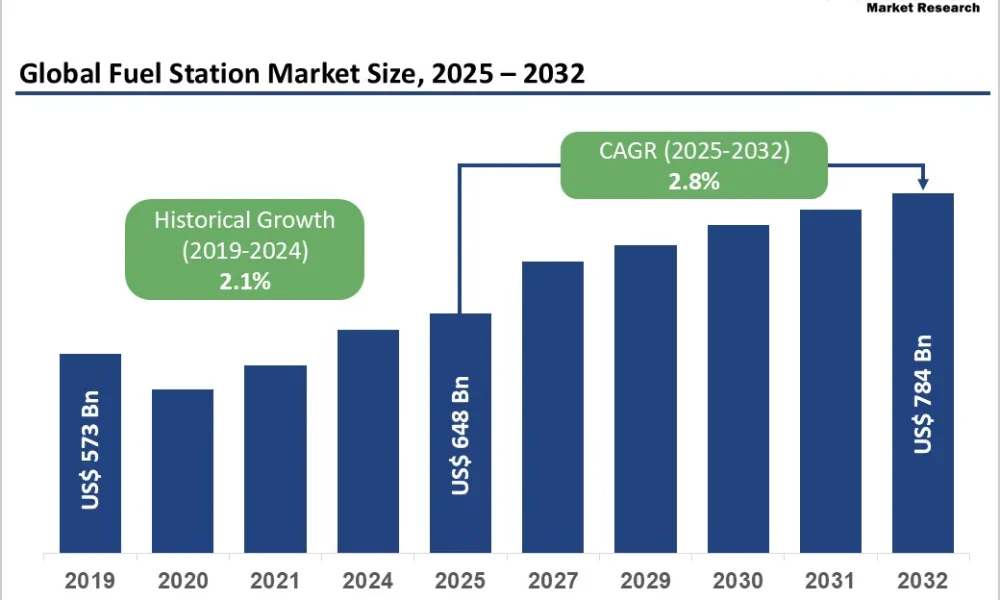
The global fuel station market is entering a phase of measured but stable expansion as mobility demand continues to grow across passenger and commercial transportation segments. According to Persistence Market Research, the market is likely to be valued at around US$648 billion in 2025 and is expected to reach around US$784 billion by 2032, growing at a CAGR of 2.8% during 2025 – 2032. This steady trajectory reflects resilient fuel consumption patterns, supported by expanding vehicle fleets in developing economies and sustained freight movement in global trade corridors.
In terms of market statistics, the projected growth from US$648 billion in 2025 to US$784 billion by 2032 underscores the structural importance of fuel retail infrastructure worldwide. A CAGR of 2.8% indicates stable demand rather than volatile spikes, positioning the fuel station market as a foundational component of the global energy and transportation ecosystem. Rising vehicle ownership, stable consumer fuel demand in major transport regions, and modernization of stations into multi-service hubs are key growth drivers. Traditional fuel retail remains the leading segment due to its widespread vehicle dependency, while Asia Pacific is emerging as the leading geographical region owing to expanding vehicle fleets and freight activity.
Want Market Insights? Get Your Free Report Sample : https://www.persistencemarketresearch.com/samples/35848
Key Highlights from the Report
➤ The global fuel station market is projected to grow from US$648 billion in 2025 to US$784 billion by 2032 at a CAGR of 2.8%
➤ Rising vehicle fleets and freight activity in developing economies are strengthening long term fuel demand
➤ Stable consumer fuel demand in major transport regions is sustaining consistent revenue streams
➤ Modernization of stations into multi-service hubs is enhancing profitability and customer engagement
➤ Investments in EV fast-charging, CNG, and biofuel integration are reshaping fuel station infrastructure
➤ Asia Pacific is emerging as a leading region driven by transportation growth and expanding logistics networks
Market Segmentation
The fuel station market can be segmented based on fuel type, station format, and end-user category. By fuel type, the market includes conventional fuels such as petrol and diesel, alongside alternative fuels such as CNG and biofuels. Traditional fuels continue to dominate due to the existing global vehicle base heavily reliant on internal combustion engines. However, the integration of EV fast-charging points is gaining traction, signaling a gradual diversification of station offerings. This dual model is allowing operators to cater to both conventional and alternative energy consumers.
Based on station format, the market includes standalone fuel pumps and multi-service hubs offering retail convenience stores, food services, and vehicle maintenance. Multi-service hubs are increasingly preferred as they enhance customer dwell time and generate additional revenue streams beyond fuel sales. In terms of end users, passenger vehicles represent a substantial share due to widespread personal mobility, while commercial fleets and freight vehicles contribute significantly to volume-based fuel consumption. This segmentation highlights how infrastructure adaptation is central to sustaining long term growth in the fuel station market.
Regional Insights
Asia Pacific is emerging as a leading region in the fuel station market, driven by expanding vehicle fleets and rising freight activity in developing economies. Rapid urbanization, industrialization, and logistics expansion are contributing to sustained demand for fuel retail infrastructure. The region’s growing middle class and increasing vehicle ownership further reinforce the need for an expanded and modernized fuel station network.
Other major transport regions continue to demonstrate stable consumer fuel demand, supporting steady revenue growth. Mature markets are focusing on modernization strategies, including the transformation of traditional fuel stations into integrated service hubs. Parallel investments in EV fast-charging, CNG, and biofuel integration are helping regional players diversify energy offerings while maintaining strong core fuel sales.
Make This Report Fit Your Needs – Customize Now : https://www.persistencemarketresearch.com/request-customization/35848
Market Drivers
One of the primary drivers of the fuel station market is the steady rise in global vehicle fleets, particularly in developing economies. As urban populations expand and disposable incomes increase, vehicle ownership continues to climb, directly boosting fuel consumption. Freight activity linked to manufacturing, construction, and e-commerce logistics also contributes significantly to fuel demand. This consistent mobility requirement supports long term stability in fuel retail revenues.
Another key driver is the modernization of fuel stations into multi-service hubs. Operators are increasingly integrating convenience retail, food outlets, and vehicle maintenance services to enhance customer engagement and profitability. These diversified offerings reduce dependence solely on fuel margins and create multiple income streams. Furthermore, investments in EV fast-charging, CNG, and biofuel integration are reshaping infrastructure, ensuring that stations remain relevant amid evolving energy transitions.
Market Restraints
Despite steady growth, the fuel station market faces structural restraints associated with energy transition policies and environmental concerns. The gradual shift toward electric mobility may moderate long term demand for conventional fuels. Regulatory pressures aimed at reducing carbon emissions can influence fuel consumption patterns and investment decisions in certain regions. Such developments require operators to adapt their business models to remain competitive.
Fluctuations in crude oil prices and operational costs also pose challenges for fuel station operators. Volatility in fuel pricing can impact profit margins and consumer purchasing behavior. Additionally, infrastructure upgrades for integrating alternative fuels and EV charging involve significant capital expenditure. These financial considerations may limit expansion strategies, particularly for smaller independent operators.
Market Opportunities
The transformation of fuel stations into energy and mobility hubs presents substantial growth opportunities. By integrating EV fast-charging infrastructure, CNG, and biofuel options, operators can attract a broader customer base. This diversification aligns with global sustainability goals while preserving the commercial relevance of fuel retail networks. Hybrid models that combine traditional fuel dispensing with alternative energy solutions are expected to drive future competitiveness.
Moreover, expanding freight networks and cross border trade activities offer additional opportunities for fuel station expansion in developing economies. Strategic placement along highways and logistics corridors can enhance volume sales and long term contracts with commercial fleet operators. Digital payment integration, loyalty programs, and data driven customer engagement strategies further provide avenues for revenue optimization in the evolving fuel station market.
Ready to Dive Deep? Buy Full Report Today : https://www.persistencemarketresearch.com/checkout/35848
Company Insights
Key players operating in the fuel station market include
- Shell plc
- BP plc
- TotalEnergies SE
- ExxonMobil Corporation
- Chevron Corporation
- Sinopec Group
- PetroChina Company Limited
- Saudi Aramco
- Indian Oil Corporation Limited
- Bharat Petroleum Corporation Limited (BPCL)
- Hindustan Petroleum Corporation Limited (HPCL)
- ENEOS Holdings, Inc.
- PTT Public Company Limited
- Repsol S.A.
- Eni S.p.A.
- Phillips 66
- Marathon Petroleum Corporation
- Valero Energy Corporation
- Petronas
- Couche-Tard Inc. (Circle K)
Recent Developments
January 2025
A leading global fuel retailer expanded its EV fast-charging network across major highway corridors to strengthen its multi energy strategy.
September 2024
A major energy company announced upgrades of selected fuel stations into integrated service hubs featuring alternative fuel options and retail enhancements.
Future Opportunities and Growth Prospects
The future of the fuel station market lies in balancing traditional fuel retail with emerging energy solutions. With projected growth to US$784 billion by 2032-35 at a CAGR of 2.8%, the market demonstrates resilience supported by mobility demand and infrastructure modernization. Investments in EV charging, CNG, and biofuel integration will likely redefine the competitive landscape. As stations evolve into comprehensive mobility hubs, operators that successfully integrate digital services, diversified energy options, and customer centric strategies are expected to capture sustained growth opportunities in the coming decade.




