
The clinical alarm management market is an essential part of healthcare technology, addressing one of the most pressing issues faced by medical institutions: alarm fatigue. Hospitals and healthcare settings have seen an exponential increase in the number of monitoring devices used to track patients’ vital signs, which in turn generates a surge of alarms. However, many of these alarms are unnecessary or false, leading to a significant amount of distraction for medical staff and, in some cases, the risk of missing critical alerts. Clinical alarm management solutions aim to filter, prioritize, and respond to these alarms in an efficient and timely manner to improve patient safety and reduce the burnout of healthcare professionals.
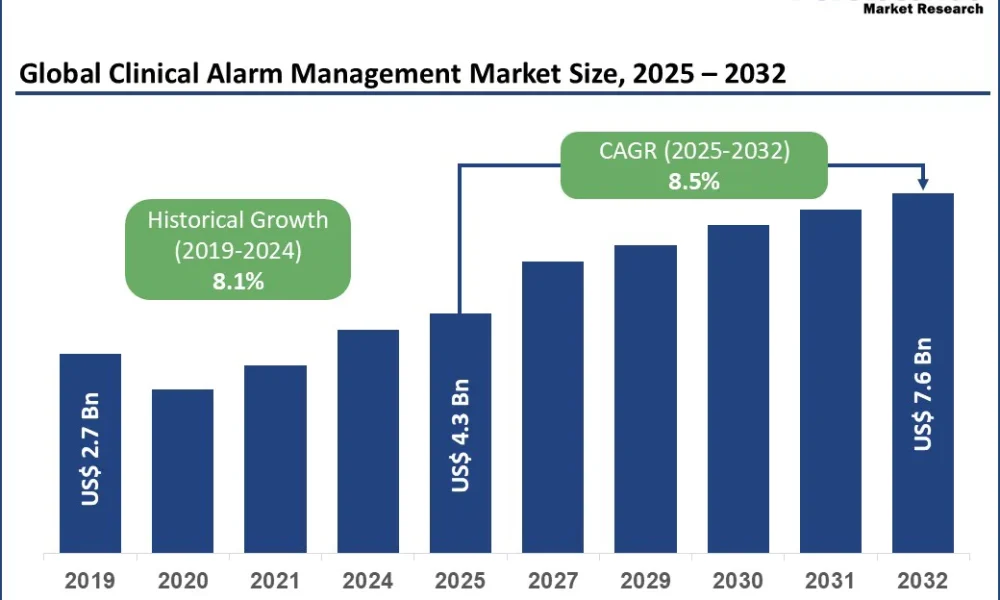
The market is poised for significant growth, with a projected value of US$ 4.3 billion in 2025 and an estimated US$ 7.6 billion by 2032, growing at a CAGR of 8.5% from 2025 to 2032. This growth is driven by a variety of factors, including rising patient safety concerns, regulatory requirements, and the growing prevalence of alarm fatigue in healthcare environments.
Among the key growth drivers, the rising adoption of digital healthcare solutions and the increasing pressure on healthcare facilities to optimize operations are paramount. Hospitals are under increasing pressure to improve efficiency while reducing costs, and alarm management solutions support these goals by eliminating unnecessary distractions, improving staff efficiency, and enhancing patient safety. Additionally, the increasing prevalence of chronic diseases and the expanding number of healthcare facilities globally are major contributing factors.
In terms of market segmentation, the nurse call systems segment is expected to be the leading product type, contributing nearly 39.7% of the market share in 2025, largely due to the rising demand for efficient communication between patients and caregivers. The North American region is expected to dominate the market with approximately 44.2% share in 2025 due to stringent regulations, advanced healthcare systems, and early adoption of innovative monitoring technologies. However, the Asia-Pacific region is expected to emerge as the fastest-growing market, driven by increasing investments in healthcare infrastructure, hospital digitalization, and rising patient safety awareness.
Download Your Free Sample & Explore Key Insights: https://www.persistencemarketresearch.com/samples/33200
Key Highlights from the Report
• The global clinical alarm management market is expected to reach US$ 7.6 billion by 2032.
• The market is growing at a compound annual growth rate (CAGR) of 8.5% from 2025 to 2032.
• Nurse call systems are forecasted to hold the largest market share, around 39.7% in 2025.
• Solutions account for approximately 55.6% of the market share, driven by regulatory compliance.
• North America is expected to hold the largest share of the market in 2025 at 44.2%.
• The Asia Pacific region is anticipated to be the fastest-growing region, driven by rising healthcare investments.
Market Segmentation
The clinical alarm management market is segmented based on product type, component, and end-user, each serving distinct needs and trends in the healthcare sector.
By Product Type:
The market is primarily divided into several product categories: nurse call systems, physiological monitors, bed alarms, Electronic Medical Record (EMR) integration systems, ventilators, and others. Among these, nurse call systems dominate, accounting for nearly 39.7% of the market share in 2025. These systems serve as essential communication tools between patients and healthcare providers, ensuring timely responses and contributing significantly to improving patient care and satisfaction. As healthcare facilities face staffing shortages and increased patient volumes, the demand for reliable communication systems has skyrocketed.
By Component:
The market can also be divided into solutions and services. Solutions are expected to account for a dominant 55.6% share in 2025. This is largely due to regulatory requirements and patient safety guidelines, particularly in North America and Europe, pushing hospitals to adopt centralized monitoring systems that integrate seamlessly with existing medical equipment. Solutions such as smart alarms and middleware platforms are in high demand for their ability to manage alarms across various devices, ensuring that only high-priority alerts are communicated to healthcare staff.
By End-User:
Hospitals and healthcare facilities form the primary end-user segment for clinical alarm management systems. These settings need alarm management solutions to handle the overwhelming number of alarms generated by monitoring devices such as ventilators, infusion pumps, and bedside monitors. These solutions not only help streamline operations but also reduce the risks associated with alarm fatigue, which can compromise patient safety.
Regional Insights
North America:
North America is currently the leading region in the clinical alarm management market, contributing 44.2% of the market share in 2025. This dominance is attributed to stringent regulations in the healthcare industry, such as the U.S. Food and Drug Administration’s (FDA) rules regarding alarm safety. Additionally, the early adoption of advanced healthcare technologies, including digital alarm systems, plays a significant role in the region’s market growth. Alarm fatigue is also a significant issue in North America, with hospitals actively seeking solutions that can reduce the number of unnecessary alarms and enhance the quality of patient care.
Asia-Pacific:
The Asia-Pacific region is expected to witness the highest growth rate in the coming years. Countries like India and China are experiencing rapid healthcare infrastructure development and increasing healthcare investments, which are driving the adoption of clinical alarm management solutions. Alarm fatigue, as well as rising concerns regarding patient safety, are becoming more prominent in these countries, further fueling the demand for effective alarm management systems.
Europe:
Europe is another important market for clinical alarm management. The region has been proactive in developing guidelines and standards to improve alarm management practices in hospitals and clinics. Moreover, technological advancements in machine learning and artificial intelligence have led to the development of smart alarm systems that can distinguish between false and true alarms. These innovations are helping improve patient safety and enhance operational efficiencies across healthcare settings.
Get Custom Insights Designed for Your Business: https://www.persistencemarketresearch.com/request-customization/33200
Market Drivers
Several factors contribute to the growth of the clinical alarm management market. One of the key drivers is the rising prevalence of alarm fatigue. Alarm fatigue occurs when medical staff become desensitized to frequent alarms, leading to slow response times or missed critical alerts. By implementing effective alarm management systems, hospitals can ensure that only the most urgent alarms are brought to the attention of medical personnel, reducing distractions and improving response times.
Another significant driver is the increasing demand for regulatory compliance. Regulatory bodies across the globe are introducing strict guidelines on alarm management to enhance patient safety. For instance, the U.S. FDA and the European Union have established comprehensive standards for clinical alarm systems. These regulations compel healthcare institutions to adopt advanced alarm management technologies that meet these standards.
Finally, the growing burden on healthcare systems is another important factor driving the market. With the increasing volume of patients and the rising complexity of patient care, hospitals and healthcare providers need efficient systems that allow them to manage large volumes of patient data and alarms without compromising care quality.
Market Restraints
Despite its growth prospects, the clinical alarm management market faces certain challenges, primarily revolving around data privacy and security concerns. Alarm management systems often involve the integration of multiple devices, electronic medical records (EMRs), and mobile platforms, all of which carry sensitive patient data. The risk of data breaches, especially when systems are cloud-based or connected to external networks, is a major deterrent for healthcare providers. Unauthorized access or poor data security protocols can lead to compliance issues, financial penalties, and damage to a hospital’s reputation.
Furthermore, high implementation costs can be a barrier for smaller healthcare institutions. While large hospitals can easily absorb the costs associated with adopting advanced alarm management systems, smaller clinics and rural healthcare facilities may struggle to justify the investment, particularly when facing budgetary constraints.
Market Opportunities
One of the most promising opportunities for the clinical alarm management market is the rise of remote patient monitoring and telehealth. With more patients being monitored at home through wearable devices or mobile health platforms, the need for effective alarm management systems is growing. These systems can help healthcare providers filter out minor alerts and prioritize critical ones, allowing them to focus on urgent cases.
Telehealth platforms are also integrating alarm management into their workflows, especially in the management of chronic diseases like diabetes and chronic obstructive pulmonary disease (COPD). By effectively managing alarms, telehealth services can offer safe and reliable remote care, reducing the need for in-person visits and improving overall healthcare accessibility.
Checkout Now & Download Complete Market Report: https://www.persistencemarketresearch.com/checkout/33200
Company Insights
The clinical alarm management market is competitive, with several large players and specialized providers offering solutions to address the challenges posed by alarm fatigue and regulatory compliance. Key players in the market include:
• Koninklijke Philips N.V.
• Ascom Holdings AG
• General Electric Company (GE Healthcare)
• Hill-Rom Services, Inc.
• Capsule Technologies, Inc.
• Vocera Communications, Inc.
• West-Com Nurse Call Systems, Inc.
• Medtronic plc
• TigerConnect
• Mobile Heartbeat
• JCT Healthcare Pty Ltd.
• Tunstall Group
• AmpleLogic
• Amplion Clinical Communications Inc.
Market Segmentation
By Product Type
- Nurse Call Systems
- Physiological Monitors
- Bed Alarms
- EMR Integration Systems
- Ventilators
- Others
By Component
- Solutions
- Services
By End-use
- Hospitals and Clinics
- Home Care Settings
- Ambulatory Care Centers
- Long-term Care Facilities
- Specialty Centers
By Region
- North America
- Europe
- East Asia
- South Asia and Oceania
- Latin America
- Middle East and Africa
Recent Developments:
In February 2025, Agiliti launched the Essentia multi-acuity bed frame, designed to support a broad range of patients in various hospital settings.
In August 2025, Medpage unveiled the MPNCAK1 CMEX-21 Nurse Call Adaptor Kit, designed to enhance patient safety and care environments using advanced fall integration sensors.
Conclusion
The clinical alarm management market is set to witness significant growth, driven by factors such as rising alarm fatigue, increasing regulatory pressure, and advancements in healthcare technologies. As hospitals seek to improve patient care while managing operational costs, clinical alarm management systems will play an integral role in enhancing staff productivity and reducing patient safety risks. With regions like North America leading the charge and Asia Pacific emerging as the fastest-growing market, the future of clinical alarm management looks promising. As the healthcare sector continues to evolve, so too will the technologies that support it, ensuring that hospitals are better equipped to manage alarms and respond effectively to patient needs.




