
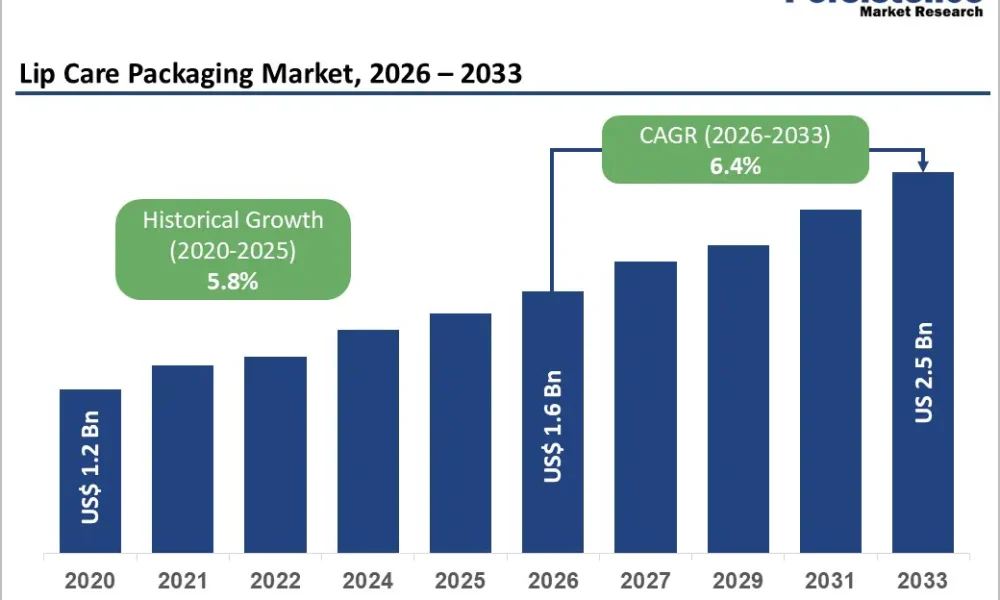
The lip care packaging market is evolving as brands focus on aesthetics, functionality, and sustainability to meet changing consumer expectations. Lip balms, serums, and tinted lip care products are increasingly positioned as daily essentials rather than seasonal products, creating steady demand for innovative primary packaging formats. According to Persistence Market Research, the global lip care packaging market size is likely to be valued at US$1.6 billion in 2026. Packaging suppliers are investing in design differentiation, material innovation, and user convenience to support premium and mass market brands. Refillable formats, twist up sticks, tubes, and roll ons are gaining popularity across global markets. Rising per capita personal care spending is strengthening the overall market foundation. Packaging plays a strategic role in brand storytelling and shelf appeal. This shift has elevated packaging from a functional component to a value adding asset.
From a statistical perspective, Persistence Market Research indicates that the market is expected to reach US$2.5 billion by 2033, growing at a CAGR of 6.4 percent between 2026 and 2033. Growth is driven by premiumization of lip care products including SPF infused balms, overnight lip masks, and treatment serums. The leading segment continues to be stick and tube based primary packaging due to portability and controlled application. The cosmetics and personal care brands segment remains the dominant end user due to continuous product launches. Asia Pacific emerges as the leading geographical region, supported by expanding beauty consumption, local manufacturing capabilities, and strong demand for affordable premium packaging solutions.
Want Market Insights? Get Your Free Report Sample : https://www.persistencemarketresearch.com/samples/36031
Key Highlights from the Report
➤ Lip care packaging market to reach US$2.5 billion by 2033 driven by premium product adoption
➤ Rising per capita personal care expenditure is strengthening packaging demand globally
➤ Sustainable and recyclable materials are reshaping primary packaging strategies
➤ Stick and tube formats remain the leading packaging segment across applications
➤ Asia Pacific leads the lip care packaging market due to volume driven cosmetic demand
➤ Brand investments in differentiated packaging designs are accelerating innovation
Market Segmentation Analysis
The lip care packaging market is segmented by product type into sticks, tubes, jars, roll ons, and other customized formats. Stick and tube packaging dominates due to its hygienic application, compact size, and consumer familiarity. Jars and specialty formats are witnessing moderate growth, particularly in premium and treatment based lip care products. Material wise segmentation includes plastic, paper based, metal, and composite packaging. Plastic continues to account for a significant share, although paper based and recyclable alternatives are gaining traction. Lightweight packaging and cost efficiency remain key considerations for manufacturers.
Based on end user, the market is segmented into mass market brands, premium beauty brands, private labels, and indie cosmetic brands. Premium and indie brands are increasingly demanding customized packaging solutions to support brand identity. Mass market brands focus on scalability and cost optimization to serve high volume demand. Customization options such as color finishes, embossing, and applicator innovation are becoming standard across segments. Contract manufacturers and packaging suppliers are aligning offerings with evolving brand requirements. This segmentation structure supports diversified growth opportunities.
Regional Insights
Asia Pacific dominates the lip care packaging market due to rapid urbanization, increasing beauty awareness, and strong manufacturing ecosystems. Countries in this region benefit from high consumption of daily use lip care products and competitive packaging production costs. Local brands and global players alike are expanding their presence to capture volume driven growth.
North America and Europe remain key mature markets driven by premium product launches and sustainability focused packaging regulations. Brands in these regions emphasize recyclable materials and refillable packaging concepts. Innovation in design and compliance with environmental standards continues to influence regional demand patterns.
Get a Customized Market View in One Click : https://www.persistencemarketresearch.com/request-customization/36031
Market Drivers
The primary driver of the lip care packaging market is the rising consumption of lip care products as part of daily personal care routines. Increased awareness of lip health, sun protection, and hydration has expanded product usage across demographics. Premiumization has intensified demand for high quality packaging that enhances perceived product value. Brand differentiation through packaging design is becoming critical in competitive retail environments. Growing disposable income supports experimentation with new product formats. Packaging innovation directly influences purchase decisions.
Another major driver is sustained brand investment in sustainable packaging solutions. Companies are transitioning toward recyclable and reduced plastic formats to align with environmental expectations. Lightweight packaging helps reduce transportation costs and carbon footprint. Refillable concepts are gaining attention among eco conscious consumers. Regulatory pressure further encourages sustainable material adoption. These factors collectively strengthen market momentum.
Market Restraints
One of the key restraints in the lip care packaging market is fluctuating raw material costs, particularly for plastics and specialty materials. Price volatility can impact profit margins for packaging manufacturers. Smaller players often struggle to absorb cost increases while maintaining competitive pricing. Supply chain disruptions may delay production schedules. These challenges can limit market expansion in cost sensitive segments.
Another restraint is the complexity of balancing sustainability with performance. Eco friendly materials may face limitations in durability, barrier protection, or compatibility with certain formulations. Compliance with cosmetic safety standards adds to development timelines. Brands may hesitate to adopt new materials without proven performance. This cautious approach can slow innovation cycles.
Market Opportunities
Significant opportunities exist in the development of refillable and reusable lip care packaging formats. Growing environmental awareness encourages consumers to choose brands offering sustainable alternatives. Refill systems help brands build long term customer relationships. This trend supports premium positioning while reducing packaging waste. Packaging suppliers can capitalize on design innovation.
Emerging markets present additional opportunities due to expanding beauty consumption and retail penetration. Local brands seek cost effective yet visually appealing packaging solutions. Digital first cosmetic brands require differentiated packaging for online appeal. Technological advancements in lightweight and mono material packaging further enhance growth potential. These factors create a favorable outlook.
Complete Your Order – Get Full Report Immediately : https://www.persistencemarketresearch.com/checkout/36031
Company Insights
Key players operating in the lip care packaging market include
- AptarGroup
- Albéa Group
- Berry Global
- HCP Packaging
- Quadpack
- Silgan Dispensing
- RPC Group
- Gerresheimer
- Berlin Packaging
- Amcor
- Cosmopak
- Aptar Beauty + Home
- Wheaton Group
- Piramal Glass
- Coveris
- CTK Cosmetics
- Rieke Packaging Systems
- Huhtamaki
Recent Developments
January 2024 Leading packaging companies expanded recyclable lip balm tube offerings to support sustainability targets
September 2023 Major cosmetic brands partnered with packaging suppliers to introduce refillable lip care formats
Future Opportunities and Growth Prospects
The future of the lip care packaging market is shaped by premiumization, sustainability, and design innovation. Brands that align packaging strategies with consumer expectations for functionality and eco responsibility will gain competitive advantage. According to Persistence Market Research, steady growth supported by rising personal care expenditure and differentiated packaging solutions positions the market for long term expansion through 2033.




