
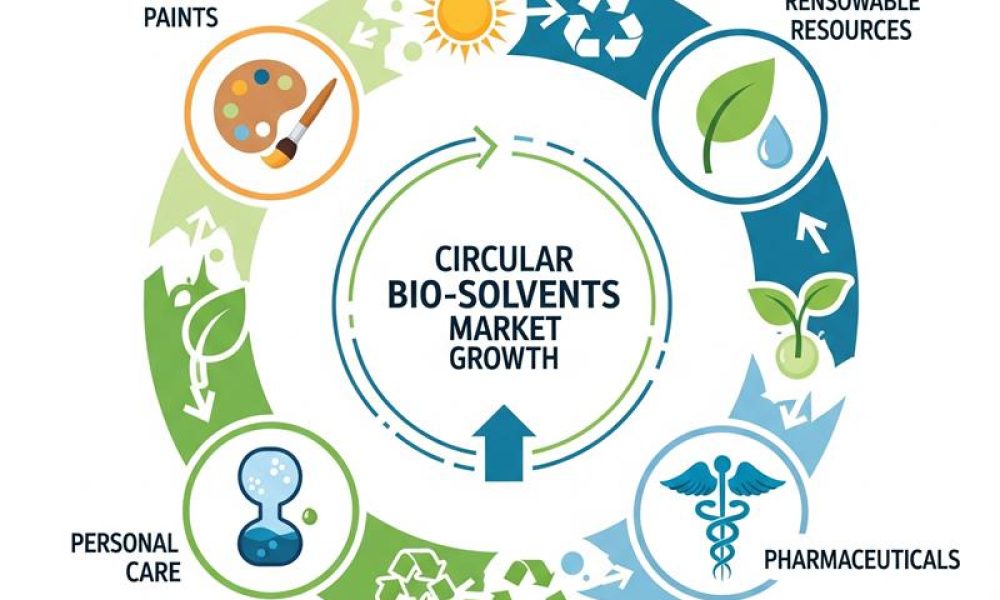
Driven by the intersection of corporate decarbonization mandates and a systemic shift toward the “Safe-and-Sustainable-by-Design” (SSbD) framework, the global circular bio-solvents market is entering a pivotal phase of industrial adoption. New industry data released today estimates the market value at $6.76 billion in 2026, up from $6.21 billion in 2025. This critical green chemistry sector is projected to reach $11.73 billion by 2032, maintaining a robust compound annual growth rate (CAGR) of 9.49%.
The market’s acceleration is primarily anchored in the transition from linear, crop-based production to a “circular bioeconomy.” Unlike first-generation bio-solvents, the circular model prioritizes the upcycling of organic waste, agricultural residues, and post-consumer feedstocks into high-purity industrial solvents. This transformation is not merely a material swap but a strategic response to the European Union’s Circular Economy Action Plan and the United States’ recent tax incentives for bio-based manufacturing.
Request for Sample Report | Customize Report | Purchase Full Report – https://www.factmr.com/connectus/sample?flag=S&rep_id=10839
The Molecular Pivot: Addressing the “Who, What, and Why”
Circular bio-solvents—including bio-alcohols, lactate esters, and bio-glycols—are the sustainable alternatives to petrochemical-derived solvents like NMP, DMF, and toluene. The “how” of this market’s evolution in 2026 is rooted in three core industry catalysts:
- Toxicity Reduction and Worker Safety: Governments worldwide are tightening Volatile Organic Compound (VOC) thresholds. Circular bio-solvents offer a high-boiling-point, non-carcinogenic profile that significantly improves air quality in manufacturing environments, particularly in the paints and coatings sector, which currently holds a 43% market share.
- Feedstock Diversification: To avoid the “food vs. fuel” dilemma, 2026 has seen a surge in solvents derived from lignocellulosic waste and coffee grounds. Projects like the EU-funded SOLRESS are now demonstrating industrial-scale production of bio-waste-derived ethyl acetate and butyl acetate.
- Price Parity via Carbon Taxing: While bio-solvents traditionally commanded a 20% to 50% premium over fossil-derived versions, the arrival of the Carbon Border Adjustment Mechanism (CBAM) in 2026 is effectively narrowing the cost gap by leveling the playing field for renewable alternatives.
Market Context: Regional Leadership and Sector Growth
The 2026 landscape is characterized by the dominance of North America and a rapid technological leap in the Asia-Pacific region.
- North America: Maintaining its status as the largest consumer, the U.S. market is driven by the Inflation Reduction Act’s support for domestic bio-manufacturing. The region currently accounts for approximately 40% of the global market share, led by high demand in the pharmaceutical and aerospace sectors.
- Asia-Pacific: Recognized as the fastest-growing market, APAC—led by China and India—is leveraging its massive agricultural base to secure local feedstocks. The region is seeing a surge in D-Limonene and Methyl Soyate production, growing at a projected 4.8% CAGR.
- Europe: As the regulatory vanguard, Europe remains the hub for “Safe-and-Sustainable-by-Design” innovation. Germany and France are leading the integration of bio-solvents into high-end automotive refinishing and cosmetic formulations.
Technological Frontiers: Micro-Refineries and Smart Biocatalysis
The technological narrative of 2026 is defined by the integration of biotechnology and modular manufacturing.
- Enzymatic Synthesis & Biocatalysis: Leading chemical producers are replacing energy-intensive distillation with enzymatic pathways. This allows for the production of specialty solvents with higher selectivity and significantly lower carbon footprints than traditional chemical synthesis.
- Decentralized “Micro-Biorefineries”: A major trend for 2026 is the deployment of containerized refineries located near agricultural waste sites. This reduces transportation emissions and allows for the localized production of bio-ethanol and bio-methanol for nearby industrial clusters.
- Low-VOC Performance: Advanced formulation techniques are overcoming the historic “slow-dry” challenges of bio-solvents. New 2026 blends of Lactate Esters and Bio-Glycols now offer evaporation rates comparable to petrochemical incumbents, enabling seamless adoption for Tier-1 automotive and construction coatings.
Competitive Landscape: The Rise of Bio-Industrial Giants
The competitive environment is shifting from specialty startups to large-scale industrial integration. Key market leaders include:
- Archer Daniels Midland (ADM) & Cargill Inc.: Leveraging vast agricultural supply chains to dominate the bio-alcohol and ester segments.
- BASF SE & Dow Inc.: Integrating circular bio-solvents into their broader mass-balance portfolios to help OEM clients meet Scope 3 emission targets.
- Corbion N.V. & Solvay S.A.: Leading the market in high-purity lactate esters and sustainable dipolar aprotic solvents for electronics and pharmaceuticals.
- Vertec Biosolvents & Stepan Company: Focusing on high-performance blends for the industrial cleaning and degreasing sectors.
The Path Toward 2032: Toward Integrated Carbon Accounting
As the industry moves toward 2032, the circular bio-solvents market is expected to transcend its role as a “green alternative.” Analysts anticipate a surge in Blockchain-verified Carbon Intensity (CI) labeling, where every liter of solvent is tracked from waste-collection to end-use. For investors and industry leaders, the strategic priority remains the mastery of the purity-to-circularity ratio—where the ability to deliver high-performance chemistry from low-value waste defines the next era of industrial resilience.
About Fact.MR
Fact.MR is a global market research and consulting firm, trusted by Fortune 500 companies and emerging businesses for reliable insights and strategic intelligence. With a presence across the U.S., UK, India, and Dubai, we deliver data-driven research and tailored consulting solutions across 30+ industries and 1,000+ markets. Backed by deep expertise and advanced analytics, Fact.MR helps organizations uncover opportunities, reduce risks, and make informed decisions for sustainable growth.



