
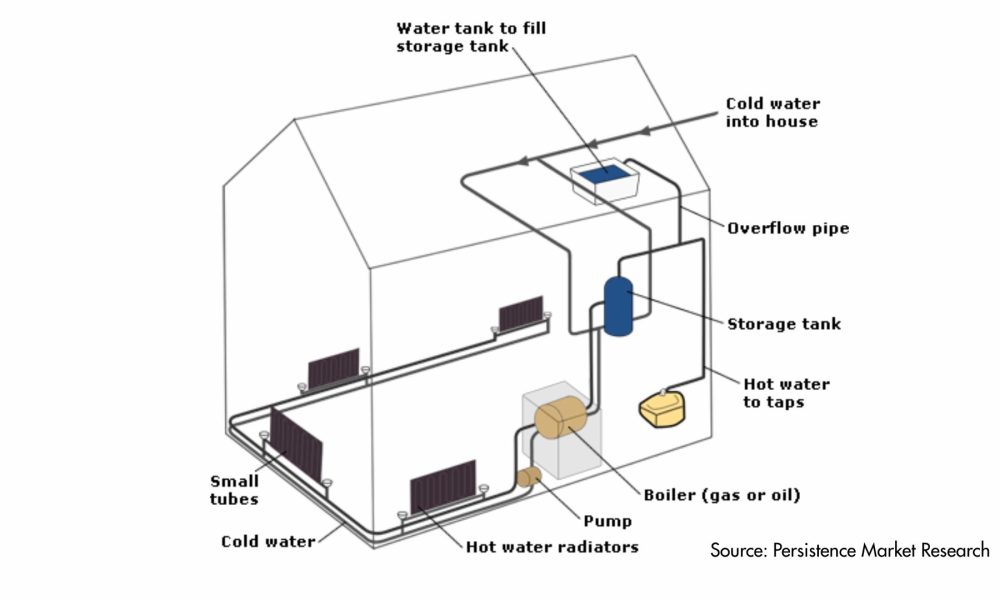
The global Centralized Heating Systems Market is projected to witness sustained expansion over the next decade, offering significant opportunities for manufacturers, developers, and end-users across residential, commercial, and industrial sectors. According to the latest insights from Persistence Market Research (PMR), the market is estimated to reach USD 43.4 billion by 2033, up from an anticipated USD 34.1 billion in 2026, registering a Compound Annual Growth Rate (CAGR) of 3.5% during 2026-2033. This growth underscores increasing demand for energy-efficient, low-carbon and technologically advanced heating infrastructure worldwide.
Market Dynamics and Growth Drivers
The global centralized heating systems market growth is primarily influenced by several strategic drivers that align with broader energy and environmental objectives. Increasing urbanization, new construction activity, and infrastructure modernization in emerging economies have led to greater adoption of centralized heating systems, particularly in multi-unit residential and large commercial buildings. Further, stringent environmental regulations and governments’ commitments to building energy efficiency standards are accelerating investments in advanced heating solutions that reduce greenhouse gas emissions and improve thermal performance.
Policy initiatives like decarbonization mandates in Europe and funding incentives in the UK have markedly increased investment momentum. Regulatory changes now channel funding toward hybrid, renewable and network-based heating systems, reinforcing centralized heating infrastructure as a compliant and future-ready solution for large developments. Such policy support, combined with technological innovations in product efficiency and smart controls, is reshaping market dynamics in favour of centralized heating.
Get Your FREE Sample Report Instantly – Click Now: https://www.persistencemarketresearch.com/samples/21775
Product Segment Insights
In the product landscape, condensing combination boilers currently dominate revenue share, accounting for approximately 32% of the market in 2026. These units are widely preferred for their outstanding energy performance and dual functionality — providing both space heating and hot water from a single unit. Their compact design and high efficiency make them particularly attractive for residential renovations and small commercial applications, where space and energy performance are critical considerations.
System boilers, meanwhile, are forecast to grow at a notably higher CAGR of 5.2% through 2033, driven by demand in larger institutional and commercial facilities. Manufacturers are increasingly offering enhanced system boiler platforms with digital interfaces, modular integrations, and improved analytics features that support remote system control and energy optimization. These advancements position system boilers as integral components of smart building infrastructure and sustainability strategies.
Energy Source Trends
Analyzing energy sources within centralized heating systems reveals that gas heating systems remain the largest contributor, representing an estimated 38% of the source share in 2026. Gas infrastructure is deeply entrenched in mature markets such as Europe and North America, where it continues to serve as a reliable heat source for both residential and commercial applications. Recent product updates emphasize low-NOx emissions and enhanced efficiency to meet local environmental standards without compromising performance.
At the same time, renewable and environmental heating sources are emerging as the fastest-growing segment, expected to achieve a 6.8% CAGR through 2033. Driven by robust decarbonization mandates and funding support for sustainable projects, use of geothermal heat, biomass energy, solar thermal systems, and recovered waste heat are gaining traction — especially in Europe. Noteworthy investments, such as grant-backed renewable district heating projects, illustrate the growing potential of renewable sources to transform centralized heating networks.
End-Use Sector Performance
The market’s end-use segmentation highlights a balanced demand across commercial and residential sectors. Commercial offices and institutional buildings are projected to hold approximately 34% of the revenue share in 2026. In this segment, large floor areas, stringent energy codes, and long-term infrastructure planning make centralized heating an efficient and cost-effective choice. Building owners and facility managers increasingly prioritize systems with integrated control capabilities that optimize performance across fluctuating load conditions, reduce lifecycle costs, and support sustainability goals.
The residential segment, meanwhile, is expected to register the fastest growth, with an estimated 6.1% CAGR through 2033, buoyed by urban housing expansion, renovation projects, and supportive financing schemes. Government grants and schemes that encourage adoption of low-carbon heating solutions have significantly boosted residential demand for centralized heating systems integrated with hybrid or renewable components.
Get a Customized Market View in One Click: https://www.persistencemarketresearch.com/request-customization/21775
Regional Market Insights
Europe stands out as the dominant regional market, capturing an estimated 37% of global centralized heating systems revenue in 2026. Strong government policies, extensive district heating networks, and large funding pools for clean energy projects underpin Europe’s leadership position. National and EU-wide initiatives are accelerating adoption, with co-funding and operational grants boosting both new installations and modernization of existing systems.
In North America, market growth is supported by federal and state-level incentives that promote energy-efficient heating solutions and retrofits of aging infrastructure. Tax credits and rebate programs for high-efficiency and hybrid systems are key enablers, complemented by collaborations among utilities, technology providers, and local governments aimed at smart system integration and predictive maintenance.
Asia Pacific is poised to register the fastest regional growth through 2033, driven by rapid urbanization, infrastructure investments, and supportive national policies focused on energy efficiency and decarbonization. China’s expanding district heating network and heat pump action plans, along with smart city initiatives in countries like India and Southeast Asia, contribute to a dynamic growth landscape that attracts both domestic and international investors.
Competitive Landscape
The centralized heating systems market remains moderately consolidated, with leading players such as Viessmann, Bosch Thermotechnology, Ariston Thermo, Daikin, and Vaillant collectively accounting for a significant share of global revenues. These companies leverage extensive distribution channels, product diversification, and integrated service offerings that span traditional boilers, hybrid systems, and renewable heat solutions. Continuous investment in R&D, compliance-oriented innovations, and digital energy management technologies sustain their competitive advantage.
Niche and regional players, including Nibe, Mitsubishi Electric, and Grundfos, focus on specialized segments such as industrial heat pumps and low-carbon solutions, capitalizing on partnerships and market expansion strategies. As market dynamics evolve, consolidation through mergers, acquisitions, and strategic alliances is expected to increase, with a shared focus on renewable integration and smart heating solutions.
For In-Depth Competitive Analysis, Buy Now: https://www.persistencemarketresearch.com/checkout/21775
Outlook and Future Opportunities
Looking ahead, the centralized heating systems market is expected to benefit from continued investments in renewable energy sources, smart grid integrations, and retrofit projects that modernize existing heat infrastructure. Policy mandates promoting net zero goals, coupled with technological advancements in digital controls and predictive analytics, are anticipated to unlock additional growth opportunities for stakeholders across the value chain.
About Persistence Market Research:
Persistence Market Research delivers strategic research solutions that drive business growth. Founded in 2012 and registered in England and Wales in 2023 as Persistence Research & Consultancy Services Ltd., we have completed 3,600+ custom and syndicated studies and supported 2,700+ projects for leading research firms. Combining traditional methodologies with modern tools, we provide actionable insights to multinational corporations, consultants, investors, and government bodies, earning strong trust through long-term client relationships.
Contact Us:
Persistence Market Research
Second Floor, 150 Fleet Street,
London, EC4A 2DQ, United Kingdom
USA Phone: +1 646-878-6329
UK Phone: +44 203-837-5656
Email: [email protected]
Web: https://www.persistencemarketresearch.com




