
The global data center landscape is undergoing a profound transformation as enterprises race to modernize their IT infrastructure for a digital-first world. At the heart of this evolution lies the Software-Defined Data Center (SDDC)—a model that abstracts compute, storage, networking, and security resources from physical hardware and delivers them as software-driven services. This paradigm shift is redefining how organizations deploy, manage, and scale mission-critical workloads.
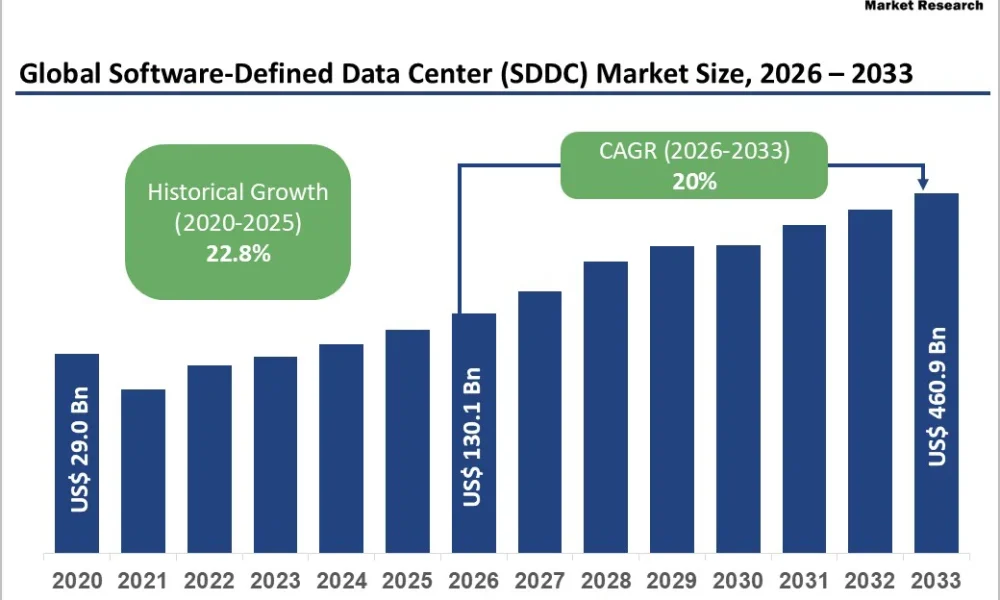
The global SDDC market is projected to be valued at US$130.1 billion in 2026 and is expected to surge to US$460.9 billion by 2033, expanding at an impressive CAGR of 20% between 2026 and 2033. This robust growth trajectory is fueled by aggressive enterprise digital transformation initiatives, the exponential rise of AI-driven workloads, and the accelerating adoption of hybrid and multi-cloud environments that demand centralized orchestration and policy-driven management.
As enterprises across industries rethink infrastructure strategies, SDDCs have evolved from an emerging IT concept into mission-critical digital infrastructure, enabling agility, cost optimization, operational efficiency, and enhanced security.
Understanding the Software-Defined Data Center Concept
A Software-Defined Data Center is built on the principle of decoupling hardware from service delivery. Unlike traditional data centers—where compute, storage, and networking are tightly bound to physical infrastructure—SDDCs virtualize all infrastructure components and manage them through intelligent software layers.
Core elements of an SDDC include:
- Software-defined compute (SDC) for virtualized processing power
- Software-defined storage (SDS) for scalable, policy-driven data management
- Software-defined networking (SDN) for programmable, automated connectivity
- Software-defined security embedded across all layers
Together, these components allow organizations to dynamically allocate resources, automate operations, and manage infrastructure holistically—regardless of whether workloads run on-premises, in the cloud, or across hybrid environments.
Market Growth Drivers: Why SDDC Adoption Is Accelerating
Enterprise Digital Transformation at Scale
Organizations across sectors are modernizing legacy IT environments to support cloud-native applications, digital services, and remote work models. SDDCs provide the agility required to rapidly deploy and scale infrastructure without the constraints of physical hardware provisioning.
Explosion of AI and Data-Intensive Workloads
AI, machine learning, big data analytics, and high-performance computing workloads require flexible compute architectures capable of dynamic scaling. Software-defined compute enables enterprises to reallocate processing power in real time, making SDDCs a natural foundation for AI infrastructure.
Shift Toward Hybrid and Multi-Cloud Strategies
Enterprises increasingly operate across hybrid and multi-cloud ecosystems to balance performance, cost, compliance, and resilience. SDDCs enable centralized orchestration, consistent policies, and unified visibility across distributed environments.
Cost Optimization and Operational Efficiency
By automating infrastructure management and improving resource utilization, SDDCs significantly reduce capital expenditure (CapEx) and operating expenses (OpEx), while minimizing downtime and manual intervention.
Elevate your business strategy with comprehensive market data. Request a sample report now: https://www.persistencemarketresearch.com/samples/35928
Key Industry Highlights and Market Segmentation Insights
Software-Defined Compute Leads Component Adoption
Among SDDC components, software-defined compute (SDC) is expected to dominate the market with a 36.5% revenue share in 2026. This leadership reflects the surging demand for flexible compute resources driven by AI workloads, containerized applications, and autonomous IT operations. Enterprises are prioritizing compute virtualization to dynamically scale processing capacity without hardware dependencies.
Cloud-Based Deployments Take the Lead
Cloud-based SDDC deployment models are projected to command 50.1% of total revenue in 2026 and are also anticipated to register the highest CAGR through 2032. As organizations migrate from on-premises infrastructure toward cloud-native architectures, cloud-based SDDCs offer faster deployment, lower upfront costs, and seamless scalability.
IT & Telecommunications Dominate Vertical Adoption
The IT and telecommunications sector holds the largest market share at 26.3% in 2026. Telecom operators are leveraging SDDCs to virtualize network functions, support 5G rollouts, and manage distributed edge infrastructure efficiently. Software-defined networking and compute are critical enablers of next-generation telecom architectures.
Government & Public Sector Emerges as Fastest-Growing Vertical
Government and public sector organizations represent the fastest-growing SDDC vertical, driven by digital government initiatives, regulatory compliance requirements, and modernization of legacy IT systems. SDDCs help public institutions improve service delivery, enhance cybersecurity, and ensure data sovereignty.
Regional Market Dynamics
North America Maintains Market Leadership
North America is forecast to account for 40.2% of global SDDC market share in 2026, supported by advanced cloud adoption, concentrated AI computing activity, and stringent regulatory compliance in the United States. The presence of hyperscale cloud providers and leading SDDC technology vendors further strengthens the region’s dominance.
Asia Pacific Emerges as the Fastest-Growing Region
The Asia Pacific region is expected to be the fastest-growing SDDC market through 2033, driven by rapid digital transformation across emerging economies. Countries such as India and China are witnessing strong demand for scalable infrastructure to support manufacturing modernization, smart cities, fintech expansion, and AI adoption.
Enterprise Focus Areas: AI Enablement and Cybersecurity
SDDCs as the Backbone of Enterprise AI
Enterprises are systematically channeling new SDDC investments toward AI infrastructure enablement. Software-defined environments allow organizations to provision GPU and accelerator resources dynamically, optimize workload placement, and support data-intensive training and inference workloads.
Embedded Security by Design
Cybersecurity has become a top priority as enterprises expand digital footprints. SDDCs integrate security directly into the infrastructure layer through microsegmentation, policy-driven access control, and real-time threat monitoring. This “security-by-design” approach reduces attack surfaces and improves compliance readiness.
Industry Developments and Strategic Investments
The accelerating demand for scalable, energy-efficient data center infrastructure is driving strategic partnerships and large-scale investments. In November 2025, Overwatch Capital partnered with Japan’s Idemitsu to develop 1 GW of hyperscale data center capacity in the United States. This initiative highlights the growing need for next-generation data centers capable of supporting software-defined architectures and AI-driven workloads at scale.
Challenges Impacting Market Growth
Despite strong momentum, the SDDC market faces several challenges:
- Complex implementation and integration with legacy systems
- Skill gaps in managing software-defined and cloud-native environments
- Data security and compliance concerns across distributed infrastructures
However, ongoing advancements in automation, AI-driven infrastructure management, and managed SDDC services are steadily addressing these barriers.
Future Outlook: The Road Ahead for SDDCs
Looking ahead, SDDCs will continue to evolve as the foundation of autonomous, intelligent data centers. Integration with AI-driven operations (AIOps), edge computing, and sustainability-focused designs will further enhance their value proposition. As enterprises demand greater agility, resilience, and scalability, SDDCs will play a central role in shaping the future of global digital infrastructure.
Conclusion
The Software-Defined Data Center market is transitioning from a strategic IT option to an essential enterprise capability. With the market poised to grow from US$130.1 billion in 2026 to US$460.9 billion by 2033, SDDCs are enabling organizations to meet the demands of AI, cloud-native applications, and digital services at unprecedented scale.
By delivering agility, efficiency, and security through software-driven infrastructure, SDDCs are redefining how data centers are built and operated—positioning themselves as the backbone of the next generation of enterprise IT.
Related Reports:




