
The global Medical Case Management Services Market is undergoing steady expansion as healthcare systems worldwide prioritize coordinated, patient-centric care models. Valued at US$ 4.9 billion in 2025, the market is projected to reach US$ 6.7 billion by 2032, registering a compound annual growth rate (CAGR) of 4.7% during the forecast period. This growth reflects increasing pressure on healthcare providers, insurers, and employers to manage rising medical costs while simultaneously improving clinical outcomes and patient experiences. Medical case management services integrate clinical oversight, psychosocial support, reimbursement navigation, and continuous treatment coordination, making them a critical component of modern healthcare delivery.
Medical case management has evolved from a support function into a strategic healthcare capability. As patient pathways become more complex due to aging populations, chronic disease prevalence, and multi-specialty treatment requirements, structured case management is emerging as a vital tool to ensure continuity of care, reduce unnecessary utilization, and improve safety. The convergence of digital health technologies, value-based care initiatives, and growing insurance penetration is further reinforcing demand across global markets.
Download Your Free Sample & Explore Key Insights: https://www.persistencemarketresearch.com/samples/5294
Market Overview and Growth Outlook
The Medical Case Management Services Market has demonstrated consistent historical growth, expanding at a CAGR of 3.9% between 2019 and 2024. This upward trajectory is expected to accelerate modestly through 2032, supported by ongoing healthcare modernization efforts. Rising healthcare expenditures, combined with growing scrutiny on cost efficiency, are pushing providers and payers to adopt coordinated care solutions that optimize clinical workflows and resource utilization.
Case managers play an increasingly important role in navigating complex healthcare systems. They ensure accurate access to patient histories, medication interactions, post-surgical care plans, and follow-up protocols, significantly reducing the risk of medical errors and fragmented care. As healthcare delivery shifts toward integrated and outcome-driven models, medical case management services are becoming indispensable across acute, post-acute, and long-term care settings.
Key Industry Highlights
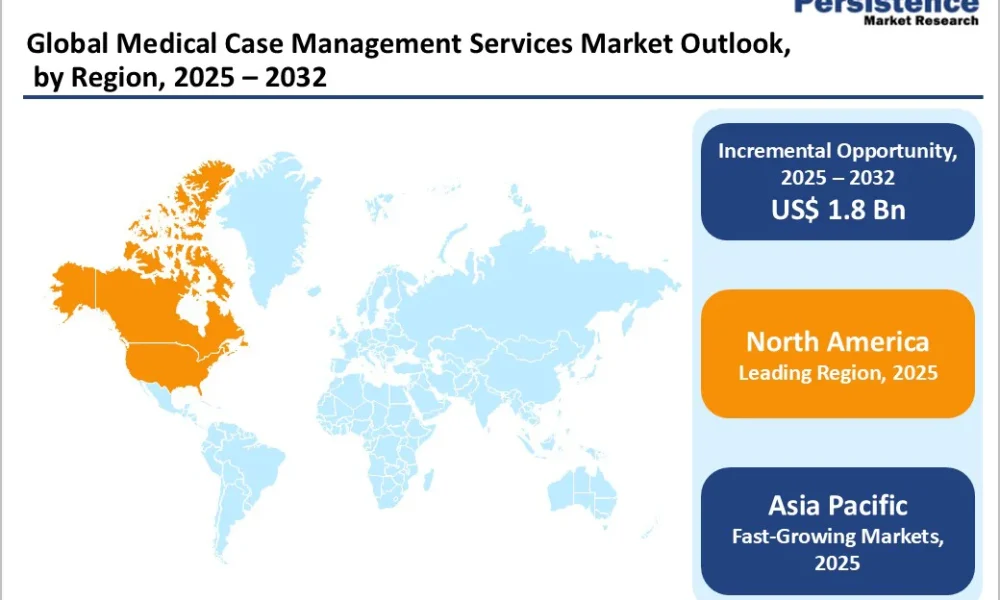
North America dominates the global Medical Case Management Services Market, accounting for 41.6% of total revenue in 2025. This leadership is driven by advanced healthcare infrastructure, strong insurance coverage, and early adoption of digital health platforms. Hospitals represent the leading end-user segment, capturing 68.2% of market share due to high patient volumes, complex case profiles, and the need for integrated clinical oversight. Web-based case management services lead by mode of service with a 42.8% share, reflecting the rapid adoption of scalable, cloud-based platforms that enable real-time care coordination.
From a clinical perspective, long-term disability represents the leading severity segment with 39.1% market share, underpinned by the rising global burden of chronic diseases such as diabetes, cancer, and cardiovascular disorders. Asia Pacific stands out as the fastest-growing regional market, projected to expand at a CAGR of 5.9%, supported by digital healthcare adoption, expanding private insurance coverage, and growing medical tourism.
Market Dynamics
Drivers: Digital Care Adoption, Chronic Disease Burden, and Advanced Care Infrastructure
The primary drivers of the Medical Case Management Services Market are the accelerating adoption of digital care technologies, the rising prevalence of chronic diseases, and the expansion of advanced healthcare infrastructure. Global population growth and aging demographics are increasing the demand for long-term and coordinated care, placing additional strain on healthcare systems. In this environment, medical case managers are essential in ensuring care continuity, patient safety, and efficient utilization of healthcare resources.
Technological advancements are significantly reshaping the market. Digital platforms now enable seamless communication between patients, providers, and insurers, improving care navigation and clinical decision-making. The increasing incidence of chronic conditions such as heart disease, cancer, stroke, and obesity further strengthens demand for structured case management, as these conditions often require multidisciplinary, long-duration care plans. Additionally, the expansion of employment benefits in developed economies is boosting the use of coordinated case management for workplace injuries and occupational health programs. The growing emphasis on value-based care models, which reward outcomes rather than service volume, is also driving adoption as providers seek solutions that reduce readmissions and improve quality metrics.
Restraints: Low Awareness, Workforce Shortages, High Costs, and Insurance Gaps
Despite strong growth drivers, several restraints continue to limit the market’s full potential. Limited awareness of medical case management services remains a significant challenge in developing regions, where vendor presence and education efforts are still limited. This lack of awareness reduces adoption among providers and patients who may not fully understand the benefits of coordinated care.
Workforce shortages present another major constraint. A significant proportion of case managers handle more than 100 cases per month, leading to high workloads, burnout, and reduced service quality. High service costs further restrict adoption, particularly in price-sensitive markets. In addition, low insurance penetration in many emerging economies weakens demand, as uninsured populations are less likely to access structured case management services. Variability in digital infrastructure also slows the adoption of web-based platforms, despite their growing prominence globally.
Opportunities: Digital Innovation, Value-Based Models, and Healthcare Modernization
The ongoing digital transformation of healthcare presents substantial opportunities for the Medical Case Management Services Market. The integration of artificial intelligence, predictive analytics, remote monitoring, and data-driven care navigation tools is enabling more proactive and personalized case management. Telehealth investments are creating new pathways for remote case oversight, particularly for patients with chronic conditions or mobility limitations.
The global shift toward value-based care offers another major opportunity, as hospitals and insurers increasingly seek coordinated solutions that lower costs and improve outcomes. In developing regions, expanding health insurance coverage and government-led healthcare modernization initiatives are expected to unlock new demand. Workplace health programs also represent a growing opportunity, with employers adopting case management services to manage occupational injuries, reduce absenteeism, and improve workforce productivity. Rising focus on patient experience and personalized care further supports the adoption of technology-enabled case management models.
Get Custom Insights Designed for Your Business: https://www.persistencemarketresearch.com/request-customization/5294
Category-wise Analysis
By Product Insights
Web-based medical case management services are projected to maintain a leading 42.8% share of the global market in 2025. Their dominance is driven by widespread healthcare digitalization and the need for real-time, interoperable care coordination platforms. These solutions enable faster case triaging, continuous access to medical records, and improved communication across care teams. Their scalability, cost efficiency, and flexible deployment models make them particularly attractive to large hospital systems and mid-sized healthcare providers alike.
By Severity of Case Insights
Long-term disability is expected to dominate the market with a 39.1% share in 2025. This segment benefits from the increasing prevalence of chronic and disabling conditions that require sustained monitoring, rehabilitation planning, and multidisciplinary intervention. Patients with long-term disabilities often face complex treatment pathways and insurance navigation challenges, increasing reliance on professional case management. As disability-related healthcare costs continue to rise globally, structured case management is becoming essential to control expenses while improving patient outcomes.
By End-user Insights
Hospitals are projected to remain the dominant end-user segment, accounting for 68.2% of market share in 2025. Their leadership reflects high patient volumes, complex clinical cases, and the need for integrated oversight across acute, specialty, and post-acute care. Hospitals are under growing pressure to reduce readmissions, improve care transitions, and meet value-based performance benchmarks, all of which reinforce dependence on comprehensive case management services.
Regional Insights
North America
North America is expected to retain its leading position with 41.6% of global market share in 2025. Strong insurance penetration, high chronic disease prevalence, and advanced healthcare infrastructure support robust adoption of case management services. The region is also a hub for innovation, with ongoing investments in digital care coordination platforms. In April 2025, Deacon Health launched a tech-enabled care coordination platform focused on value-based outcomes, improved clinician workflows, and enhanced patient engagement, further strengthening North America’s leadership.
Europe
Europe is projected to account for 29.4% of the global market in 2025. Universal healthcare systems across the region facilitate structured case management adoption, while a rapidly aging population is increasing demand for long-term, coordinated care. Government initiatives aimed at reducing hospital readmissions and improving care transitions are further driving market growth, positioning Europe as a stable and steadily expanding market.
Asia Pacific
Asia Pacific represents the fastest-growing regional market, with a projected CAGR of 5.9%. Rapid healthcare digitalization, expanding private insurance coverage, and rising chronic disease prevalence are key growth drivers. The region’s growing medical tourism industry also increases demand for cross-border care coordination. In May 2025, MeshApp launched a digital platform in India offering workflow management, insurance access, and medico-legal support, highlighting the region’s accelerating adoption of technology-enabled case management solutions.
Competitive Landscape
The competitive landscape of the Medical Case Management Services Market is increasingly technology-driven. Leading players are focusing on AI-enabled platforms that automate administrative tasks, enhance clinical decision support, and improve interoperability with electronic health record systems. Innovation efforts emphasize predictive analytics, regulatory compliance, data privacy, and workflow optimization across the care continuum.
Recent industry developments underscore this trend. In February 2025, Innovaccer launched Agents of Care™, an AI-driven suite integrated with over 80 EHRs to automate scheduling, referrals, and care gap closure. Oracle introduced AI-enhanced capabilities in its Argus and Safety One Intake solutions in July 2024, improving safety case management and regulatory compliance. Paragon 28 also advanced AI-driven surgical planning with its SMART28 Case Management Portal.
Checkout Now & Download Complete Market Report: https://www.persistencemarketresearch.com/checkout/5294
Market Segmentation
By Mode of Service
- Web-based Case Management Service
- Telephonic Case Management Service
- Field Case Management Service
- Bilingual Field Case Management Service
- Others
By Severity Of Case
- Catastrophic Case Management
- Chronic Pain Case Management
- Independent Medical Examinations
- Long-term Disability
- Short-term Disability
By End-user
- Hospitals
- Homecare Settings
By Region
- North America
- Europe
- East Asia
- South Asia & Oceania
- Latin America
- Middle East and Africa
Companies Covered
Key players operating in the Medical Case Management Services Market include GENEX Services Inc., Europ Assistance Global Corporate Solutions, Medical Case Management Group, EK Health Services Inc., EagleOne, Axiom Medical Consulting LLC, Healthcare Resolution Services Inc., MMRO, CorVel Corporation, United HealthCare Services Inc., Global Excel Management Inc., GMMI, PayerFusion Holdings LLC, and TRIUNE Health Group. Together, these companies are shaping a market that is increasingly focused on digital innovation, coordinated care, and value-driven healthcare delivery.




