
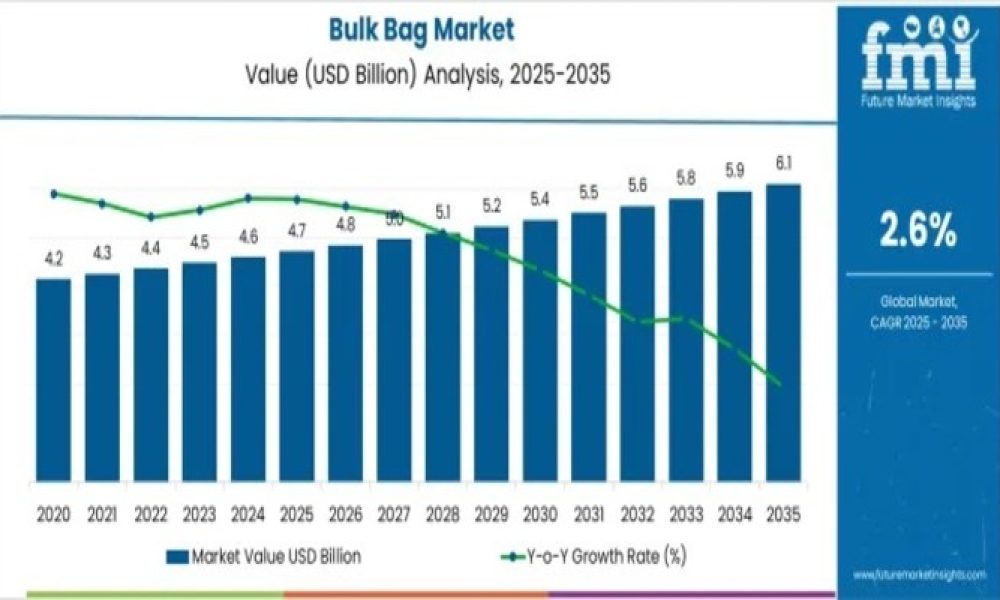
The global bulk bag market is poised for consistent growth over the next decade, expanding from USD 4.7 billion in 2025 to USD 6.1 billion by 2035, advancing at a compound annual growth rate (CAGR) of 2.6%. This steady upward trajectory reflects the growing preference for flexible intermediate bulk containers (FIBCs) as a practical, safe, and cost-effective solution for handling large volumes of dry and flowable materials across industries.
Bulk bags have become indispensable in logistics, construction, chemicals, agriculture, mining, food processing, and pharmaceuticals, where operational efficiency, material safety, and cost control are critical. Their lightweight design, high load-bearing strength, and space optimization capabilities are accelerating the shift away from traditional rigid packaging formats such as drums and cartons.
Market at a Glance
- Market Value (2025): USD 4.7 billion
- Forecast Value (2035): USD 6.1 billion
- Forecast CAGR (2025–2035): 2.6%
- Leading Fabric Type (2025): Type C (37.4% share)
- Key Growth Regions: Asia-Pacific, North America, Europe
Discover Growth Opportunities in the Market – Get Your Sample Report Now
Industrial Expansion and Bulk Commodity Handling Fuel Demand
One of the most influential drivers shaping the bulk bag market is the growing need for secure and efficient handling of bulk commodities, including grains, fertilizers, cement, sand, and industrial chemicals. Bulk bags offer superior durability, reusability, and reduced transportation costs, making them a preferred choice for global supply chains.
Industrial expansion in Asia-Pacific, particularly in construction and agriculture, continues to reinforce consumption volumes. At the same time, infrastructure development and global trade flows are sustaining long-term demand for reliable bulk material packaging solutions.
Key Advantages Driving Adoption
- Reduced transportation and warehousing costs through lightweight construction
- Improved safety and load stability during handling and transit
- Compatibility with automated filling and discharging systems
- Reusability supporting cost savings and sustainability goals
Regulations and Sustainability Redefine Product Innovation
Regulatory frameworks emphasizing material safety, hygiene, and recyclability are reshaping bulk bag design and manufacturing practices. Compliance requirements in food, pharmaceutical, and chemical industries are accelerating demand for food-grade, UN-certified, and anti-static bulk bags.
Sustainability initiatives are also pushing manufacturers to adopt:
- Recyclable woven fabrics and biodegradable liners
- Low-emission production techniques
- Circular economy-aligned reusable bag designs
These regulatory and environmental pressures are encouraging suppliers to differentiate through advanced coatings, barrier properties, and enhanced fabric performance.
Technology and Smart Packaging Gain Momentum
Technological progress is emerging as a critical growth catalyst. Automation in bag filling and discharging systems is improving productivity while minimizing product spillage and contamination. At the same time, smart packaging features are gaining traction across advanced logistics networks.
Key technology trends include:
- RFID-enabled bulk bags for real-time tracking
- Sensor integration for inventory and condition monitoring
- Improved fabric durability with moisture resistance and anti-static protection
These innovations are enhancing supply chain visibility and supporting data-driven logistics strategies aligned with Industry 4.0.
Segmental Insights Highlight Performance and Safety Leadership
Type C Fabric Leads by Safety Standards
The Type C fabric segment, accounting for 37.4% of the market in 2025, dominates due to its superior electrostatic discharge protection. These conductive bulk bags are essential for handling flammable powders and chemicals, making them a preferred choice in hazardous industrial environments.
U-Panel Bags Remain the Preferred Design
With a 29.6% share, U-panel bags continue to lead due to their structural stability, cost-effectiveness, and ease of production. Their excellent load distribution and stacking efficiency support repeated use and international shipping requirements.
Spout Top & Spout Bottom Configurations Gain Traction
Representing 32.8% of filling and discharge systems, this configuration enables controlled material flow, reduces contamination risks, and supports compatibility with automated handling equipment—particularly in chemicals, agriculture, and construction.
Regional Outlook: Emerging Markets Drive Volume, Developed Markets Drive Value
- India leads growth with a 5.8% CAGR, supported by FMCG expansion and SME-driven demand for flexible packaging
- United States growth is driven by stringent safety regulations and smart logistics adoption
- Germany benefits from Industry 4.0 integration and warehouse automation
- Japan and South Korea see steady demand from pharmaceuticals, food safety, electronics, and recycling initiatives
This dual growth model highlights volume expansion in developing economies alongside premiumization and innovation in mature markets.
Competitive Landscape and Recent Developments
The bulk bag market remains highly competitive, with global leaders leveraging scale, technology, and strong distribution networks. Key players include:
- Berry Global Group, Inc.
- Greif, Inc.
- Conitex Sonoco
- Mondi Group
- BAG Corp
- LC Packaging International BV
Recent innovations underscore the industry’s focus on cleaner, safer bulk handling. In 2025, manufacturers introduced next-generation bulk bag filling and discharging systems designed to reduce dust emissions, improve hygiene, and enhance operational efficiency.
Outlook: A Market Built on Reliability and Innovation
As industries prioritize efficiency, safety, sustainability, and digital integration, bulk bags are evolving from a basic packaging solution into a strategic logistics asset. With steady demand across core industries and continuous innovation in materials and smart technologies, the bulk bag market is well positioned for resilient growth through 2035.
Why FMI: https://www.futuremarketinsights.com/why-fmi
About Future Market Insights (FMI)
Future Market Insights, Inc. (FMI) is an ESOMAR-certified, ISO 9001:2015 market research and consulting organization, trusted by Fortune 500 clients and global enterprises. With operations in the U.S., UK, India, and Dubai, FMI provides data-backed insights and strategic intelligence across 30+ industries and 1200 markets worldwide.



