
The Automotive Predictive Analytics Market is emerging as a cornerstone of the data-driven mobility ecosystem, reshaping how vehicles are designed, operated, and maintained. Predictive analytics leverages historical and real-time vehicle data, combined with artificial intelligence (AI), machine learning (ML), and advanced statistical models, to forecast outcomes such as component failures, driving behavior, maintenance needs, and safety risks. As vehicles become increasingly connected, electric, and autonomous, the reliance on predictive insights has shifted from being a competitive advantage to a strategic necessity for automakers, fleet operators, insurers, and mobility service providers.
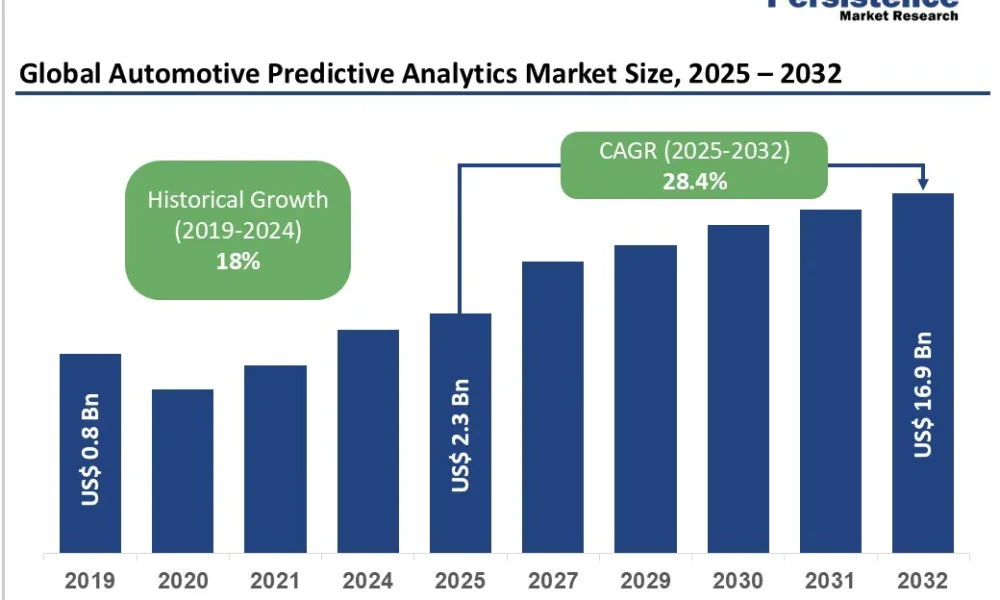
From a market size perspective, the global automotive predictive analytics market is likely to be valued at US$ 2.3 billion in 2025 and is projected to reach US$ 16.9 billion by 2032, expanding at a robust CAGR of 28.4% during 2025–2032. This rapid growth is driven by the accelerating integration of AI and ML in connected vehicles, the rising adoption of predictive maintenance solutions, and the widespread expansion of telematics and usage-based insurance (UBI) models. Predictive maintenance currently represents the leading application segment due to its ability to reduce downtime and lifecycle costs, while North America dominates geographically, supported by advanced digital infrastructure, strong OEM presence, and proactive government initiatives promoting connected and intelligent transportation systems.
Key Highlights from the Automotive Predictive Analytics Market Report
- Predictive maintenance accounts for nearly 45% of market revenue in 2025, driven by cost-saving and uptime optimization benefits.
- Software solutions dominate the market with over 51% share, reflecting strong demand for AI-powered analytics platforms.
- Passenger cars lead adoption, while electric vehicles represent the fastest-growing vehicle category through 2032.
- North America holds the largest market share, whereas Asia Pacific is projected to witness the fastest growth.
- Integration of AI, ML, and cloud analytics is transforming telematics and usage-based insurance models globally.
- Regulatory support and government investments are accelerating predictive analytics deployment in intelligent mobility systems.
Automotive Predictive Analytics Market Segmentation Analysis
The automotive predictive analytics market is segmented based on component, application, vehicle type, and end user, each playing a critical role in shaping market dynamics. By component, the market is broadly categorized into software and services. Software solutions dominate the market, accounting for approximately 51.7% share in 2025, as OEMs and mobility providers increasingly deploy advanced analytics platforms for real-time insights, fault detection, and performance forecasting. These platforms integrate AI, ML, and big data analytics to process massive volumes of sensor and telematics data generated by modern vehicles.
On the application side, predictive maintenance remains the leading segment due to its proven ability to reduce unexpected breakdowns, optimize maintenance schedules, and extend vehicle lifespan. Vehicle telematics, however, is the fastest-growing application, registering a CAGR of around 31% through 2032. Telematics-based predictive analytics supports fleet management, driver behavior analysis, route optimization, and insurance risk modeling. In terms of vehicle type, passenger cars currently command the largest share, while electric vehicles (EVs) are expected to witness the fastest adoption as they rely heavily on analytics for battery health monitoring, energy optimization, and safety assurance.
Regional Insights: Global Automotive Predictive Analytics Landscape
North America leads the global automotive predictive analytics market with nearly 33% share in 2025, driven by early adoption of connected vehicle technologies, strong presence of automotive OEMs, and significant investments in AI-driven mobility solutions. U.S. federal initiatives, including over US$ 800 million in funding for connected vehicle pilot programs, are accelerating V2X adoption and predictive analytics deployment in traffic management and safety systems.
The Asia Pacific region is projected to grow at the fastest CAGR of over 31% during the forecast period, fueled by rapid vehicle electrification, expanding telematics penetration, and smart city initiatives across China, Japan, South Korea, and India. Meanwhile, Europe continues to benefit from regulatory harmonization, AI safety oversight, and strong automotive engineering capabilities, particularly in Germany and the U.K., where intelligent vehicle systems and data-driven mobility solutions are gaining traction.
Market Drivers: Forces Powering Industry Expansion
One of the primary drivers of the automotive predictive analytics market is the rapid integration of AI and machine learning in connected vehicles. Modern vehicles generate massive volumes of real-time data from sensors, cameras, and control systems, creating strong demand for analytics solutions that can convert raw data into actionable insights. Predictive analytics enables proactive decision-making, improving vehicle performance, safety, and reliability across diverse use cases.
Another major growth driver is the rising adoption of predictive maintenance solutions by OEMs and fleet operators. Predictive maintenance minimizes unexpected failures, reduces operational costs, and enhances asset utilization, making it highly attractive for commercial fleets, ride-hailing services, and logistics providers. Additionally, the growing popularity of usage-based insurance and telematics-driven services is pushing insurers to adopt predictive analytics for risk assessment, pricing optimization, and fraud detection.
Market Restraints: Challenges Limiting Growth Potential
Despite its strong growth outlook, the automotive predictive analytics market faces certain restraints. Data privacy and cybersecurity concerns remain significant challenges, as connected vehicles continuously collect sensitive user and operational data. Ensuring compliance with data protection regulations and safeguarding analytics platforms from cyber threats increases implementation complexity and costs.
Another limiting factor is the high initial investment required for deploying predictive analytics infrastructure, particularly for small and mid-sized fleet operators. Integrating analytics platforms with legacy vehicle systems and ensuring data standardization across different OEMs can also pose technical challenges. These factors may slow adoption in cost-sensitive and emerging markets, despite long-term benefits.
Market Opportunities: Unlocking Future Growth Avenues
The accelerating penetration of electric and autonomous vehicles presents substantial growth opportunities for automotive predictive analytics providers. EVs rely heavily on analytics for battery health monitoring, energy efficiency optimization, and thermal management, while autonomous vehicles require predictive models for perception, decision-making, and safety validation.
Another promising opportunity lies in the expansion of smart city and intelligent transportation initiatives worldwide. Predictive analytics can play a crucial role in traffic optimization, congestion management, and accident prevention by integrating vehicle data with urban mobility systems. Furthermore, partnerships between automakers, cloud service providers, and analytics firms are expected to drive innovation and scalability across global markets.
Reasons to Buy the Automotive Predictive Analytics Market Report
✔ Gain detailed insights into market size, growth trends, and future forecasts through 2032.
✔ Understand key growth drivers, restraints, and opportunities shaping the industry.
✔ Identify leading segments and high-growth regional markets for strategic decision-making.
✔ Analyze competitive landscape, key players, and recent industry developments.
✔ Support investment, expansion, and product development strategies with data-driven insights.
Frequently Asked Questions (FAQs)
How Big is the Automotive Predictive Analytics Market in 2025 and beyond?
Who are the Key Players in the Global Automotive Predictive Analytics Market?
What is the Projected Growth Rate of the Automotive Predictive Analytics Market?
What is the Market Forecast for Automotive Predictive Analytics Market for 2032?
Which Region is Estimated to Dominate the Industry through the Forecast Period?
Company Insights: Key Players and Recent Developments
Key Players Operating in the Automotive Predictive Analytics Market
- IBM Corporation
- SAP SE
- Microsoft Corporation
- Oracle Corporation
- SAS Institute Inc.
- Bosch Mobility Solutions
- Continental AG
- Harman International
- Trimble Inc.
- TIBCO Software
Recent Developments
- July 2025: Malaysia Automotive Robotics and IoT Institute (MARii) partnered with Petronas Global Technical Solutions to launch ADaPTiV, an AI-powered predictive maintenance platform that leverages IoT sensor data to forecast component failures and enable condition-based maintenance.
- Leading automotive OEMs and cloud providers have intensified partnerships to integrate predictive analytics into next-generation connected and electric vehicles, strengthening real-time diagnostics and performance optimization capabilities across North America and Asia Pacific.
Conclusion: The Road Ahead for Automotive Predictive Analytics
The automotive predictive analytics market is entering a transformative phase, driven by the convergence of AI, connected vehicles, electrification, and intelligent mobility systems. As automakers and mobility stakeholders increasingly prioritize data-driven decision-making, predictive analytics will become integral to vehicle design, operation, and customer experience. With strong growth prospects, expanding applications, and supportive regulatory environments, the market is well-positioned to play a defining role in shaping the future of global mobility through 2032 and beyond.
Related Reports:




