
The global photo printers market is undergoing a steady transformation as consumer preferences shift toward personalization, instant gratification, and mobile-enabled printing solutions. While digital photography and cloud storage dominate how images are captured and stored, the demand for high-quality physical photo prints remains resilient—particularly for personal keepsakes, professional photography, retail photo services, and event-based applications.
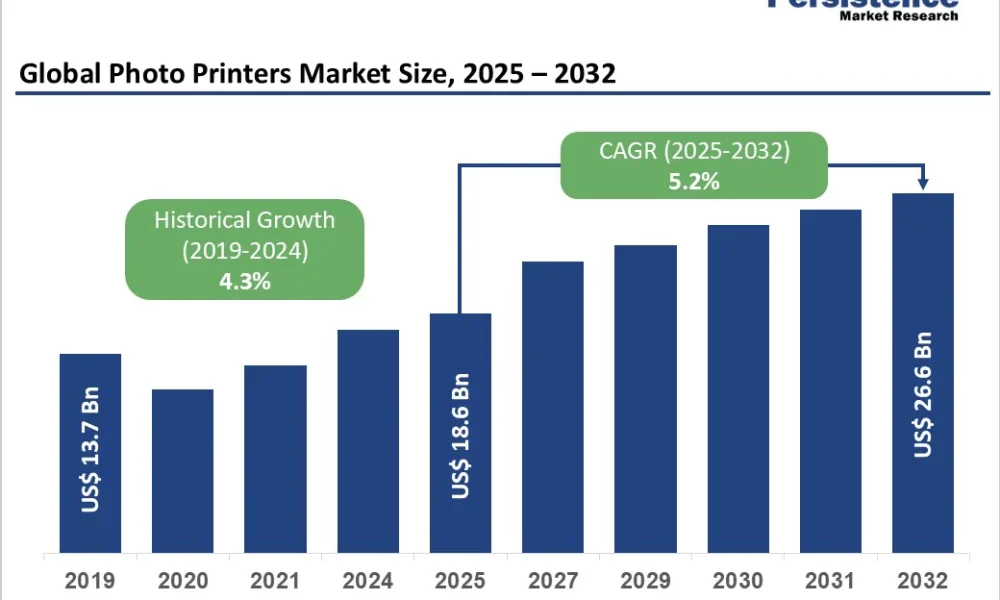
In 2025, the global photo printers market is expected to reach US$ 18.6 billion, and it is projected to grow to US$ 26.6 billion by 2032, expanding at a compound annual growth rate (CAGR) of 5.2% during the forecast period. This growth is supported by rising adoption of instant and portable photo printers, deeper smartphone integration, and continuous innovation in inkjet and dye-sublimation printing technologies.
As manufacturers prioritize eco-friendly consumables, compact designs, and AI-enabled features, the photo printers industry is evolving to meet the expectations of modern consumers and businesses alike.
Understanding the Photo Printers Market
Photo printers are specialized printing devices designed to produce high-resolution photographic images on various media, including photo paper, canvases, and specialty materials. These printers are widely used across households, professional studios, retail photo kiosks, commercial print labs, and event-based services.
Unlike conventional printers, photo printers emphasize color accuracy, tonal gradation, and image longevity. Advances in ink formulations, printhead precision, and software optimization have significantly improved output quality, making photo printers more accessible and versatile across price segments.
Market Size and Growth Outlook
The photo printers market has demonstrated consistent historical growth, with a CAGR of 4.3% between 2019 and 2024. This momentum is expected to accelerate moderately over the next decade as new use cases and technologies emerge.
Key Market Metrics
- Market Size (2025E): US$ 18.6 billion
- Market Forecast (2032F): US$ 26.6 billion
- Projected CAGR (2025–2032): 5.2%
- Historical CAGR (2019–2024): 4.3%
The steady growth trajectory reflects a balance between mature demand in developed markets and expanding adoption in emerging economies, particularly across Asia Pacific.
Key Drivers Shaping Market Growth
Rising Demand for Instant and Portable Printing Solutions
One of the strongest growth drivers in the photo printers market is the increasing popularity of instant and portable photo printers. Compact, wireless devices that connect directly to smartphones allow users to print photos on demand, catering to lifestyle-driven consumption patterns.
Consumers increasingly value tangible photo memories, especially for social gatherings, travel experiences, and personal gifting. Portable photo printers have become particularly popular among younger demographics and content creators who seek convenience without compromising print quality.
Smartphone Integration and Wireless Connectivity
The integration of photo printers with smartphones and mobile ecosystems has significantly enhanced user accessibility. Features such as Bluetooth, Wi-Fi Direct, cloud printing, and app-based editing tools enable seamless printing from mobile devices.
With smartphone penetration continuing to rise globally, especially in emerging markets, mobile-first photo printing solutions are expected to remain a central pillar of market expansion.
Growth of Personalized and Event-Based Printing
Personalized photo products—including photo books, customized prints, greeting cards, and memorabilia—are gaining traction across both consumer and commercial segments. Additionally, event-based photo printing services, such as weddings, corporate events, exhibitions, and retail promotions, are driving demand for high-speed kiosk and minilab systems.
Retail photo centers and pharmacies continue to deploy advanced printing kiosks that offer instant photo printing, digital payment integration, and high-volume throughput, reinforcing the relevance of physical photo prints in a digital-first world.
Continuous Innovation in Printing Technologies
Technological innovation remains a cornerstone of the photo printers market. Manufacturers are improving printhead accuracy, ink efficiency, color consistency, and durability, while also reducing operational costs.
Advancements in inkjet and dye-sublimation technologies have enabled higher-resolution outputs, faster print speeds, and longer-lasting prints, expanding the use of photo printers across professional and commercial environments.
Technology Trends in the Photo Printers Market
Inkjet Printers: Dominant Technology Segment
Inkjet printers continue to dominate the global photo printers market, accounting for approximately 62.3% of total market share. Their widespread adoption is driven by affordability, multipurpose functionality, and continuous improvements in ink and printhead technologies.
Modern inkjet photo printers benefit from:
- Enhanced pigment-based inks for longer print life
- Improved droplet control for sharper images
- Compatibility with various paper sizes and materials
These advantages make inkjet printers suitable for both home users and professional photographers.
Dye-Sublimation Printers: Growing Popularity for Premium Prints
Dye-sublimation printers are gaining popularity in applications that require consistent color reproduction and professional-grade output, such as event photography and retail kiosks. These printers use heat to transfer dye onto paper, resulting in smooth tonal transitions and durable prints.
While dye-sublimation systems typically involve higher upfront costs, their reliability and premium quality continue to attract commercial users and service providers.
Printing Format Analysis
Kiosk and Minilab Systems Lead the Market
Kiosk and minilab systems represent approximately 29% of the global photo printers market, making them the leading printing format segment. These systems are widely deployed in:
- Retail photo centers
- Pharmacies
- Shopping malls
- Tourist locations
Their success is attributed to instant printing capabilities, user-friendly interfaces, and the integration of digital payment and cloud connectivity. As on-demand printing services expand, kiosks and minilabs are expected to remain critical distribution channels.
Elevate your business strategy with comprehensive market data. Request a sample report now: https://www.persistencemarketresearch.com/samples/35789
Regional Market Insights
Asia Pacific: Leading and Fastest-Growing Region
Asia Pacific accounts for approximately 38.8% of global photo printers market revenue, making it both the largest and fastest-growing regional market. Several factors contribute to this dominance:
- Large-scale manufacturing capabilities in China
- High smartphone adoption rates
- Strong consumer demand in Japan and India
- Expanding urban populations
- Government incentives supporting domestic electronics production
The region’s rapid growth in event-based photo printing, retail kiosks, and portable printers positions Asia Pacific as a key investment destination for global manufacturers.
North America: Stable Demand and Technology Adoption
North America represents a mature yet stable market, characterized by strong demand for professional photo printing, home-based creative printing, and commercial photo services. High disposable incomes and early adoption of advanced printing technologies support consistent market performance.
Europe: Sustainability and Premium Printing Focus
Europe’s photo printers market is increasingly shaped by environmental regulations and sustainability initiatives. Manufacturers are emphasizing recyclable materials, energy-efficient designs, and reduced ink waste to align with regional sustainability goals.
Sustainability and Eco-Friendly Innovations
Sustainability has become a critical focus area for the photo printers industry. Leading manufacturers are investing in:
- Recyclable cartridges and packaging
- Refillable ink systems
- Energy-efficient hardware designs
- Reduced plastic usage
Eco-conscious consumers and regulatory pressures are encouraging brands to adopt greener practices, which is expected to influence product differentiation and purchasing decisions over the forecast period.
Competitive Landscape and Investment Strategies
The global photo printers market is moderately consolidated, with major players such as Canon, Epson, and HP maintaining strong brand recognition and extensive distribution networks.
Key Strategic Initiatives Include:
- Investment in AI-enabled printing systems for enhanced image optimization
- Development of compact and portable dye-sublimation printers
- Expansion of mobile app ecosystems for seamless printing
- Adoption of sustainable materials and consumables
These strategies aim to strengthen global portfolios while addressing evolving consumer and regulatory expectations.
Future Outlook and Market Opportunities
Looking ahead, the photo printers market is poised for steady and sustainable growth. Key opportunities are expected to emerge from:
- Expansion of instant photo printing among Gen Z and millennials
- Growth of on-demand and event-based photo services
- Increasing adoption of portable printers in emerging economies
- Continued advancements in printing quality and sustainability
As digital experiences continue to dominate daily life, the emotional and experiential value of printed photos will remain a powerful driver of demand.
Conclusion
The global photo printers market stands at the intersection of digital convenience and physical personalization. With the market projected to grow from US$ 18.6 billion in 2025 to US$ 26.6 billion by 2032, the industry is well-positioned to benefit from evolving consumer lifestyles, technological innovation, and expanding regional opportunities.
Driven by strong demand in Asia Pacific, dominance of inkjet technology, and rising popularity of portable and kiosk-based solutions, photo printers continue to hold relevance in an increasingly digital world. As manufacturers align innovation with sustainability and user-centric design, the market’s future outlook remains positive and resilient.
Related Reports:




