
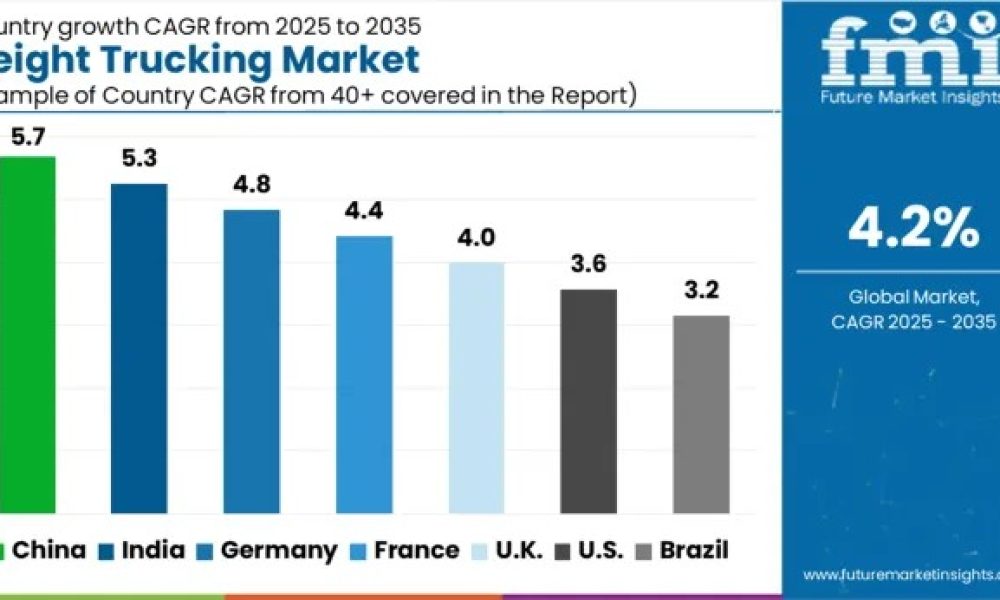
The global freight trucking market continues to assert its role as the backbone of international and domestic supply chains, with market value projected to rise from USD 2.7 trillion in 2025 to USD 4.1 trillion by 2035, expanding at a compound annual growth rate (CAGR) of 4.2%. This steady expansion underscores the sector’s structural resilience and its critical importance to industrial activity, retail distribution, and global trade flows.
A closer examination of growth patterns reveals a clear two-phase trajectory. Between 2025 and 2030, the market is expected to increase from USD 2.7 trillion to USD 3.2 trillion, reflecting a period of consolidation and operational strengthening. During this phase, growth is primarily supported by industrial output, rising e-commerce penetration, and modernization of domestic logistics networks. Fleet upgrades, fuel efficiency improvements, and optimization of delivery routes dominate strategic priorities as operators enhance reliability and cost control.
The second growth block, spanning 2030 to 2035, marks a sharper acceleration, with the market expanding from USD 3.2 trillion to USD 4.1 trillion—an incremental gain of nearly USD 0.9 trillion within five years. This surge is closely tied to the expansion of international trade corridors, increased reliance on last-mile delivery services, and widespread adoption of digital freight platforms that enhance transparency and coordination across supply chains. Collectively, these phases contribute to the creation of an additional USD 1.4 trillion in market value by 2035, highlighting freight trucking’s adaptability in an evolving global economy.
Get access to comprehensive data tables and detailed market insights — request your sample report today!
https://www.futuremarketinsights.com/reports/sample/rep-gb-25297
Market Structure Reflects Balance Between Scale and Growth Potential
The freight trucking market is characterized by a layered structure that balances scale-driven stability with high-growth service segments. Long-haul trucking accounts for nearly 40% of total market share, supported by cross-border trade, bulk commodity movement, and industrial shipments that underpin global commerce. Regional and short-haul trucking, at approximately 28%, serves domestic retail supply chains and manufacturing clusters, ensuring steady volume flow.
Meanwhile, last-mile delivery represents around 15% of the market and is one of the fastest-growing segments, fueled by the expansion of e-commerce and consumer expectations for rapid delivery. Specialized freight services, including refrigerated, hazardous, and oversized cargo, contribute 10%, catering to pharmaceuticals, chemicals, and perishables where precision and safety are essential. The remaining 7% stems from intermodal integration, where trucking connects seamlessly with rail, sea, and air freight, reinforcing its indispensable role as the first and last mile of global logistics.
This structure illustrates how traditional freight volumes provide stability, while emerging service models unlock incremental growth opportunities, positioning trucking as both resilient and future-ready.
Key Segments Driving Revenue Leadership
By truck type, truck trailers dominate the market, accounting for 42.6% of revenue in 2025. Their versatility, load capacity, and compatibility with advanced telematics systems make them the preferred choice for transporting diverse cargo across varying distances. Standardization and durability further strengthen adoption across large-scale freight networks.
From a distance perspective, long-haul trucking is projected to capture 57.8% of market revenue in 2025, reflecting its central role in connecting production centers with consumption markets. Investments in dedicated freight corridors, highway infrastructure, and route optimization technologies continue to enhance efficiency and reliability in this segment.
By service type, full truckload (FTL) services lead with a 48.5% revenue share, driven by demand for direct, time-sensitive shipment handling. Reduced handling risk, faster transit times, and improved cargo security make FTL services especially attractive for manufacturing, retail, and automotive supply chains.
Drive Your Business Growth Strategy: Checkout the Report for Key Insights
https://www.futuremarketinsights.com/checkout/25297
Global Growth Anchored in Asia, Efficiency in Europe, and Resilience in North America
Regional dynamics further reinforce the market’s expansion outlook. Asia-Pacific emerges as the fastest-growing region, led by China (CAGR 5.7%) and India (5.3%). China’s growth is supported by large-scale industrial output, cross-border trade, Belt and Road infrastructure investments, and surging e-commerce volumes. India’s expansion is driven by government-backed freight corridors, manufacturing growth, and rapid adoption of digital freight platforms, alongside increasing demand for cold-chain logistics.
In Europe, countries such as Germany (4.8%), France (4.4%), and the UK (4.0%) benefit from strong industrial exports, dense logistics networks, and regulatory-driven efficiency upgrades. Emphasis on fleet modernization and intermodal integration supports steady, compliance-focused growth.
North America, led by the United States (3.6%), represents a mature but resilient market. Growth is anchored in replacement demand for aging fleets, strong intermodal connectivity, and sustained e-commerce-driven last-mile delivery, ensuring long-term stability despite lower relative growth rates.
Competitive Landscape Defined by Integration and Digital Capability
Competition in the freight trucking market is increasingly shaped by scale, geographic reach, and the ability to deliver integrated logistics solutions. Global leaders such as DHL Express, UPS, and FedEx leverage extensive networks and advanced digital tracking to offer end-to-end services. C.H. Robinson and XPO Logistics strengthen the market through data-driven freight brokerage and supply chain optimization, while J.B. Hunt and Schneider National dominate long-haul and intermodal operations in North America. Players like Maersk and Nippon Express are expanding aggressively into trucking to reinforce multimodal logistics strategies, underscoring a shift toward integrated supply chain ecosystems.
Outlook: A Strategic Pillar of Global Commerce
As global trade intensifies, consumer behavior shifts, and supply chains prioritize resilience and transparency, freight trucking remains indispensable. Its ability to evolve through technology adoption, service diversification, and intermodal integration ensures sustained relevance and value creation over the next decade. The market’s projected expansion to USD 4.1 trillion by 2035 signals not only growth in scale but also a transformation in how goods move across the world—cementing freight trucking as a strategic pillar of the global economy.
Why Choose FMI: Empowering Decisions that Drive Real-World Outcomes: https://www.futuremarketinsights.com/why-fmi
About Future Market Insights (FMI)
Future Market Insights, Inc. (FMI) is an ESOMAR-certified, ISO 9001:2015 market research and consulting organization, trusted by Fortune 500 clients and global enterprises. With operations in the U.S., UK, India, and Dubai, FMI provides data-backed insights and strategic intelligence across 30+ industries and 1200 markets worldwide.



