
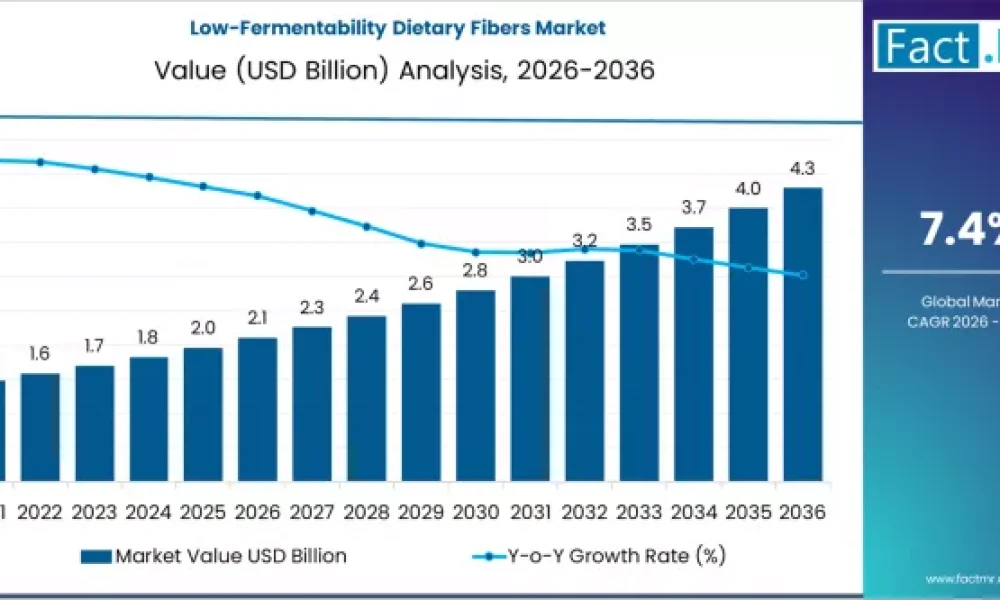
The global low-fermentability dietary fibers market is entering a phase of high-growth specialization, with its valuation projected to rise from USD 620 million in 2026 to USD 1.3 billion by 2036. According to specialized industry analysis, the market is set to expand at a compound annual growth rate (CAGR) of 7.8%, driven by the rising prevalence of Irritable Bowel Syndrome (IBS) and a growing consumer shift toward “gut-friendly” fibers that provide bulk without the associated gas and bloating.
Traditional high-fermentability fibers, such as inulin, can cause significant digestive distress for sensitive individuals. Low-fermentability fibers—including Cellulose, Hemicellulose, and certain Resistant Starches—are characterized by their slow or minimal breakdown by gut bacteria. This makes them the “gold standard” for the booming Low-FODMAP (Fermentable Oligosaccharides, Disaccharides, Monosaccharides, and Polyols) food segment, allowing manufacturers to boost fiber content in products without compromising digestive comfort.
Summary Table: Low-Fermentability Dietary Fibers Market Outlook
| Metric | Details |
| Market Value (2026E) | USD 620 Million |
| Forecast Value (2036F) | USD 1.3 Billion |
| Projected CAGR (2026-2036) | 7.8% |
| Leading Product Type | Cellulose & Hemicellulose (42.5% Share) |
| Primary End-User | Bakery & Confectionery (35%+ Share) |
| Highest Growth Market | India (10.2% CAGR) |
Request for Sample Report | Customize Report | Purchase Full Report – https://www.factmr.com/connectus/sample?flag=S&rep_id=13686
Core Market Dynamics: Answering the Strategic ‘How’ and ‘Why’
The market is shifting from “one-size-fits-all” fiber fortification toward precision nutrition aimed at functional digestive health.
Who is leading the sector? Industry pioneers including Tate & Lyle, Archer Daniels Midland (ADM), Cargill, Ingredion, and Roquette Frères are at the forefront, developing specialized resistant starches and purified cellulose fibers for clean-label applications.
What is the dominant product type? Cellulose and Hemicellulose command a significant 42.5% market share. Their inert nature and ability to improve texture in bakery and snack products while providing calorie-free bulk make them highly versatile for industrial food processing.
Where is growth most accelerated? India is emerging as a global growth leader with a 10.2% CAGR, fueled by an increasing awareness of preventive digestive health. China follows with a 9.5% CAGR, supported by a rapid expansion in the functional beverage and meal replacement sectors.
Why is the technology shifting? The market is moving toward Enzymatic Modification of Starches. Modern processing techniques allow manufacturers to create “Type 4” Resistant Starch, which resists digestion in the small intestine but ferments much more slowly than traditional prebiotics, offering the benefits of fiber with superior gastrointestinal tolerance.
Sector Insights: Bakery, Cereals, and Medical Nutrition Drive Volume
The Bakery and Confectionery segment remains the primary end-user, projected to hold over 35% of the market share by 2026. However, the Clinical and Medical Nutrition segment is seeing the fastest adoption. Low-fermentability fibers are increasingly being formulated into enteral nutrition (tube feeding) and geriatric supplements to manage bowel regularity in patients who cannot tolerate highly fermentable fibers.
“Fiber is being redefined by its tolerability,” the analysis states. “We are seeing a major trend where ‘The Gas-Free Claim’ is becoming a powerful marketing tool. As more consumers identify as having ‘sensitive stomachs,’ the demand for fibers that offer the physiological benefits of roughage without the social or physical discomfort of fermentation is becoming a mandatory requirement for the next generation of wellness brands.”
Key Market Trends and Strategic Outlook
1. Optimization through “Clean Label” Plant Fibers
A significant absolute dollar opportunity lies in Fruit and Vegetable-Derived Fibers. Extracts from bamboo, oat, and citrus that are naturally low in fermentable sugars are seeing high demand in the United States (7.2% CAGR) and European Union (6.8% CAGR) as brands look to avoid synthetic-sounding ingredients like “polydextrose.”
2. The Rise of Hybrid Prebiotic Blends
Innovation is focused on balance. Manufacturers are creating “Precision Prebiotic Blends” that combine a small amount of fast-fermenting fiber with a majority of low-fermentability fiber. This approach supports a diverse microbiome while keeping the “fermentation rate” low enough to prevent digestive symptoms.
3. Regulatory and Certification Tailwinds
Growth is being accelerated by the “Monash University Low-FODMAP Certification.” As this seal of approval becomes more recognizable globally, food companies are specifically seeking out low-fermentability fiber suppliers to ensure their end-products meet the strict criteria for IBS-friendly labeling.
Investment Perspective: A High-Value Pillar of the Functional Food Era
The low-fermentability dietary fibers market represents a robust opportunity for ingredient manufacturers. As the global medical community continues to advocate for the Low-FODMAP diet as a first-line treatment for digestive disorders, the demand for “gentle” fiber solutions is expected to remain a primary growth engine for the food and beverage industry through 2036.
Have specific requirements or need assistance on report pricing or have a limited budget? Please contact [email protected]
About Fact.MR:
Fact.MR is a global market research and consulting firm, trusted by Fortune 500 companies and emerging businesses for reliable insights and strategic intelligence. With a presence across the U.S., UK, India, and Dubai, we deliver data-driven research and tailored consulting solutions across 30+ industries and 1,000+ markets. Backed by deep expertise and advanced analytics, Fact.MR helps organizations uncover opportunities, reduce risks, and make informed decisions for sustainable growth



