
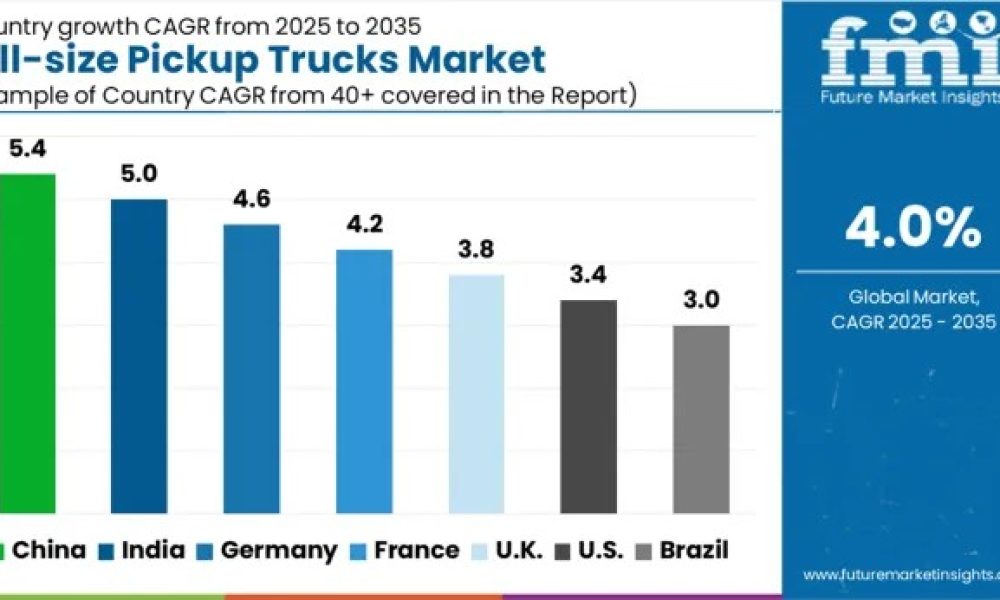
The global full-size pickup trucks market is projected to grow from USD 94.3 billion in 2025 to USD 139.6 billion by 2035, registering a compound annual growth rate (CAGR) of 4.0% over the forecast period. This measured but resilient growth trajectory reflects a market deeply anchored in utility-driven demand while undergoing gradual transformation through electrification, digitalization, and evolving cost structures across the automotive value chain.
Full-size pickup trucks remain critical assets across commercial, industrial, and lifestyle applications, particularly in regions with strong construction, agriculture, logistics, and infrastructure activity. While growth is moderate compared to emerging mobility segments, the market’s scale, durability, and recurring replacement cycles underscore its long-term stability and strategic importance within the global automotive industry.
Cost Structure and Value Chain Dynamics
The value structure of the full-size pickup trucks market is strongly influenced by raw material inputs, manufacturing complexity, and downstream value capture. Steel and aluminum account for a significant portion of material costs, especially as manufacturers prioritize lightweight frames that improve fuel efficiency while maintaining durability and towing capability. The gradual integration of electrified powertrains introduces additional cost layers, with battery components becoming increasingly relevant as electric and hybrid pickups expand their share of the product mix.
The value chain begins with component suppliers, including chassis, drivetrain, electronics, safety systems, and increasingly software and connectivity providers. Original equipment manufacturers (OEMs) maintain substantial control over design, integration, and final assembly, where labor efficiency, automation, regulatory compliance, and platform standardization directly influence margins. Downstream, dealer networks and traditional distribution channels continue to play a central role, although digital sales platforms and connected retail models are gradually reshaping cost allocation and customer engagement.
Beyond initial vehicle sales, aftersales services, spare parts, and accessories represent a critical source of recurring revenue. These elements reinforce lifecycle profitability and help offset rising research, development, and capital expenditures linked to electrification, safety technologies, and connectivity features. By 2035, while internal combustion engine models remain cost-efficient anchors, the value chain is expected to increasingly integrate advanced technologies, reshaping long-term competitive positioning.
Get access to comprehensive data tables and detailed market insights — request your sample report today!
Market Growth Drivers and Demand Fundamentals
The steady expansion of the full-size pickup trucks market is driven by sustained demand for versatile, high-performance vehicles capable of serving both professional and personal use cases. Infrastructure development, logistics expansion, and rural connectivity projects—particularly in emerging economies—continue to support fleet growth. In developed markets, strong cultural affinity for pickup trucks, combined with their adaptability for towing, hauling, and recreation, sustains replacement demand.
Automakers are also broadening the appeal of full-size pickups by integrating premium interiors, advanced safety systems, and digital connectivity, attracting buyers beyond traditional utility-focused segments. Policy support for local manufacturing, access to commercial vehicle financing, and targeted incentives for cleaner powertrains further reinforce market momentum.
Segment Insights: Configuration, Fuel, and Application
By cab type, regular cab pickup trucks account for 47.3% of market revenue in 2025, making them the leading configuration. Their dominance stems from straightforward design, lower manufacturing costs, and superior payload efficiency. The extended cargo space offered by regular cabs is particularly valued in construction, agriculture, and logistics, where operational efficiency and ease of maintenance are top priorities.
From a fuel perspective, gasoline-powered pickup trucks hold 52.6% of market revenue in 2025. This leadership reflects widespread fuel availability, lower upfront vehicle costs, and improvements in fuel efficiency and emissions performance. Gasoline pickups also offer smoother operation and broader model availability, making them attractive to both individual buyers and small commercial operators. While electric and hybrid variants are gaining traction, gasoline remains the dominant choice in the near term.
By application, the commercial segment represents 58.1% of total market revenue in 2025, anchoring overall demand. Full-size pickups are indispensable across construction, agriculture, mining, and delivery services due to their ability to handle heavy payloads, tow equipment, and operate across challenging terrain. Public and private fleet procurement continues to be a major demand driver as infrastructure and industrial activity scales globally.
Technology, Electrification, and Evolving Use Cases
The market is undergoing a gradual but meaningful shift toward electrification and advanced vehicle technologies. Leading manufacturers are investing in electric and hybrid pickup models to address tightening emissions regulations and growing interest in sustainable mobility. Electric pickups are being engineered to deliver high torque and competitive towing capacity, positioning them as viable alternatives for select commercial and lifestyle applications.
At the same time, integration of advanced safety systems, driver assistance technologies, telematics, and connectivity is redefining the value proposition of full-size pickups. Features such as adaptive cruise control, collision avoidance, blind-spot monitoring, and real-time vehicle diagnostics are increasingly standard, elevating pickups from purely utilitarian vehicles to sophisticated mobility platforms. For fleet operators, telematics enables improved asset utilization, predictive maintenance, and operational efficiency.
Drive Your Business Growth Strategy: Checkout the Report for Key Insights
Regional Outlook Highlights
Regionally, North America remains the largest and most mature market, supported by entrenched pickup culture and sustained demand from construction, logistics, and energy sectors. The United States is projected to grow at a CAGR of 3.4%, with electric full-size pickups gradually gaining market share.
In Asia-Pacific, faster growth is expected. China, with a CAGR of 5.4%, benefits from domestic manufacturing expansion, infrastructure investment, and rising adoption in construction and logistics. India, at 5.0%, is emerging as a key growth market, driven by infrastructure development, rural connectivity, and increasing preference for cost-efficient utility vehicles.
In Europe, growth is steady but shaped by emissions regulations and technology adoption. Germany is forecast to grow at 4.6%, supported by industrial demand and investment in electrified and connected pickup models, while the United Kingdom records 3.8%, driven by logistics expansion and niche lifestyle adoption.
Competitive Landscape and Strategic Positioning
The full-size pickup trucks market is defined by intense competition among global automakers. Ford Motor Company maintains a dominant position through its F-Series, while General Motors continues to strengthen its presence with the Chevrolet Silverado and GMC Sierra. Ram Trucks differentiates through luxury-oriented interiors and high towing performance, while Toyota, Nissan, Isuzu, Honda, Mitsubishi Motors, Great Wall Motors, and Volkswagen expand their reach through reliability, regional adaptation, and competitive pricing strategies.
As investments in electrification, safety, and digital connectivity accelerate, competition is increasingly centered on platform flexibility, lifecycle value, and the ability to balance cost efficiency with technological advancement. These dynamics position the full-size pickup trucks market as a resilient, evolving segment with sustained relevance across both developed and emerging economies—offering compelling insights for stakeholders seeking a deeper understanding of its long-term trajectory.
Why Choose FMI: Empowering Decisions that Drive Real-World Outcomes: https://www.futuremarketinsights.com/why-fmi
About Future Market Insights (FMI)
Future Market Insights, Inc. (FMI) is an ESOMAR-certified, ISO 9001:2015 market research and consulting organization, trusted by Fortune 500 clients and global enterprises. With operations in the U.S., UK, India, and Dubai, FMI provides data-backed insights and strategic intelligence across 30+ industries and 1200 markets worldwide.



