
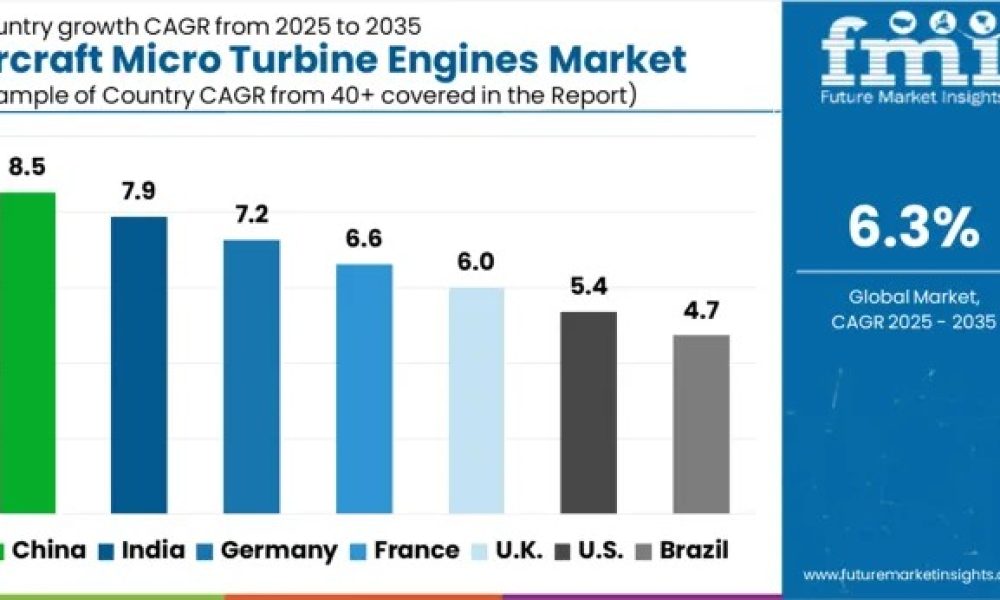
The global aircraft micro turbine engines market is entering a sustained growth phase, supported by rising adoption across unmanned aerial vehicles (UAVs), auxiliary power systems, and emerging hybrid-electric aviation platforms. Market value is projected to increase from USD 3.4 billion in 2025 to USD 6.3 billion by 2035, expanding at a compound annual growth rate (CAGR) of 6.3% over the forecast period. This trajectory reflects the strategic importance of compact, high power-to-weight propulsion systems in both civil and defense aviation ecosystems.
Between 2021 and 2025, the market expanded rapidly from USD 2.5 billion to USD 3.4 billion, marking an early adoption phase driven by UAV proliferation, growing demand for compact auxiliary power units (APUs), and increased experimentation in lightweight aircraft propulsion. This initial surge established micro turbine engines as a viable alternative to piston engines and battery-only solutions in applications where endurance, reliability, and payload capacity are critical.
Market Evolution Reflects Transition from Rapid Adoption to Structured Expansion
From 2026 to 2030, the aircraft micro turbine engines market is expected to grow from USD 3.6 billion to USD 4.6 billion, maintaining momentum while beginning to show early signs of market maturation. During this phase, penetration within defense UAV fleets and commercial drone operations increases significantly, gradually slowing first-time adoption rates. However, improvements in efficiency, digital engine controls, and hybrid integration sustain demand, particularly in long-endurance and mission-critical applications.
Between 2031 and 2035, market value is forecast to rise further from USD 4.9 billion to USD 6.3 billion, marking the approach toward saturation in core segments. Growth during this period is expected to be driven primarily by replacement demand, fleet upgrades, aftermarket services, and niche expansion in hybrid-electric aviation, advanced UAVs, and specialized auxiliary power systems. While the pace moderates compared to earlier years, the market remains structurally resilient due to the long operational life and service intensity of turbine-based platforms.
Get access to comprehensive data tables and detailed market insights — request your sample report today!
Niche but Strategic Role Across Aviation and Defense Domains
Although aircraft micro turbine engines account for just 2–3% of the broader aerospace propulsion market, their strategic value is disproportionately high. In the UAV propulsion segment, micro turbines represent 12–14% of market share, reflecting their importance in endurance drones, target UAVs, and tactical systems where power density and reliability outweigh fuel efficiency constraints.
Within auxiliary power unit (APU) applications, micro turbines contribute approximately 6–7%, providing compact and reliable onboard power for electrical and pneumatic systems in smaller aircraft. The defense and military aviation sector accounts for an estimated 8–9% share, leveraging micro turbines for reconnaissance platforms, mobile power generation, and mission-critical equipment. General aviation adoption remains moderate at 4–5%, primarily in experimental aircraft and lightweight platforms emphasizing simplicity and performance.
Aftermarket Services Anchor Revenue Stability
By installation type, the aftermarket segment dominates with a projected 57% revenue share in 2025, underscoring the importance of maintenance, repair, and overhaul (MRO) activities in sustaining fleet readiness. Operators increasingly prioritize lifecycle cost optimization, predictive maintenance, and service flexibility to maximize asset utilization and reduce downtime.
Advancements in diagnostics, digital monitoring, and software-enabled upgrades have strengthened aftermarket value propositions. Regulatory compliance requirements further reinforce regular maintenance cycles, ensuring consistent service demand. As micro turbine fleets expand globally, well-established service networks and modular upgrade pathways continue to anchor aftermarket leadership.
General Aviation and Turboshaft Engines Lead Platform Adoption
Among platform categories, general aviation is expected to command 45% of market revenue in 2025, driven by demand for lightweight, fuel-flexible propulsion systems in small aircraft, business aviation, and personal air mobility concepts. Micro turbine engines offer advantages in altitude performance, vibration control, and operational simplicity, making them attractive for diverse mission profiles.
By engine type, turboshaft micro turbine engines account for an estimated 40% share, reflecting their suitability for sustained power output in rotary-wing aircraft, UAVs, and specialized fixed-wing platforms. Compact design, durability, and multi-fuel capability have positioned turboshaft variants as a preferred solution across both civil and defense applications.
Growth Drivers, Constraints, and Emerging Opportunities
Market growth is being fueled by the need for high power density, compact packaging, rapid start capability, and reliable electrical output, particularly in UAVs and hybrid aviation systems. Micro turbines are increasingly specified as turbogenerators, supporting battery-assisted propulsion architectures and enabling extended range without large battery payloads.
However, adoption remains constrained by specific fuel consumption challenges at small scales, thermal and acoustic management complexity, precision manufacturing costs, and rigorous certification requirements. These factors continue to limit penetration in cost-sensitive and fuel-constrained applications.
Opportunities are expanding rapidly in hybrid-electric aircraft, long-endurance unmanned operations, and compact APUs. Advances in additive manufacturing, ceramic materials, high-speed generators, and digital condition-based maintenance are reshaping product roadmaps. Suppliers that deliver integrated engine-generator-control packages with strong field support are gaining competitive advantage.
Drive Your Business Growth Strategy: Checkout the Report for Key Insights
Asia-Pacific Emerges as High-Growth Region
Geographically, China leads global growth with a forecast CAGR of 8.5%, followed by India at 7.9% and Germany at 7.2%. Growth in Asia-Pacific is driven by rapid UAV expansion, defense modernization, and increasing localization of aerospace manufacturing. While the United States records a comparatively lower CAGR of 5.4%, it remains the largest market by absolute value due to advanced defense programs and propulsion innovation.
Competitive Landscape Defined by Technology and Integration
The aircraft micro turbine engines market remains highly competitive, with key players including Rolls-Royce Holdings plc, Honeywell International Inc., GE Aerospace, Pratt & Whitney (RTX), Safran S.A., Kratos Defense & Security, PBS Group, and Elliott Company. Competitive differentiation is increasingly shaped by thrust-to-weight ratios, digital engine controls, lifecycle support capabilities, and integration readiness for hybrid systems.
As aviation platforms evolve toward greater electrification and autonomy, micro turbine engines are expected to remain a critical enabling technology—positioned at the intersection of propulsion efficiency, operational flexibility, and long-term fleet sustainability.
Why Choose FMI: Empowering Decisions that Drive Real-World Outcomes: https://www.futuremarketinsights.com/why-fmi
About Future Market Insights (FMI)
Future Market Insights, Inc. (FMI) is an ESOMAR-certified, ISO 9001:2015 market research and consulting organization, trusted by Fortune 500 clients and global enterprises. With operations in the U.S., UK, India, and Dubai, FMI provides data-backed insights and strategic intelligence across 30+ industries and 1200 markets worldwide.



