
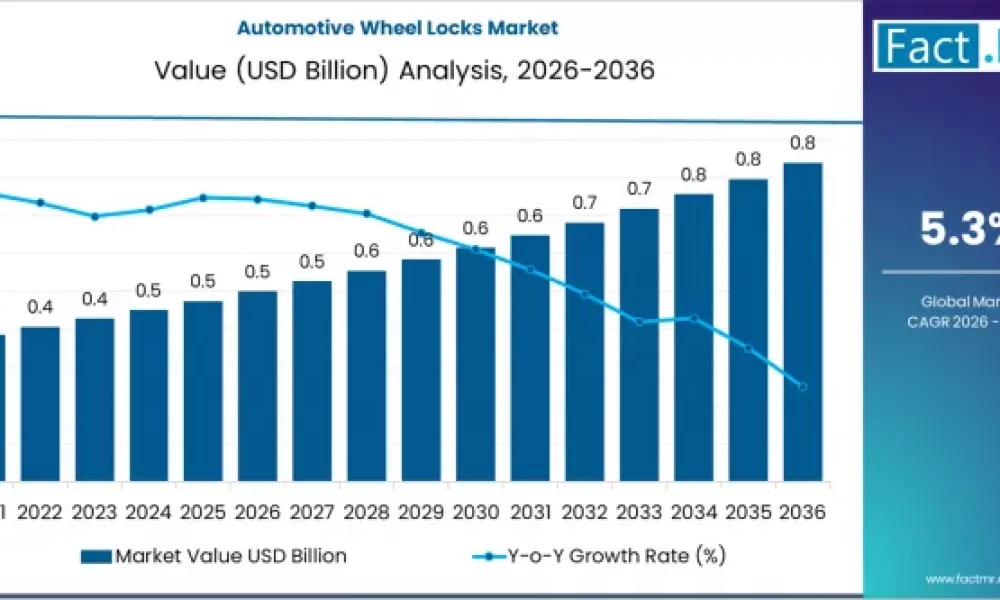
The global automotive wheel locks market is shifting into high gear, with its valuation projected to rise from USD 650 million in 2026 to over USD 1.1 billion by 2036. According to specialized industry analysis, the market is set to expand at a steady compound annual growth rate (CAGR) of 5.6%, driven by the increasing retail value of aftermarket wheels and the rising sophistication of opportunistic vehicle parts theft.
As automotive manufacturers increasingly equip standard models with high-value, oversized alloy wheels, the risk of “block-propping” theft has escalated. Automotive wheel locks—specialized lug nuts that require a unique keyed socket for removal—have transitioned from a niche enthusiast accessory to an essential security feature for both individual consumers and commercial fleet operators.
Summary Table: Automotive Wheel Locks Market Outlook
| Metric | Details |
| Market Value (2026E) | USD 650 Million |
| Forecast Value (2036F) | USD 1.1 Billion |
| Projected CAGR (2026-2036) | 5.6% |
| Leading Product Type | Key-to-Key Locks (42.5% Share) |
| Primary End-User | Passenger Cars (65%+ Share) |
| Highest Growth Market | India (8.2% CAGR) |
Request for Sample Report | Customize Report | Purchase Full Report – https://www.factmr.com/connectus/sample?flag=S&rep_id=13638
Core Market Dynamics: Answering the Strategic ‘How’ and ‘Why’
Automotive wheel locks function as a mechanical deterrent, replacing one standard lug nut per wheel with a uniquely patterned fastener to prevent unauthorized removal.
Who is leading the sector? Industry pioneers including McGard LLC, McGard DE, Farad S.r.l., Wheeliok, and Gorilla Automotive Products dominate the landscape, alongside a significant market for Genuine OEM Accessories provided by major automakers like Toyota, Ford, and BMW.
What is the dominant product type? Key-to-Key Wheel Locks command a significant 42.5% market share. These are favored for their high security-to-cost ratio, offering thousands of unique computer-generated patterns that make them virtually impossible to defeat with standard tools.
Where is growth most accelerated? India is emerging as a high-velocity market with an 8.2% CAGR, fueled by a burgeoning mid-premium SUV segment. China follows with a 7.8% CAGR, supported by a massive domestic aftermarket culture and high rates of urban vehicle ownership.
Why is the technology shifting? The market is moving toward High-Torque, Narrow-Groove Designs. As wheel designs become more intricate and lug nut “wells” become deeper and narrower, manufacturers are developing slim-line locks that offer the same security profile without interfering with the aesthetics of high-performance rims.
Sector Insights: Passenger Cars and Aftermarket Sales Drive Volume
The Passenger Car segment remains the primary end-user, projected to hold over 65% of the market share by 2026. However, the Aftermarket Distribution channel is seeing the fastest growth. With the average cost of a premium set of tires and rims now exceeding USD 2,000, consumers are increasingly viewing a USD 50–USD 100 investment in wheel locks as a mandatory insurance policy.
“Wheel theft is a crime of seconds, and wheel locks are a deterrent of minutes,” the analysis states. “We are seeing a major trend toward ‘Total Wheel Security’ kits. Instead of selling just the locks, manufacturers are bundling them with ‘spun-sleeve’ technology—outer rings that spin freely if a thief tries to use a pipe wrench or grip tool—making the lock immune to common bypass methods.”
Key Market Trends and Strategic Outlook
1. Optimization through Corrosion-Resistant Platings
One of the most significant absolute dollar opportunities lies in Chrome and Black-Phosphate Finishes. Because wheel locks are exposed to road salt, brake dust, and extreme moisture, there is high demand for locks that maintain their aesthetic appeal and structural integrity for the life of the vehicle.
2. The Rise of “Smart” Key Management
Innovation is currently focused on digital key registration. Leading manufacturers are now providing mobile apps where users can register their unique key code via QR code, ensuring that if the original socket is lost, a replacement can be overnighted to a dealership or residence, eliminating the “stranded motorist” scenario.
3. Regulatory and Insurance Tailwinds in the West
In the United States (5.2% CAGR) and United Kingdom (4.8% CAGR), some insurance providers are offering modest premium discounts or deductible waivers for vehicles equipped with Thatcham-approved or high-security mechanical anti-theft devices, further incentivizing the installation of wheel locks at the point of sale.
Investment Perspective: A High-Necessity Automotive Staple
The automotive wheel locks market represents a robust, high-margin opportunity for hardware and automotive accessory firms. As vehicle designs continue to emphasize large, stylized wheels and the global cost of raw materials keeps replacement costs high, the demand for simple, effective, and low-maintenance security solutions is expected to remain a primary growth engine through 2036.
Have specific requirements or need assistance on report pricing or have a limited budget? Please contact [email protected]
About Fact.MR:
Fact.MR is a global market research and consulting firm, trusted by Fortune 500 companies and emerging businesses for reliable insights and strategic intelligence. With a presence across the U.S., UK, India, and Dubai, we deliver data-driven research and tailored consulting solutions across 30+ industries and 1,000+ markets. Backed by deep expertise and advanced analytics, Fact.MR helps organizations uncover opportunities, reduce risks, and make informed decisions for sustainable growth



