
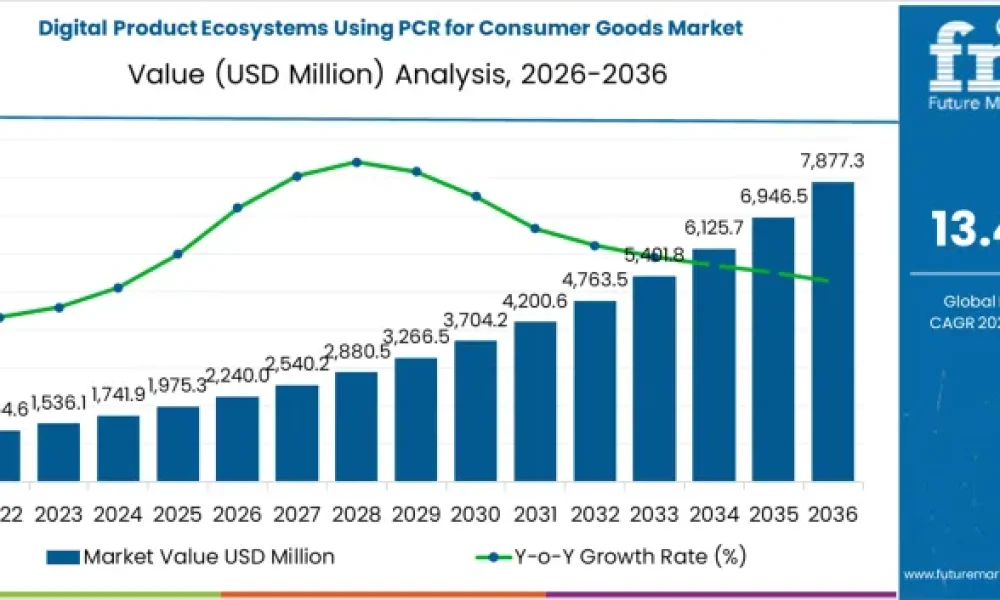
The Digital Product Ecosystems Using PCR for Consumer Goods Market is entering a decisive growth phase as regulatory pressure, sustainability mandates, and digital transformation converge across global consumer goods value chains. According to the latest market outlook, the sector is projected to expand from USD 2,240 million in 2026 to USD 7,877.3 million by 2036, registering a robust CAGR of 13.4% during the forecast period.
Unlike earlier waves of sustainability-driven digitization, growth in this market is no longer fueled by experimentation or branding alone. Instead, it is increasingly shaped by compliance economics, as governments and regulatory bodies demand verifiable proof of post-consumer recycled (PCR) content, standardized digital reporting, and auditable supply-chain transparency. Digital product ecosystems are now becoming essential compliance infrastructure rather than optional innovation tools.
Explore the full market insights and exclusive data breakdowns – Request Your Sample Report Now
Market Outlook: From Sustainability Messaging to Legal Necessity
Digital product ecosystems using PCR are transforming how consumer goods companies manage recycled materials, product data, and regulatory reporting. These ecosystems automate data capture, link certification records, and ensure audit readiness, significantly lowering long-term compliance costs. As regulations such as digital product passports and extended producer responsibility (EPR) frameworks gain momentum, brands are increasingly embedding PCR traceability into their core digital architecture.
However, certification complexity and fragmented global standards raise entry barriers. Adoption is currently concentrated among large FMCG and global consumer goods manufacturers that can absorb upfront integration costs. Over time, technology providers that position themselves as compliance enablers, rather than simple visibility platforms, are expected to capture disproportionate value.
How Digital Integration and PCR Traceability Are Reshaping Consumer Goods
Consumer goods companies are shifting from isolated PCR sourcing toward fully connected digital product ecosystems. PCR data is now integrated with product design, packaging identity, logistics, and post-consumer recovery systems. This allows brands to verify recycled content, track material flows, and demonstrate compliance across multiple jurisdictions.
Digital integration is also redefining procurement and supplier relationships. Real-time visibility into PCR availability, quality metrics, and certification status reduces sourcing risk and enables long-term contracting. As a result, suppliers that can digitally interface with brand systems are gaining strategic relevance beyond material supply.
Commercial Value Creation Beyond Materials
In this evolving market, data has become as valuable as materials. Digital PCR ecosystems enable monetization through:
- Automated compliance and ESG reporting
- Lifecycle analytics and circularity metrics
- Consumer-facing transparency tools
- Streamlined audits and certification workflows
For manufacturers and technology providers alike, competitive advantage increasingly depends on scalable digital infrastructure rather than PCR volume alone.
Key Segments of the Digital Product Ecosystems Using PCR for Consumer Goods Market
By End Use
- FMCG & durable goods
- Brand-consumer transparency initiatives
- Digital retail ecosystems
- High-trust consumer goods
- Emerging digital FMCG formats
- Regional consumer brands
FMCG and durable goods account for 45% market share, driven by high product turnover, complex supply chains, and frequent retail interactions requiring accurate digital product data.
By Ecosystem Type
- Digital product passport ecosystems
- Connected packaging ecosystems
- Platform-integrated PCR tracking
- Secure product ecosystems
Digital product passport ecosystems lead with a 37% share, as they consolidate product-level PCR and compliance data into structured, interoperable digital records.
By Region
- Asia Pacific
- Europe
- North America
- Latin America
- Middle East & Africa
Asia Pacific emerges as the fastest-growing region, supported by large-scale digitization and expanding FMCG participation.
Country-Level Growth Highlights
- India: Fastest-growing market at 16.0% CAGR, driven by mobile-first, scalable platforms and rapid FMCG digitization
- China: 15.2% CAGR, supported by high-volume consumer markets and integration with e-commerce ecosystems
- United States: 13.4% CAGR, led by large brand portfolios and cloud-native scalability
- Germany: 12.8% CAGR, focused on data integrity, interoperability, and structured adoption
- Japan: 11.0% CAGR, emphasizing precision, reliability, and governance
Competitive Landscape: Established Leaders and Emerging Innovators
Competition in the digital product ecosystems using PCR market centers on data transparency, traceability frameworks, and regulatory alignment.
- SAP SE leads with deep ERP and PLM integration, enabling real-time PCR tracking and audit-ready compliance dashboards.
- Circularise B.V. differentiates through blockchain-based, permissioned traceability that protects sensitive commercial data.
- Salesforce, Inc. (Net Zero Cloud) integrates PCR tracking with carbon accounting and sustainability analytics tied to CRM insights.
- Digimarc Corporation leverages digital watermarking to link PCR verification with product authentication and consumer engagement.
- Alibaba Cloud and AntChain Technologies provide scalable cloud and blockchain infrastructure for high-volume, cross-border ecosystems.
- NEC Corporation and Fujitsu Limited support secure, enterprise-grade digital platforms aligned with long-term data governance needs.
Both established technology leaders and new ecosystem innovators are actively expanding capabilities, forming partnerships, and developing next-generation PCR traceability technologies to support global compliance.
Outlook: Compliance-Driven Growth Through 2036
As regulatory scrutiny intensifies, digital product ecosystems using PCR will become foundational to consumer goods manufacturing. Vendors that align technology with evolving compliance frameworks, interoperability standards, and scalable data governance will be best positioned to support both established manufacturers and new entrants seeking to expand globally.
Have a specific Requirements and Need Assistant on Report Pricing or Limited Budget please contact us – [email protected]
About Future Market Insights (FMI)
Future Market Insights, Inc. (FMI) is an ESOMAR-certified, ISO 9001:2015 market research and consulting organization, trusted by Fortune 500 clients and global enterprises. With operations in the U.S., UK, India, and Dubai, FMI provides data-backed insights and strategic intelligence across 30+ industries and 1200 markets worldwide
Why Choose FMI: https://www.futuremarketinsights.com/why-fmi



