
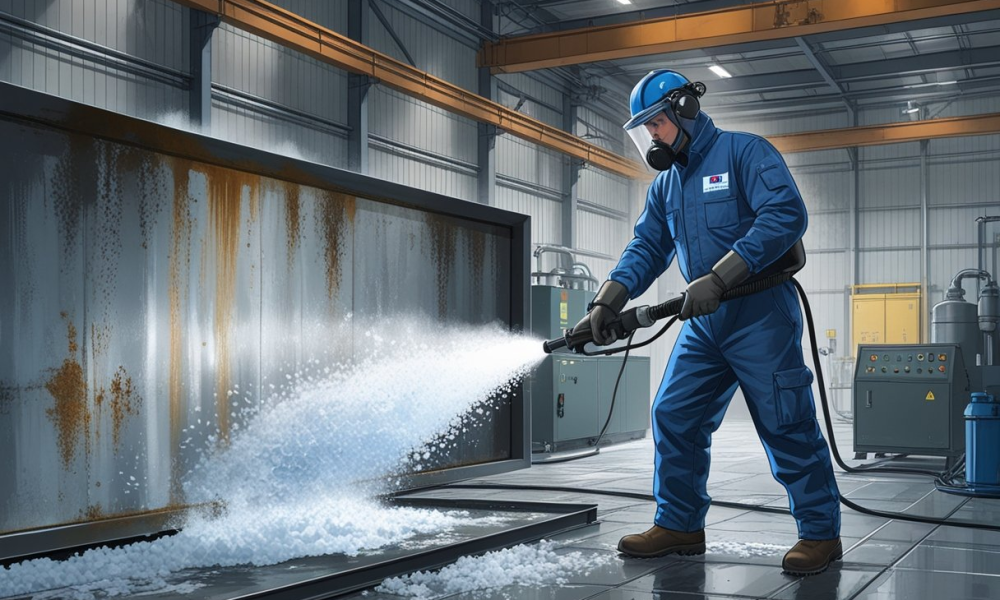
Industrial facilities routinely face cleaning challenges such as hardened residue buildup, extended maintenance downtime, and the risk of damaging sensitive equipment surfaces. To address these issues, Nu-Ice Dry Ice Blasting™ designs and manufactures industrial dry ice blasting systems engineered for precision cleaning. Dry ice blasting uses compressed air to propel dry ice pellets, lifting contaminants without abrasion, moisture, or secondary waste. Within this process, blasting nozzles play a critical role in directing airflow and media delivery, making them essential dry ice blasting accessories for optimizing performance across different industrial applications.
Dry ice blasting is a non-abrasive cleaning method that uses solid carbon dioxide (CO₂) pellets accelerated by compressed air to remove surface contaminants. According to Nu-Ice Dry Ice Blasting™, the process relies on directing dry ice pellets at a target surface, where they impact residues such as grease, coatings, or buildup. Upon contact, the dry ice sublimates—transitioning directly from solid to gas—leaving no secondary waste. Because no water or chemicals are involved, the process supports dry, residue-free cleaning in industrial environments.
Kinetic Impact
Dry ice pellets are propelled at high velocity using compressed air. This kinetic energy helps dislodge contaminants from surfaces without abrasion, making the process suitable for sensitive equipment.
Thermal Shock
Dry ice pellets are extremely cold. When they strike a warmer surface, the rapid temperature change causes contaminants to contract and weaken their bond with the substrate.
Sublimation Expansion
As described by Nu-Ice Dry Ice Blasting™, dry ice sublimates instantly on impact, expanding into gas. This expansion helps lift and separate loosened contaminants from the surface, supporting efficient removal without leftover blasting media.
A dry ice blasting system consists of several integrated components. An air compressor supplies the compressed air required to propel pellets. The dry ice hopper stores and feeds solid CO₂ pellets into the system. A metering system controls pellet flow to regulate cleaning intensity. Pellets travel through a hose to the nozzle, which directs airflow and dry ice toward the target surface. Together, these components—outlined in Nu-Ice’s equipment documentation—enable controlled, dry, and non-abrasive cleaning across industrial applications.
Nu‑Ice Age, Inc.™ is a veteran-owned industrial equipment manufacturer founded in 2007 and based in Jackson, Michigan. The company develops and assembles dry ice blasting machines and accessories that are proudly Made in USA, serving a wide range of industrial cleaning and restoration needs. After years of research and testing, Nu-Ice Age engineered its lineup of high-performance dry ice cleaning solutions, including the Commando® series of dry ice blasters and related accessories, designed for environments where residue removal, maintenance efficiency, and minimal cleanup are priorities.
Dry ice blasting accessories within its portfolio support effective operation and customization across applications.
Nu-Ice dry ice blasters are built with several practical features that support controlled and efficient surface cleaning. Each unit includes a blasting gun designed to connect to a range of interchangeable nozzles, allowing operators to tailor airflow patterns and pellet velocity for specific tasks. Nozzle options may vary from round to fan shapes to support broader or more concentrated blast streams.
Integrated into many machines is a moisture separator and aftercooler system, which helps remove water and cool compressed air before it enters the blasting stream. Cooler, drier air supports consistent pellet feed and minimizes freeze-ups inside the equipment during operation.
These systems also feature the patented BlitzFeed® freezeless dry ice delivery design in the hopper, ensuring a steady pellet flow without interruptions.
The Commando® 55 Dry Ice Blaster is engineered for heavy-duty cleaning performance in industrial and commercial environments. It measures approximately 33.25 inches long, 23 inches wide, and 39 inches high, and has a total weight of about 234 pounds, making it substantial yet maneuverable for shop and field use.
Its dry ice hopper holds up to 55 pounds of pellets, feeding them into the blasting stream via the BlitzFeed® freezeless delivery system. Airflow capacity ranges from roughly 85 to 375 cubic feet per minute (CFM) with a pressure range of approximately 60 to 250 psi, enabling a broad operational envelope for different cleaning requirements.
Dry ice consumption for the Commando 55 spans from zero to about 425 pounds per hour, depending on blast pressure and cleaning intensity. The machine includes an integrated moisture separator, adjustable blast pressure controls, and fittings for standard compressed air connections.
Preparation and Setup
Using Nu-Ice Dry Ice Blasting™ equipment begins with connecting the unit to a suitable compressed air supply and loading the hopper with dry ice pellets. Operators verify air pressure settings and pellet feed rates based on the cleaning task.
Safety Requirements
Nu-Ice outlines standard safety practices, including the use of insulated gloves, eye protection, hearing protection, and proper ventilation. Because dry ice sublimates into CO₂ gas, adequate airflow in the work area is required.
Typical Workflow Steps
Once powered, compressed air conveys pellets through the hose to the blasting gun. The operator activates the trigger, directs the nozzle toward the surface, and adjusts pressure or pellet flow as needed. Pellets sublimate on contact, and removed material is collected separately if required.
Nu-Ice dry ice blasting equipment is used across a broad range of industrial and commercial environments. In manufacturing and production facilities, systems are applied for cleaning molds, tooling, conveyors, and production equipment without introducing moisture. Food processing and sanitation environments use dry ice blasting to address buildup on processing lines, ovens, and packaging equipment while supporting dry cleaning protocols.
For historical restoration and delicate surfaces, Nu-Ice systems are utilized on substrates such as wood, stone, and brick, where abrasive methods may be unsuitable. Automotive and aerospace applications include cleaning engines, molds, composites, and fixtures during maintenance or refurbishment. Electrical and specialty cleaning applications involve motors, control panels, and industrial machinery where water or chemicals could pose risks.
Across these sectors, Nu-Ice equipment is selected for situations requiring controlled media delivery, minimal disassembly, and dry operation, aligning with diverse operational requirements rather than a single industry outcome.
Dry ice blasting offers several operational characteristics that influence its use in industrial settings. The process generates no secondary waste because dry ice sublimates into gas upon impact, leaving only the removed contaminant behind. Its non-abrasive interaction helps preserve surface integrity when properly configured. As a dry, chemical-free process, it avoids introducing moisture or solvents into the work area.
Operational considerations include proper ventilation to manage CO₂ gas, safe handling of dry ice, and matching air supply capacity to equipment requirements. Selection and configuration of components such as blasting nozzles and other dry ice blasting accessories play a role in adapting the process to different surfaces and environments.
Nu-Ice equipment supports system integration through a range of compatible accessories designed to support different operating environments. Interchangeable nozzles and hose lengths allow operators to adjust pellet delivery patterns and reach confined or elevated areas. Nu-Ice systems are designed to connect to standard industrial air supplies, with optional aftercoolers and moisture separators used to condition compressed air before it enters the blasting unit. For storage and maintenance, the company recommends keeping machines clean and dry, regularly inspecting hoses and fittings, and storing dry ice separately to maintain pellet quality and system reliability.
What is dry ice blasting?
Dry ice blasting is a cleaning process that uses solid carbon dioxide pellets accelerated by compressed air to remove surface contaminants. The pellets sublimate on impact, leaving no residual blasting media behind.
Is Nu-Ice equipment compatible with standard air compressors?
Nu-Ice dry ice blasters are designed to operate with commonly available industrial air compressors, provided they meet the airflow and pressure requirements specified for each machine.
What safety considerations apply when dry ice blasting?
Operators should use protective equipment such as gloves, eye protection, and hearing protection. Adequate ventilation is required to manage carbon dioxide gas produced during sublimation.
What infrastructure is needed to operate a dry ice blaster?
Typical requirements include a compressed air source, access to dry ice pellets, electrical power for auxiliary components if applicable, and sufficient ventilation in the work area.
How does dry ice blasting compare to abrasive cleaning methods?
Dry ice blasting differs in that it does not rely on abrasive media. Abrasive methods remove material mechanically, while dry ice blasting focuses on lifting contaminants through impact, temperature change, and sublimation.
What is the environmental impact of dry ice blasting?
Dry ice blasting does not introduce additional chemicals or water. The carbon dioxide used is commonly sourced as a byproduct of other industrial processes rather than newly generated.
Can dry ice blasting be used on sensitive equipment?
When properly configured, dry ice blasting is used on sensitive surfaces and equipment because it is non-abrasive and dry, reducing the risk of moisture-related damage.
This press release has outlined the fundamentals of dry ice blasting, explaining how the process works, the principles behind contaminant removal, and the core components involved in system operation. It has also provided an overview of Nu-Ice Dry Ice Blasting™ and its U.S.-manufactured equipment, including key features and specifications of the Commando® 55 Dry Ice Blaster. By covering operational workflows, safety considerations, accessories, and a wide range of industrial and commercial applications, the release presents a clear, factual overview of how dry ice blasting systems are integrated into modern cleaning and maintenance environments.