
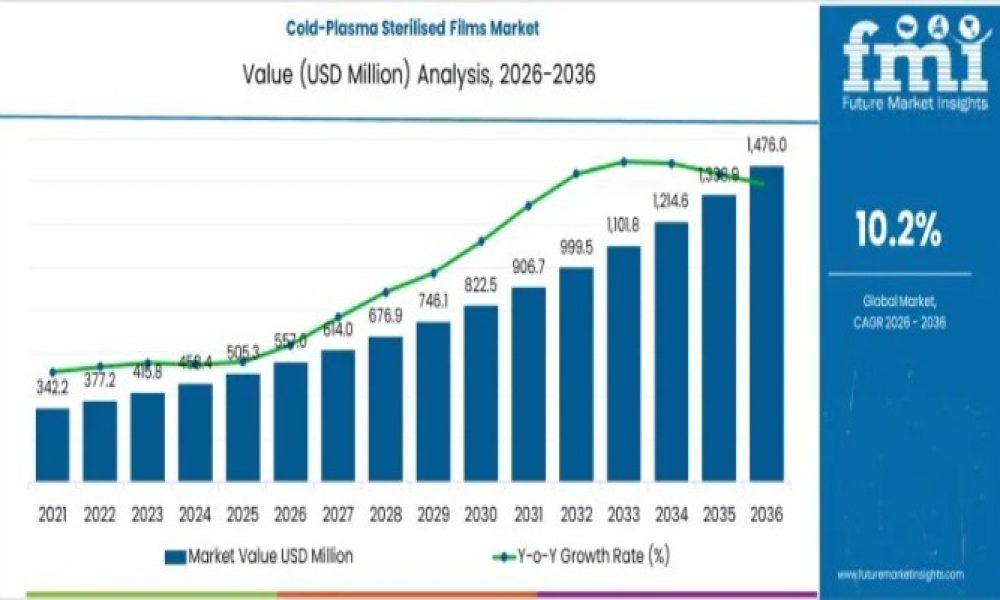
The global Cold-Plasma Sterilised Films Market is entering a decisive growth phase as packaging, healthcare, and food manufacturers increasingly prioritise sterility without compromising material performance. Valued at USD 557 million in 2026, the market is forecast to reach USD 1,476 million by 2036, expanding at a robust CAGR of 10.2% over the forecast period.
This growth reflects a structural shift in how sterility is achieved in flexible packaging. Cold-plasma technology enables effective surface decontamination at low temperatures, preserving the mechanical strength, seal integrity, and optical clarity of polymer films. As a result, it is gaining rapid adoption in medical devices, pharmaceutical packaging, and aseptic food applications, where conventional heat or chemical sterilisation methods often fall short.
Discover Market Opportunities – Get Your Sample of Our Industry Overview Today!
Market Snapshot: Quick Stats
- Market Value (2026): USD 557 million
- Forecast Value (2036): USD 1,476 million
- Forecast CAGR (2026–2036): 10.2%
- Leading Packaging Format: Sterile lidding & pouch films (45% share)
- Key Growth Regions: India, China, USA, Brazil, Germany
- Major Market Players: Amcor, Mondi, Wanhua, UFlex, Toray, DuPont, regional converters
Sterility Moves Upstream in Packaging Design
Cold-plasma sterilised films initially emerged as a solution to a very specific manufacturing problem. Heat-sensitive films used in medical and pharmaceutical packaging were prone to warping, seal failure, or long aeration cycles when exposed to traditional sterilisation techniques. Cold plasma addressed these issues by neutralising microorganisms directly on the film surface, without bulk heating or chemical residues.
Over time, this approach evolved from a niche workaround into a baseline capability. Today, sterility is increasingly specified at the material level rather than applied after package formation. Inline plasma treatment systems with short cycle times now align seamlessly with high-speed, automated packaging lines, making cold-plasma sterilised films compatible with modern industrial workflows.
Growth Outlook: From Early Adoption to Scaled Integration
Between 2026 and 2031, the market grows from USD 557 million to approximately USD 795 million, marking the early adoption phase. Annual value additions rise steadily as pilot projects in North America and Europe validate sterilisation efficacy, material compatibility, and process integration for thermoforming and flexible films.
From 2031 to 2036, expansion accelerates sharply. Market value nearly doubles to USD 1,476 million, driven by broader commercialisation, repeat procurement, and portfolio-wide adoption across food, pharmaceutical, and medical packaging lines. Annual increments increase from USD 75 million to USD 156 million, reflecting a transition from selective use to normalized deployment across global packaging production.
Key Market Takeaways
- Medical and pharmaceutical packaging dominates, accounting for ~40% of total demand
- Aseptic food packaging emerges as the fastest-scaling secondary application
- Sterile lidding and pouch films remain the preferred formats due to proven reliability
- Inline plasma treatment innovations are improving scalability and cost efficiency
- Regulatory support and export growth are reinforcing long-term demand
End-Use Applications Driving Demand
Cold-plasma sterilised films are primarily adopted where non-thermal sterilisation is essential:
- Medical & pharmaceutical packaging: Ensures validated sterility while preserving polymer properties
- Aseptic food packaging: Extends shelf life for heat-sensitive products
- Medical disposables: Maintains hygiene during storage and transport
- Pharma export packaging: Delivers consistent sterility across long transit times
- Hospital and advanced medical packs: Supports infection control and device sensitivity requirements
Demand in these segments is driven by sterility assurance and regulatory compliance rather than overall packaging volume, resulting in stable and predictable adoption patterns.
Packaging Formats Shaping Market Structure
Packaging format plays a critical role in sterilisation performance and barrier reliability:
- Sterile lidding & pouch films: ~45% market share, widely used in medical trays and device packs
- Form-fill-seal (FFS) films: Growing adoption in aseptic food and pharma packaging
- Rollstock films: High-volume applications for disposables
- Sachets & pouches: Unit-dose and export-oriented formats
Once a format is validated for plasma sterilisation, manufacturers are reluctant to change it, reinforcing long-term demand concentration in proven structures.
Regional Momentum Highlights
- India (12.0% CAGR): Driven by expanding food and pharmaceutical industries and rising hygiene standards
- China (11.2% CAGR): Large-scale food production and medical packaging adoption
- USA (8.6% CAGR): Strong uptake in healthcare, food, and industrial films
- Brazil (8.0% CAGR): Packaging modernisation and safety compliance
- Germany (7.6% CAGR): Stringent sterilisation regulations and advanced packaging infrastructure
Competitive Landscape: Where Material Meets Sterilisation
Competition in the cold-plasma sterilised films market is shaped less by resin innovation and more by material behaviour under plasma exposure. Leading players such as Amcor, Mondi, Toray, DuPont, UFlex, and Wanhua, alongside regional converters, are evaluated on their ability to maintain sealability, surface stability, and processing efficiency after repeated plasma treatment.
Local converters often act as gatekeepers, determining which materials transition from pilot trials to full-scale production based on real-world line performance. As sterilisation parameters vary across facilities, the market remains fragmented, with success defined by operational predictability rather than standardisation.
Why FMI: https://www.futuremarketinsights.com/why-fmi
About Future Market Insights (FMI)
Future Market Insights, Inc. (FMI) is an ESOMAR-certified, ISO 9001:2015 market research and consulting organization, trusted by Fortune 500 clients and global enterprises. With operations in the U.S., UK, India, and Dubai, FMI provides data-backed insights and strategic intelligence across 30+ industries and 1200 markets worldwide.



