
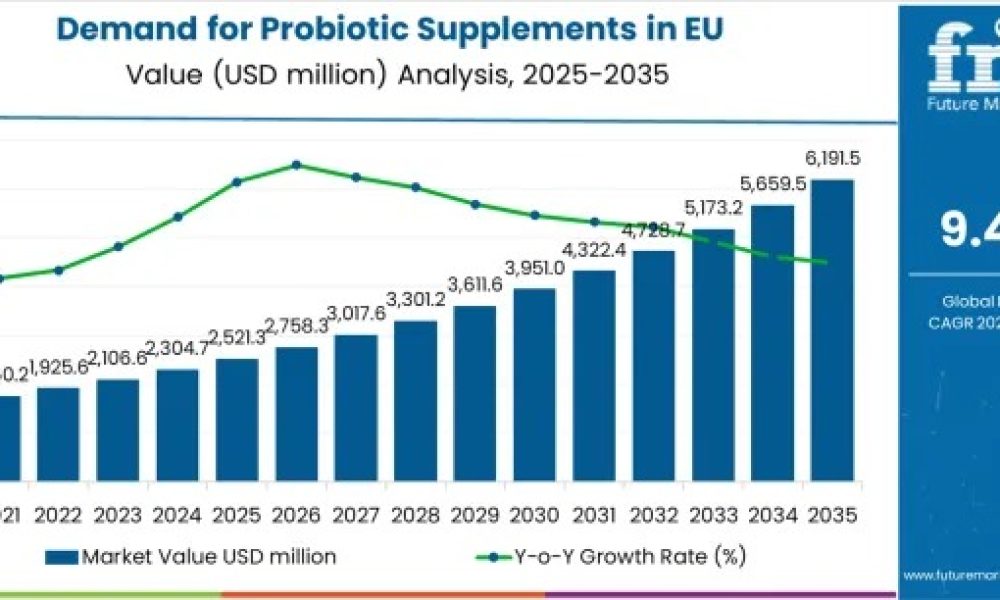
The European Union probiotic supplements market is entering a decisive growth phase, underpinned by rising awareness of gut health, expanding clinical validation, and broader acceptance of preventive nutrition solutions. According to recent analysis by Future Market Insights (FMI), EU probiotic supplements sales are projected to grow from USD 2,521.3 million in 2025 to approximately USD 6,191.5 million by 2035, registering an absolute increase of USD 3,656.6 million. This represents total growth of 145%, with demand expanding at a compound annual growth rate (CAGR) of 9.4% over the forecast period.
FMI insights, widely referenced across nutrition, sweetener, and alternative protein markets, indicate that the EU probiotic supplements industry is expected to grow by nearly 2.5X between 2025 and 2035. Growth is supported by increasing consumer focus on digestive wellness, immune resilience, and metabolic health, alongside the expansion of pharmacy-led distribution and rapidly maturing online retail channels across Europe.
Explore trends before investing – request a sample report today!
Quick Stats: EU Probiotic Supplements Market
- Market Value (2025): USD 2,521.3 million
- Forecast Value (2035): USD 6,191.5 million
- Forecast CAGR (2025–2035): 9.4%
- Leading Product Type: Lactobacillus (35% share)
- Top Application: Digestive Health (38%)
- High-Growth Countries: Spain, Italy, Netherlands
Between 2025 and 2030, EU probiotic supplements demand is projected to rise to USD 3,914.9 million, adding USD 1,393.6 million and accounting for 38.1% of total decade growth. This phase reflects rising awareness of the gut–brain axis, greater scientific confidence in probiotic efficacy, and growing acceptance of probiotics as daily preventive health solutions. Manufacturers are responding by expanding strain-specific, clinically validated, and multi-strain formulations aligned with targeted health outcomes.
From 2030 to 2035, market value is forecast to climb further to USD 6,177.9 million, adding USD 2,263 million, or 61.9% of total forecast growth. This period will be shaped by advanced formulations, including postbiotics, synbiotics, and personalized probiotics, alongside stronger consumer willingness to invest in premium, outcome-driven supplements with documented strain efficacy.
Strong Historical Momentum Anchors Future Growth
Between 2020 and 2025, EU probiotic supplements sales grew from USD 1,610.7 million to USD 2,521.3 million, maintaining a 9.4% CAGR. Pandemic-era immunity concerns, expanding microbiome research, and rising digestive health awareness accelerated adoption. Pharmaceutical companies, nutrition brands, and wellness specialists increasingly recognized probiotics as evidence-based solutions, supported by advances in strain stability, shelf-life technologies, and clinical substantiation.
Why Demand Continues to Accelerate
The market’s expansion is closely linked to the rising prevalence of digestive concerns and consumer preference for natural, scientifically validated wellness solutions. Probiotic supplements are now widely used to support digestive balance, immune function, and metabolic health, even for mild concerns such as bloating, irregularity, or antibiotic-associated gut disruption. Regulatory clarity around labeling, strain identification, and health claims is further reinforcing consumer trust and product quality expectations.
Segment Insights: Where Growth Is Concentrated
By Product Type, Lactobacillus accounts for 35% of EU sales in 2025, supported by decades of clinical research, proven safety, and broad applicability across digestive, immune, and women’s health formulations. While its share is expected to ease slightly to 33% by 2035, it remains the cornerstone of European probiotic portfolios.
By Application, digestive health represents 38% of total demand in 2025, reflecting its role as the primary entry point for probiotic adoption. Although its share moderates to 34% by 2035, absolute growth remains strong as immune and metabolic applications scale faster.
By Distribution Channel, pharmacies and drugstores lead with 40% share in 2025, driven by professional guidance and cold-chain integrity. However, online and e-commerce channels are forecast to surpass pharmacies by 2035, reflecting improved logistics and digitally driven consumer behavior.
Country-Level Growth Highlights
Spain is projected to record the fastest growth at a 10.1% CAGR, followed by Italy (9.8%) and the Netherlands (9.6%). Germany remains the largest market, supported by its extensive pharmacy infrastructure and evidence-based wellness culture, while France maintains steady expansion anchored in its strong pharmaceutical retail tradition.
Subscribe for Year-Round Insights → Stay ahead with quarterly and annual data updates
Competitive Landscape
The EU probiotic supplements market remains highly competitive, with multinational nutrition companies, pharmaceutical brands, and specialized probiotic players investing heavily in clinical validation, personalization platforms, and formulation innovation. Garden of Life (Nestlé SA), Culturelle, Align, and NOW Foods collectively hold a modest share, while a large proportion of demand is served by regional brands, pharmacy private labels, and emerging direct-to-consumer innovators.
As microbiome science advances and consumers increasingly prioritize preventive health, EU probiotic supplements are evolving from niche digestive aids into core wellness solutions, positioning the market for sustained, data-driven expansion through 2035.
Key Players
- Garden of Life (Nestlé SA)
- Culturelle (i-Health Inc.)
- Align (Procter & Gamble)
- NOW Foods
- Renew Life (Clorox)
- Bio-Kult
- Optibac Probiotics
- VSL#3
- Jarrow Formulas
- Nature’s Way
About Future Market Insights (FMI)
Future Market Insights, Inc. (FMI) is an ESOMAR-certified, ISO 9001:2015 market research and consulting organization, trusted by Fortune 500 clients and global enterprises. With operations in the U.S., UK, India, and Dubai, FMI delivers data-backed insights and strategic intelligence across 30+ industries and 1,200 markets worldwide, empowering stakeholders to make confident, future-ready decisions.



