
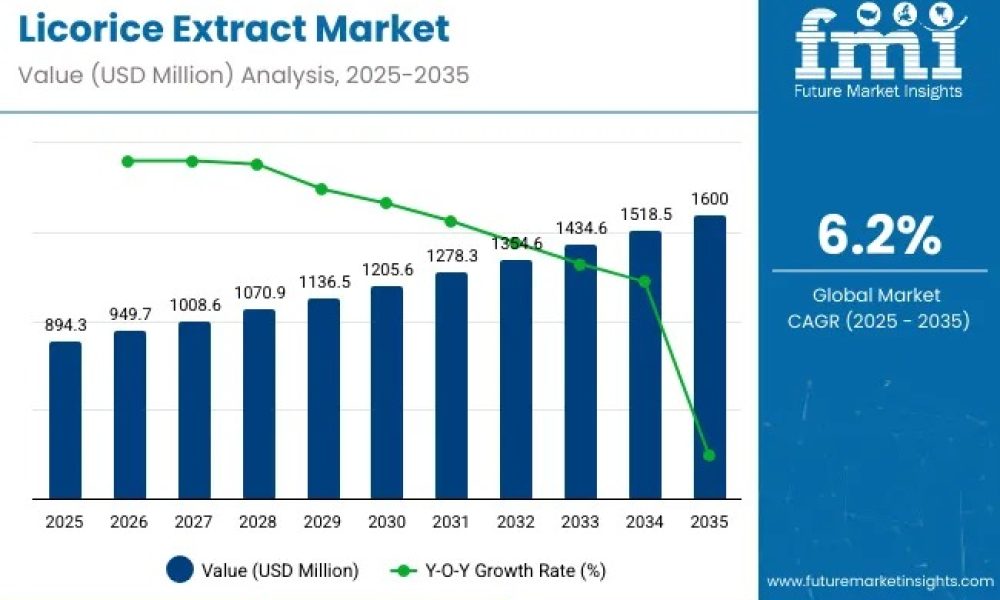
The global licorice extract market is poised for steady expansion, projected to grow from USD 894.3 million in 2025 to USD 1,600 million by 2035, registering a CAGR of 6.2% over the forecast period. This growth trajectory reflects rising adoption of licorice extracts across nutraceuticals, herbal supplements, pharmaceuticals, functional foods, cosmetics, and oral care, driven by consumer preference for plant-based, multifunctional ingredients.
Licorice extract, rich in bioactives such as glycyrrhizin, glycyrrhetinic acid, and flavonoids, is increasingly positioned as a natural adaptogen and anti-inflammatory agent. Its applications in digestive health, immune support, respiratory care, skin brightening, and liver support formulations are expanding its relevance across both preventive wellness and therapeutic use cases.
Get Exclusive Access To Data Tables, Market Sizing Dashboards, And Analyst Insights. Request Sample Report!
Clean-Label and Botanical Trends Strengthen Market Momentum
A global shift toward clean-label, botanical, and traceable ingredients is reinforcing demand for both glycyrrhizin-rich extracts and de-glycyrrhizinated licorice (DGL) variants. Consumers are increasingly avoiding synthetic additives, encouraging manufacturers to adopt standardized, high-purity licorice extracts aligned with global quality and regulatory benchmarks.
Licorice extract currently accounts for an estimated 7–9% share of the herbal extracts and botanicals market, around 3–5% of nutraceutical ingredients, and 2–3% of pharmaceutical excipients, underlining its cross-industry importance. In the flavor and fragrance segment, its naturally sweet, complex profile secures a 1–2% share, particularly in confectionery and beverages.
Asia-Pacific Emerges as the Primary Growth Engine
Asia-Pacific, led by India, China, and Australia, is identified as the fastest-growing regional market. Strong roots in Ayurvedic and Traditional Chinese Medicine (TCM), combined with expanding nutraceutical and cosmetic manufacturing bases, are driving regional demand. India is projected to register a standout CAGR of 11.5% through 2035, supported by rising healthcare spending and government-backed promotion of traditional medicine.
China continues to dominate global production and exports, supplying pharmaceutical-grade and food-grade licorice extracts to North America, Europe, Japan, and South Korea—regions that rely heavily on imports due to limited domestic cultivation.
Liquid Licorice Extract Leads by Form
By 2025, the liquid licorice extract segment is expected to command 44.9% of total market share, making it the leading form used across industrial applications. Its higher concentration, ease of blending, and rapid absorption make it particularly suitable for:
- Cough syrups, herbal tonics, and throat lozenges
- Functional beverages and confectionery
- Skincare emulsions, serums, and lotions
Manufacturers are increasingly adopting vertical integration strategies to ensure consistency, traceability, and extract purity, strengthening supply chain reliability.
Immune Support Applications Gain Strong Traction
The immune support segment is projected to account for 22.6% of total demand by 2025. Post-pandemic consumer behavior has accelerated interest in botanical immunity boosters, positioning licorice extract as a staple ingredient in teas, nutraceutical blends, and functional foods. Clinical research highlighting its antiviral, anti-inflammatory, and gut-immune support properties continues to support adoption across North America, Europe, and East Asia.
Innovation, Sustainability, and Trade Shape Competitive Dynamics
Innovation in delivery formats—including capsules, gummies, chewables, and HPMC-based supplements—is improving consumer access and compliance. Meanwhile, sustainability initiatives such as organic sourcing and fair-trade certification are gaining prominence, as brands align with ethical procurement expectations.
The industry demonstrates moderate-to-high concentration, with tier-1 players holding approximately 25–30% share, tier-2 players 35–40%, and the remainder distributed among regional specialists. Key suppliers include MAFCO Worldwide LLC, Norevo GmbH, Shaanxi Jiahe Phytochemicals, Zhejiang Kangling, Hebei Jingu, and Hunan Huakang, alongside emerging players emphasizing sustainable sourcing and high-purity extracts.
Recent developments, such as Norevo GmbH’s fair-trade licorice extract launch in Europe and MAFCO’s organic licorice powder introduction in North America, signal increasing alignment with clean-label and responsible sourcing trends.
Buy Report Now – Click Here to Purchase the Report
Outlook: Botanical Credibility Meets Scientific Validation
As scientific research continues to validate the therapeutic potential of licorice extract—particularly in immune modulation, metabolic health, and dermatology—the market is expected to benefit from evidence-based product innovation. Combined with strong demand from nutraceuticals, pharmaceuticals, and personal care, licorice extract is set to remain a high-value botanical ingredient through 2035.
About Future Market Insights (FMI)
Future Market Insights, Inc. (FMI) is an ESOMAR-certified, ISO 9001:2015 market research and consulting organization, trusted by Fortune 500 clients and global enterprises. With operations in the U.S., UK, India, and Dubai, FMI delivers data-backed insights and strategic intelligence across 30+ industries and 1,200 markets worldwide, enabling businesses to navigate change and unlock growth opportunities.



