
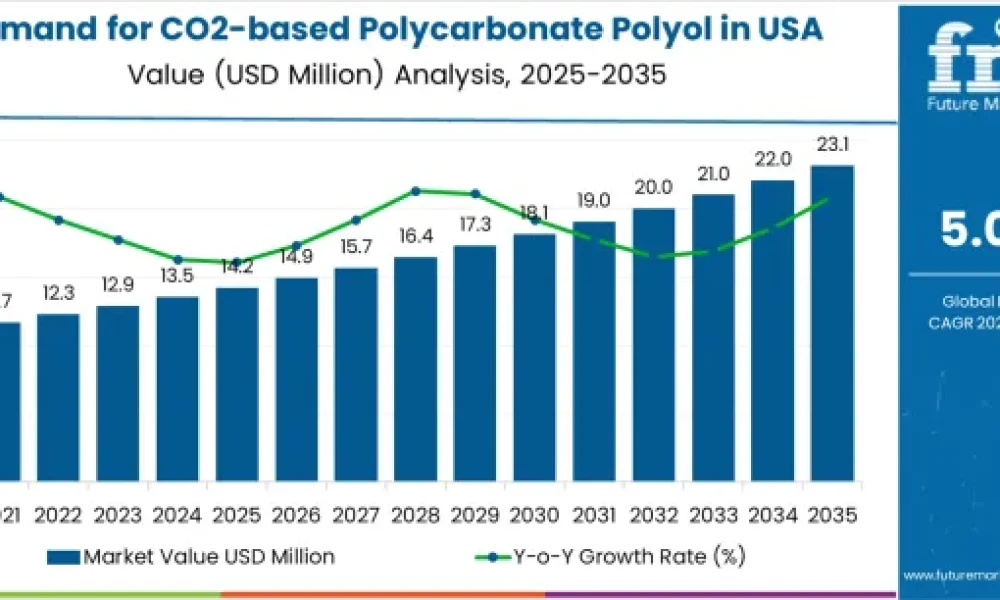
The United States CO₂-based polycarbonate polyol market is projected to expand from USD 14.2 million in 2025 to USD 23.1 million by 2035, advancing at an estimated 5.0% CAGR as manufacturers accelerate the transition toward low-carbon materials, next-generation polymer systems, and sustainable production technologies. This upward trajectory reflects growing adoption of CO₂-derived polyols across polyurethane elastomers, specialty coatings, adhesives, and advanced industrial applications.
The market’s momentum is shaped by increasing corporate sustainability commitments, integration of carbon utilization processes in material manufacturing, and expanding downstream demand for eco-efficient performance polymers. At the same time, steady regulatory alignment toward emissions reduction and life-cycle efficiency continues to strengthen the case for CO₂-based polycarbonate polyol as a commercially viable alternative to conventional fossil-based polyol systems.
Key Market Insights at a Glance
Industry assessments indicate that the liquid polycarbonate polyol segment accounts for roughly 64.8% of total market value in 2025, supported by superior processing compatibility, stable molecular characteristics, and seamless integration into existing polyurethane production lines. Polyurethane elastomers remain the largest application segment, representing more than half of overall demand, driven by their extensive use in flexible industrial materials, engineered polymers, and performance elastomer formulations.
Macroeconomic trends including industrial decarbonization initiatives, expansion of advanced material manufacturing, and rising emphasis on recyclable polymer structures continue to reinforce growth opportunities across the value chain. However, the market also faces challenges associated with production cost sensitivity, technology scalability, and competition from traditional polyol formulations, underscoring the importance of process innovation and performance optimization.
Segment Overview
Product segmentation highlights the dominance of liquid CO₂-based polycarbonate polyols, favored for their consistent flow behavior, compatibility with automated processing environments, and alignment with the performance benchmarks required in high-value polyurethane systems. Within end-use categories, polyurethane elastomers retain a leading presence due to their widespread applicability in industrial equipment components, specialty material fabrication, and durable polymer applications that benefit from improved resilience and environmental efficiency.
To access the complete data tables and in-depth insights, request a sample report here
Regional Overview
Across the United States, the Southern region emerges as a key growth hub, supported by a concentration of chemical manufacturing facilities, access to industrial feedstocks, and increasing capital investments in sustainable polymer technologies. The Midwest continues to gain traction as automotive, transportation, and heavy manufacturing sectors adopt advanced polyol formulations. Meanwhile, the Northeast and Western regions demonstrate steady expansion fueled by materials innovation, research activity, and precision chemical development initiatives.
Competitive Landscape
The competitive environment features established multinational chemical producers alongside specialized material innovators advancing CO₂-based polyol capabilities. Leading companies are strengthening product portfolios, enhancing technical service networks, and investing in scalable production infrastructure to meet rising customer demand for sustainable, performance-driven polyurethane inputs. Strategic priorities include process efficiency enhancement, supply chain resilience, and the development of tailored formulations for application-specific performance requirements.
Recent Strategic Developments
Recent industry developments include collaborative research programs focused on carbon utilization chemistry, expansion of domestic polyol manufacturing capacity, and technology partnerships designed to accelerate market-ready innovation. Several producers are prioritizing modernization of production assets, deployment of digital quality monitoring systems, and integration of modular processing platforms to support consistent output at commercial scale.
Market Outlook: Powering the Next Decade
Looking ahead, the U.S. CO₂-based polycarbonate polyol market is positioned to evolve into a critical pillar of next-generation materials manufacturing. Over the coming decade, growth is expected to be supported by continued adoption of sustainability-aligned procurement policies, deeper integration of automation and analytics in polyol processing, and broader cross-industry acceptance of low-carbon polymer solutions.
As manufacturers seek to balance performance reliability with environmental responsibility, CO₂-based polycarbonate polyols are set to play a pivotal role in enabling durable, resource-efficient material innovation across the nation’s industrial ecosystem.
Have a specific Requirements and Need Assistant on Report Pricing or Limited Budget please contact us – [email protected]
About Future Market Insights (FMI)
Future Market Insights, Inc. (FMI) is an ESOMAR-certified, ISO 9001:2015 market research and consulting organization, trusted by Fortune 500 clients and global enterprises. With operations in the U.S., UK, India, and Dubai, FMI provides data-backed insights and strategic intelligence across 30+ industries and 1200 markets worldwide.
Why Choose FMI: https://www.futuremarketinsights.com/why-fmi



