
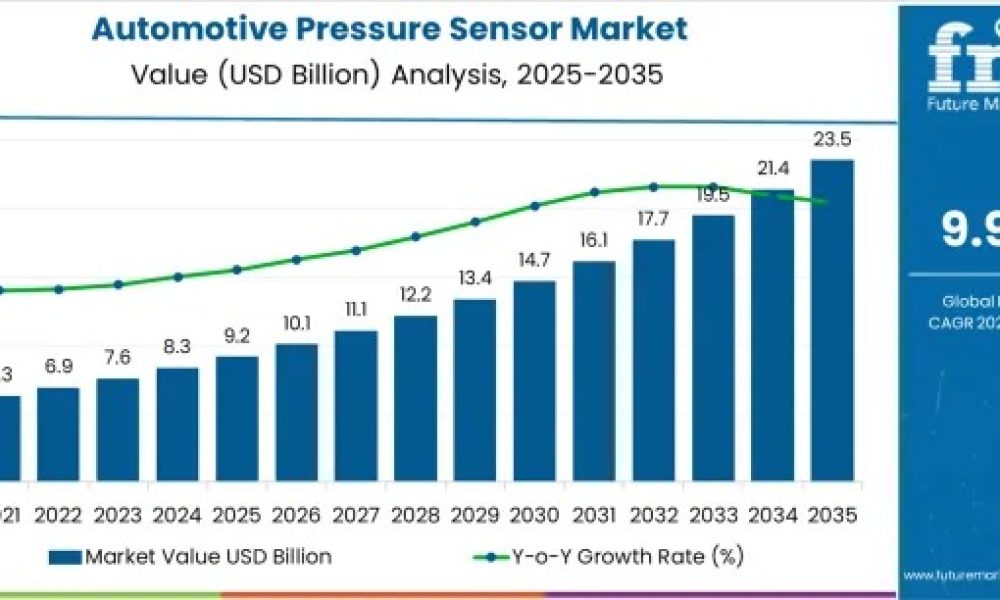
The global automotive pressure sensor market is projected to expand from USD 9.2 billion in 2025 to USD 23.5 billion by 2035, reflecting a robust compound annual growth rate (CAGR) of 9.9%. The market’s growth is fueled by rising integration of electronic control systems, regulatory mandates for vehicle safety, emissions compliance, and the proliferation of advanced driver-assistance systems (ADAS) across vehicle segments.
Pressure sensors are critical for engine monitoring, tire pressure management, brake systems, and EV battery monitoring, enabling real-time diagnostics, enhanced vehicle safety, and fuel efficiency. Technological innovation in microelectromechanical systems (MEMS) has further strengthened market adoption, offering precision, miniaturization, and cost-effective production.
Key Market Highlights
- Market Value (2025): USD 9.2 billion
- Market Forecast (2035): USD 23.5 billion
- Forecast CAGR (2025–2035): 9.9%
- Leading Technology Segment (2025): MEMS (58.2%)
- Dominant Vehicle Type: Passenger Vehicles (65.2%)
- Leading Application: Direct Tire Pressure Monitoring Systems (TPMS, 39.3%)
- Key Growth Regions: North America, Asia-Pacific, Europe
- Top Market Players: NXP Semiconductors, Denso Corporation, Robert Bosch, Honeywell, Analog Devices, Continental AG, Delphi, Sensata Technologies, Infineon, STMicroelectronics
Get access to comprehensive data tables and detailed market insights — request your sample report today!
Technology Insights: MEMS Lead Market Adoption
The MEMS segment dominates with 58.2% market share, driven by high sensitivity, small form factor, and low manufacturing costs. MEMS sensors are widely used in:
- Manifold Absolute Pressure (MAP) sensing
- Fuel rail pressure monitoring
- Tire Pressure Monitoring Systems (TPMS)
Ongoing research in wafer-level packaging and silicon-based sensing elements improves reliability under extreme temperatures and vibration, reinforcing MEMS as the preferred choice for next-generation vehicles.
The MEMS segment is projected to grow at a CAGR of 10.3%, reflecting scalability, integration flexibility, and real-time monitoring capabilities.
Vehicle Type Insights: Passenger Vehicles Drive Demand
Passenger vehicles account for 65.2% of the market, reflecting widespread sensor adoption to meet:
- Safety standards (TPMS, brake monitoring)
- Engine efficiency and diagnostics
- Consumer demand for advanced safety and comfort
Integration of modular sensor architectures across multiple models improves cost-efficiency and standardization. Passenger vehicles are expected to remain the largest adopter throughout the forecast period.
Application Insights: Direct TPMS Leads
Direct Tire Pressure Monitoring Systems (TPMS) hold a 39.3% market share, bolstered by:
- Mandatory regulations in developed countries
- Rising safety awareness in emerging markets
- Integration with vehicle telematics and mobile applications
TPMS enhances fuel efficiency, reduces CO₂ emissions, and prevents tire-related accidents, ensuring continued market dominance.
Regional Market Outlook
- United States: CAGR 10.8% – driven by R&D, ADAS adoption, and stringent safety regulations.
- United Kingdom: CAGR 11.7% – emphasis on emission reduction and sustainability.
- China: CAGR 10.9% – EV adoption, government incentives, and large-scale automotive production.
- Japan: CAGR 11.9% – strict safety standards and technological innovation in sensor systems.
- South Korea: CAGR 12.2% – strong automotive manufacturing and adoption of advanced vehicle sensors.
Asia-Pacific markets, led by China and South Korea, are expected to be major growth engines due to rapid EV adoption and smart vehicle integration.
Market Drivers
- Electrification and EV Growth: Increasing demand for battery monitoring and brake pressure management sensors.
- Vehicle Safety & ADAS: Pressure sensors critical for TPMS, brake systems, and engine monitoring.
- Emission Compliance: Growing regulatory requirements drive adoption of precise pressure measurement systems.
- Technological Innovation: MEMS and advanced transduction technologies enable miniaturization, low power consumption, and high accuracy.
Market Restraints
- Economic Volatility & Raw Material Prices: Fluctuating costs can affect sensor production.
- Integration Complexity: Difficulty in incorporating sensors into existing vehicle architectures.
- Performance & Reliability Concerns: Stringent quality requirements limit adoption of low-grade solutions.
Personalize Your Experience: Ask for Customization to Meet Your Requirements
Key Players and Competitive Landscape
Global automotive pressure sensor manufacturers are focusing on R&D, product diversification, and integrated sensor solutions to meet growing demand. Leading companies include:
- NXP Semiconductors
- Denso Corporation
- Robert Bosch
- Honeywell International Inc.
- Analog Devices
- Continental AG
- Delphi
- Sensata Technologies
- Infineon
- STMicroelectronics
These players are developing high-performance, durable, and cost-efficient sensors for both conventional and electric vehicles, strengthening their positions in an increasingly competitive market.
Outlook
The automotive pressure sensor market is poised for continued growth, driven by electrification, vehicle safety standards, ADAS expansion, and smart vehicle integration. With MEMS technology and passenger vehicle adoption at the forefront, pressure sensors will remain a critical component in enhancing vehicle efficiency, safety, and regulatory compliance through 2035.
About Future Market Insights (FMI)
Future Market Insights, Inc. (FMI) is an ESOMAR-certified, ISO 9001:2015 market research and consulting organization, trusted by Fortune 500 clients and global enterprises. With operations in the U.S., UK, India, and Dubai, FMI provides data-backed insights and strategic intelligence across 30+ industries and 1200 markets worldwide.



