
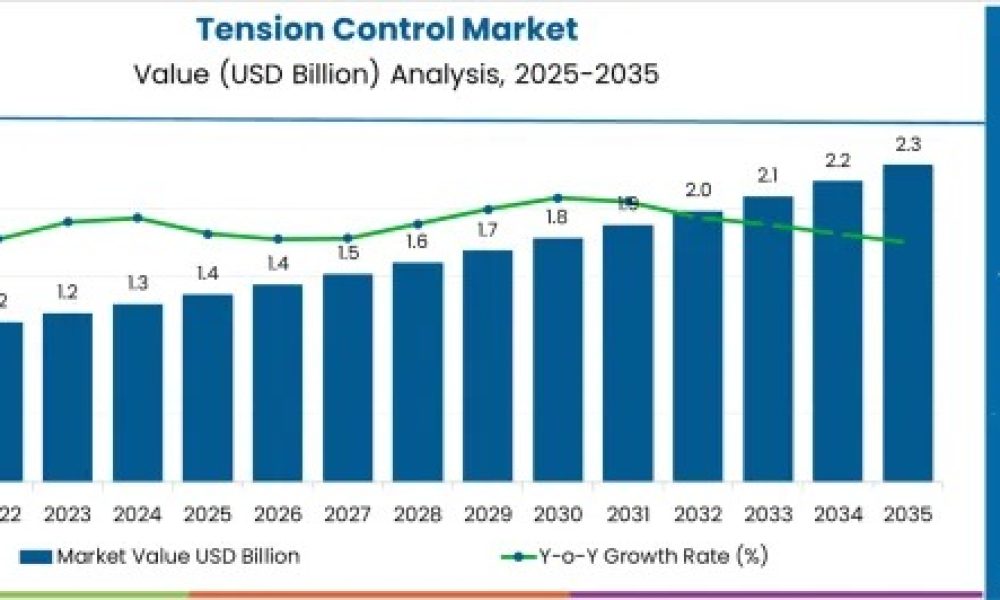
Market Snapshot: Precision Becomes Mission-Critical
The global Tension Control Market is gaining sustained momentum as manufacturers prioritize precision, automation, and waste reduction across high-speed production environments. Valued at USD 1.4 billion in 2025, the market is projected to reach USD 2.3 billion by 2035, registering a CAGR of 5.3% over the forecast period.
This growth reflects the rising need for consistent web handling in industries such as flexible packaging, printing, paper, textiles, and electronics. As production lines operate faster and materials become thinner and more specialized, even minor tension variations can lead to defects, downtime, and material loss—making advanced tension control systems a core operational investment.
Subscribe for Year-Round Insights → Stay ahead with quarterly and annual data updates:
Automation Dominates Market Adoption
Automation remains the strongest growth pillar in the tension control market. Automated systems account for approximately 62.1% of total market share in 2025, reflecting their ability to deliver accuracy, consistency, and real-time responsiveness in complex production settings.
Key advantages driving adoption include:
- Continuous monitoring and automatic adjustment of material tension
- Reduced dependency on manual intervention
- Lower scrap rates and improved throughput
- Seamless integration with Industry 4.0 and smart factory platforms
As manufacturers pursue operational excellence and predictable output quality, automated tension control systems are becoming standard rather than optional.
Load Cells Lead Component-Level Demand
From a component perspective, load cells represent the leading segment with around 51.7% market share. Their dominance is driven by their accuracy in direct force measurement and their reliability across diverse industrial environments.
Key factors supporting load cell adoption include:
- High precision and repeatability in tension measurement
- Durability under variable temperature and load conditions
- Compatibility with digital and automated control systems
- Expanding use in printing, packaging, and paper manufacturing
Ongoing innovations in miniaturization, signal stability, and digital outputs are further strengthening the role of load cells in advanced tension control architectures.
Flexible Printing Remains the Core Application
Flexible printing accounts for approximately 47.3% of total application demand, underscoring its central role in shaping market growth. The segment benefits directly from the global expansion of flexible packaging in food, beverage, and consumer goods industries.
Growth drivers within this segment include:
- Increasing demand for high-speed, defect-free printing
- Rising use of lightweight and sustainable packaging materials
- Need for precise web alignment and print registration
- Growth in customized and short-run packaging formats
Advanced tension control ensures consistent quality while minimizing material waste—critical factors for brand owners and converters alike.
Industry 4.0 and Sustainability Reshape Market Dynamics
The rapid adoption of Industry 4.0 is redefining expectations for tension control systems. Manufacturers increasingly demand solutions that provide real-time data, predictive insights, and seamless digital integration. Tension control systems naturally align with these requirements, positioning them as essential components of connected manufacturing ecosystems.
At the same time, sustainability objectives are accelerating adoption. Advanced tension control systems help manufacturers:
- Reduce raw material waste
- Optimize energy consumption
- Improve process stability
- Support environmentally responsible production
As sustainability metrics become embedded in procurement strategies, demand for high-performance tension control solutions continues to rise.
Regional Growth Reflects Industrial Expansion
North America, Europe, and Asia-Pacific remain the primary growth regions, supported by industrial modernization and automation investments.
- The United States is projected to grow at a CAGR of 5.6% through 2035, driven by reshoring initiatives and smart manufacturing adoption.
- The United Kingdom is expected to expand at nearly 7% CAGR, supported by precision engineering and sustainability goals.
- China is forecast to grow at 6.3% CAGR, fueled by large-scale industrialization and infrastructure development.
- Japan and South Korea continue to benefit from high-tech manufacturing and strong R&D ecosystems.
Competitive Landscape Focused on Innovation and Expansion
Leading players including Montalvo, Maxcess, Erhardt+Leimer, Dover Flexo Electronics, Double E, Nexen, FMS, RE Controlli Industriali, and Nireco are actively investing in R&D, digital integration, and global expansion.
In 2025, Maxcess International strengthened its Asia-Pacific presence by launching a new advanced facility near Mumbai, supporting manufacturing, R&D, and service operations. Such investments highlight the importance of localized capabilities in high-growth regions.
Market Outlook: Stable Growth with Strategic Importance
The tension control market is positioned for consistent, long-term growth through 2035. While challenges such as initial investment costs and system complexity remain, the strategic benefits—precision, efficiency, and sustainability—continue to outweigh adoption barriers.
Get data that aligns with your strategic priorities — ask for report customization today:
Have a specific Requirements and Need Assistant on Report Pricing or Limited Budget please contact us – [email protected]
About Future Market Insights (FMI)
Future Market Insights, Inc. (FMI) is an ESOMAR-certified, ISO 9001:2015 market research and consulting organization, trusted by Fortune 500 clients and global enterprises. With operations in the U.S., UK, India, and Dubai, FMI provides data-backed insights and strategic intelligence across 30+ industries and 1200 markets worldwide.
Contact Us:
Future Market Insights Inc.
Christiana Corporate, 200 Continental Drive,
Suite 401, Newark, Delaware – 19713, USA
T: +1-347-918-3531



